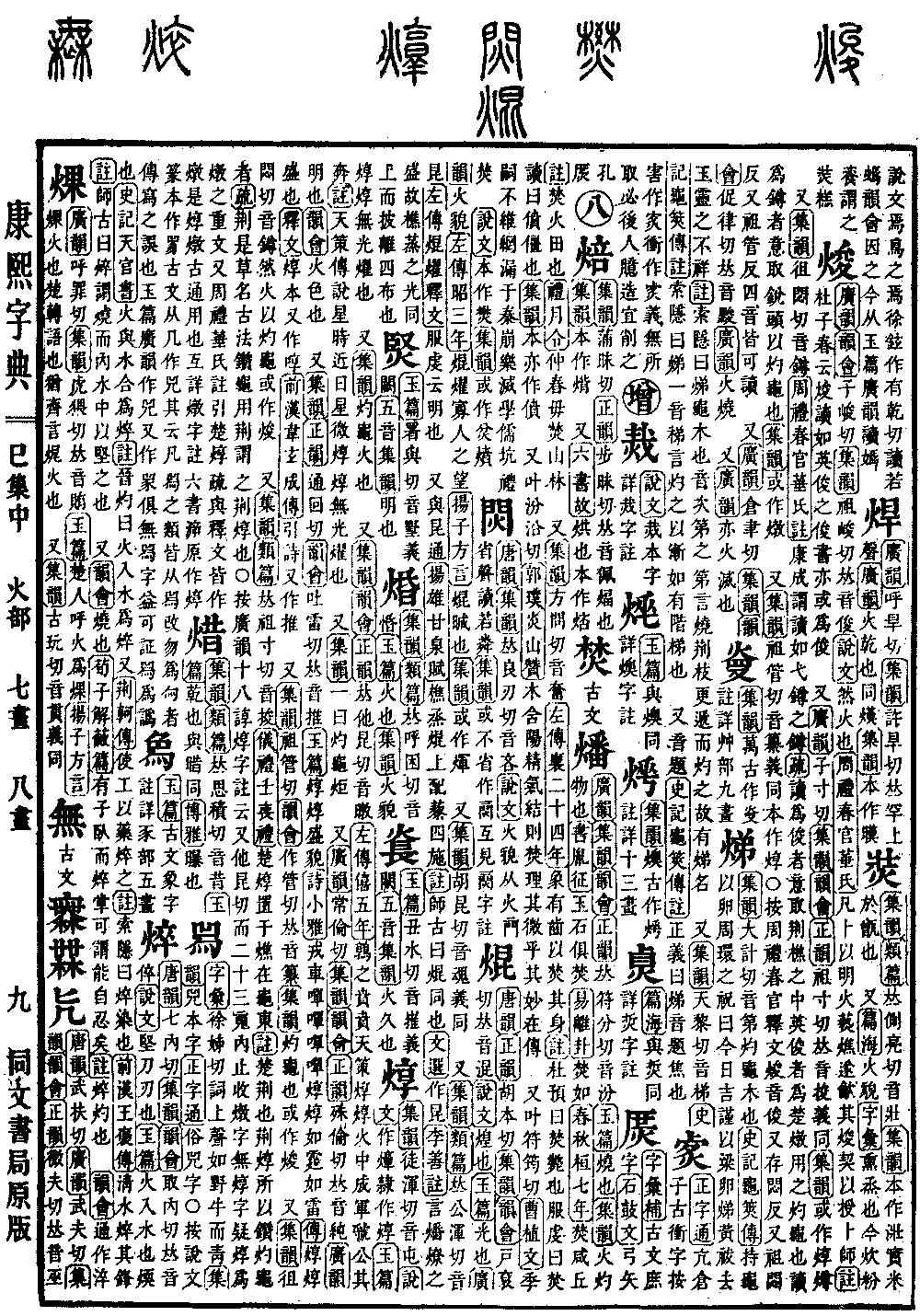
Si Collection, Middle Volume
Radical: Fire (huǒ)
Kangxi Strokes: 11
Page 673, Entry 03
Guangyun and Yunhui: Pronounced jun (falling tone). Jiyun: Pronounced jun (falling tone). According to the Shuowen Jiezi (Explanation of Graphs and Analysis of Characters), it means to ignite a fire.
In the Rites of Zhou (Zhouli), Spring Office, Chui Shi: For all divination, use bright fire to light torches, then consume the charred slip, and present it to the divination master. Commentary: Du Zichun states: The character is pronounced like the word for talented or handsome. In some texts, it is written as the character for talented or handsome.
Also, in Guangyun: Pronounced zun (falling tone). In Jiyun, Yunhui, and Zhengyun: Pronounced zun (falling tone). The meaning is the same. In Jiyun: Sometimes written in variant forms.
Also, in Jiyun: Pronounced zun (falling tone). In the commentary to the Rites of Zhou, Spring Office, Chui Shi: Zheng Kangcheng states: Read like the word for a spear butt. Commentary: The reading of jun is intended to signify the most excellent wood from the brambles used for burning the tortoise shell, while the reading of zun is intended to signify the sharp tip used to burn the tortoise shell. In Jiyun: Sometimes written as the character for burning.
Also, in Jiyun: Pronounced zuan (falling tone). The meaning is the same. Originally written as the character for glowing. Note: In the commentary on the Rites of Zhou, Spring Office, it is pronounced jun; also pronounced cun (falling tone); also pronounced zun (falling tone); also pronounced zuan (falling tone). All four pronunciations are acceptable.
Also, in Guangyun: Pronounced qu (entering tone). In Jiyun and Yunhui: Pronounced qu (entering tone). It means to burn with fire. Also, in Guangyun: It also means fire extinguished.
Textual Research: In the Rites of Zhou, Spring Office, Chui Shi, the commentary by Zheng Kangcheng states: Read like the word for a spear butt. Following the original text, spear butt has been corrected.