Xu Collection, Lower Volume
Radical: Wind (fēng)
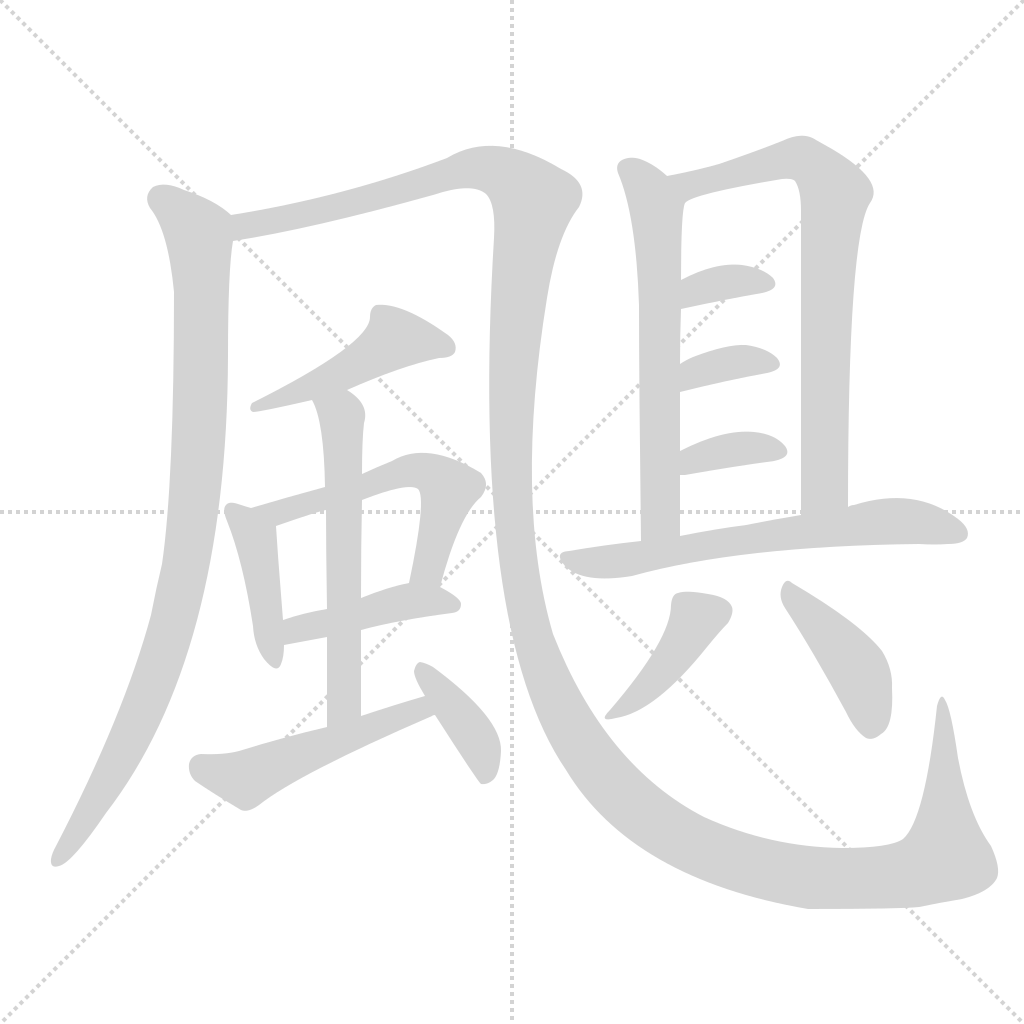
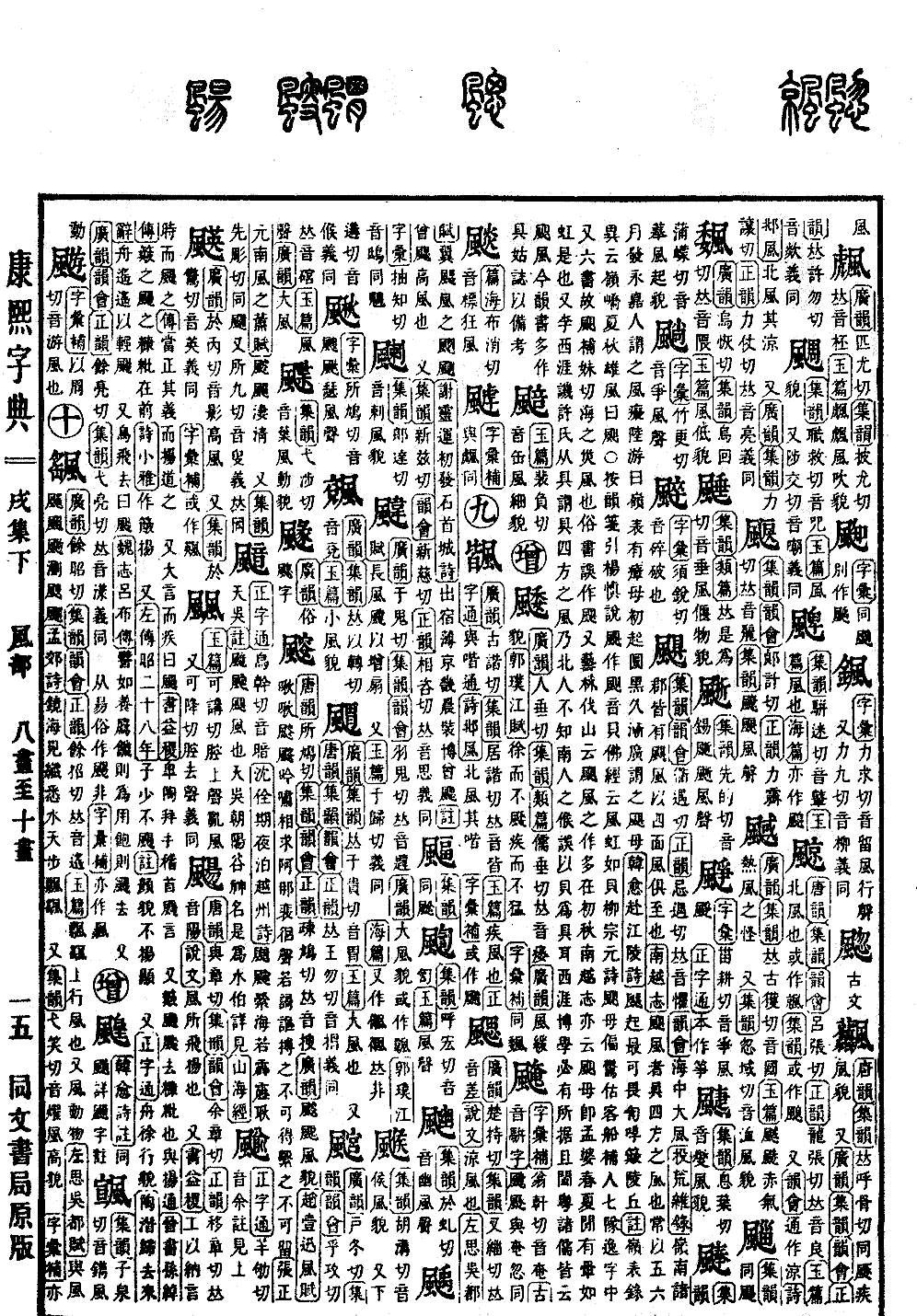
Entry: 颶
Kangxi stroke count: 17
Page 1413, Entry 20
Pronounced jù.
Collection of Rhymes (Jiyun) and Rhyme Anthology (Yunhui): Pronounced jù. Correct Rhymes (Zhengyun): Pronounced jù.
Rhyme Anthology (Yunhui): A great wind at sea.
Notes on an Exile (Touhuang Zalu): In all the prefectures of Lingnan, there are typhoon-like winds, so named because the wind arrives from all four directions simultaneously.
Records of Southern Yue (Nanyuezhi): The typhoon-like wind is called so because it contains winds from all four directions; it typically occurs in the fifth or sixth lunar month. The people of Yongjia call it wind-madness.
Lu You stated: In the regions beyond the Lingnan mountain ranges, there is a phenomenon called the typhoon-mother. It first appears as a black circle, and over time it gradually expands; this is what is called the typhoon-mother.
Han Yu, Poem on Traveling to Jiangling: The typhoon rises, most terrifying, roaring and shaking the hills.
Commentary: Records of Strange Things in the Lingnan Regions (Lingqiaoluyi) states: In the summer and autumn, the fierce winds of the Lingnan mountain passes are called this.
According to the Rhyme Annotations (Yunqian), quoting the theory of Yang Shen: The character is written with a different component, pronounced bèi; Buddhist scriptures state that the wind is like a shell. In the poem by Liu Zongyuan, it is noted that the mother frightens the merchant ships, added to the missing characters of the seventh rhyme group.
Furthermore, Six Scripts Explained (Liushugu): Pronounced mèi, it refers to a catastrophic wind at sea; vulgar texts mistakenly write it as the current character.
Furthermore, Forest of Arts and Cleaving Mountains (Yilin Fashan) states: The wind usually occurs in early autumn. Records of Southern Yue (Nanyuezhi) also states: The typhoon-mother is the same as the Mengpo, which appears between spring and summer with a halo like a rainbow.
Furthermore, Li Xiya criticized the Xu family for using the component meaning to prepare, arguing that it refers to wind from four directions, and that northerners, not knowing the true character used by southerners, mistakenly used the component meaning to prepare instead of the component meaning shell. Li Xiya was highly learned and must have had evidence for this; moreover, various scholars of Fujian and Guangdong all use a different character for this wind. As current rhyme books mostly use the character with the component to prepare, I am recording this for reference.