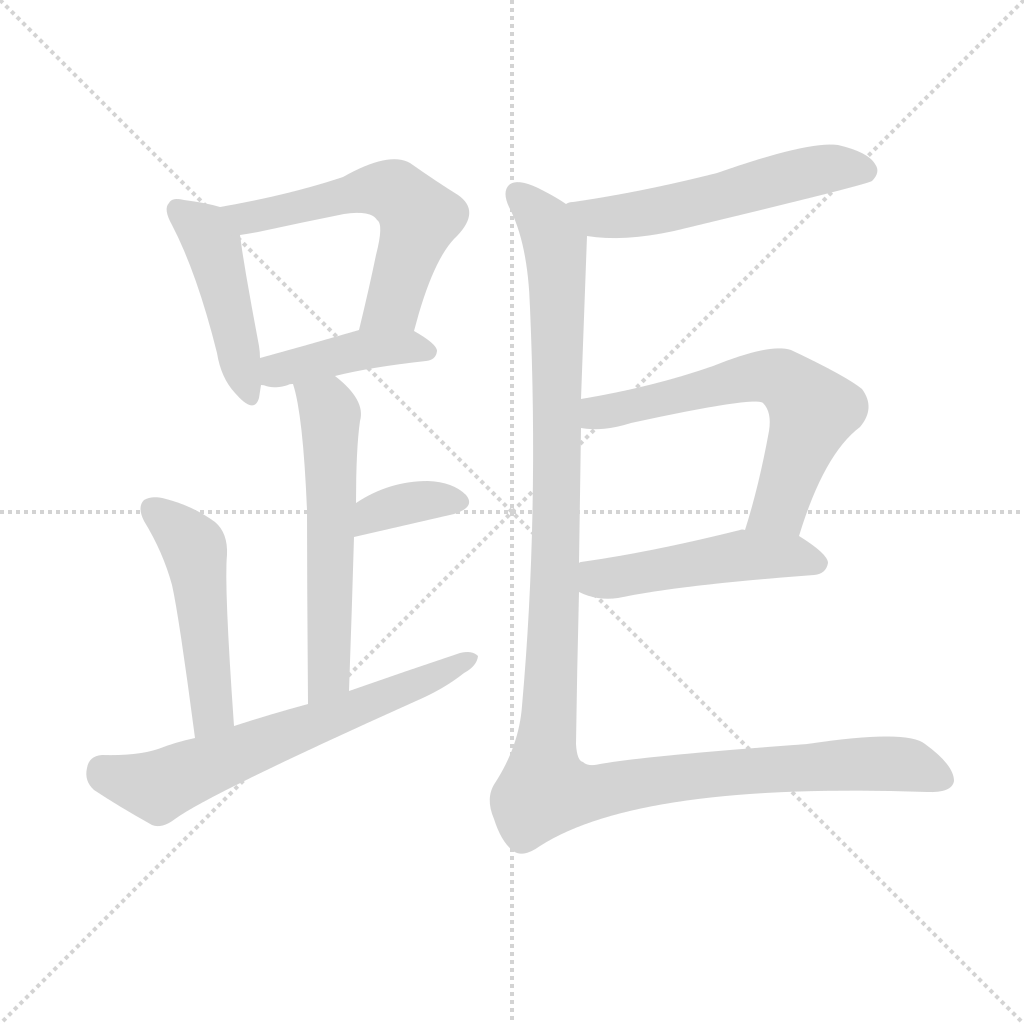
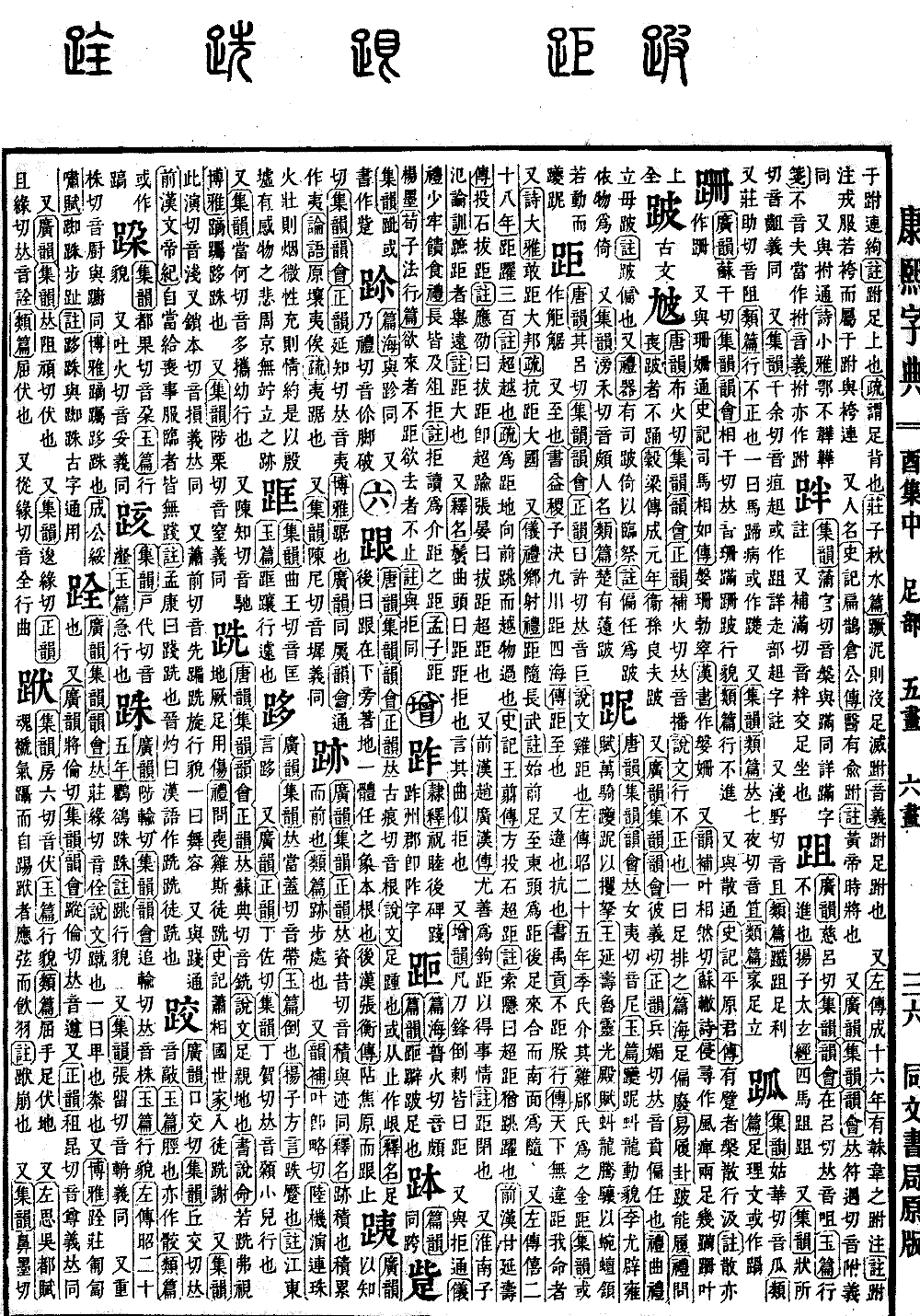
You Collection, Middle Volume
Radical: Foot (zú)
Kangxi Strokes: 12
Page 1224, Entry 08
Pronounced jù.
In the Explanation of Characters (Shuowen Jiezi), it refers to the spur of a rooster.
In the Commentary on the Spring and Autumn Annals (Zuo Zhuan), under the twenty-fifth year of Duke Zhao: The Ji family equipped their rooster with metal spurs provided by the Hou family.
It is also written in a variant form.
It means to reach or arrive at. In the Book of Documents (Shujing), section on the Benefits of the Throne (Yiji): I diverted the nine rivers to reach the four seas. The commentary states: Ju means to reach.
It also means to oppose or resist. In the Book of Documents (Shujing), section on the Tribute of Yu (Yu Gong): Do not oppose my movements. The commentary states: There is no one in the world who opposes or resists my command.
Also, in the Book of Odes (Shijing), Greater Odes (Daya): Dare to oppose a great state. The commentary states: To resist a great nation.
In the Book of Etiquette and Ceremonial (Yili), section on the Rural Archery Ritual (Xiangshe Li): Advance and follow with long martial music. The commentary states: Placing the front foot forward to reach the eastern limit is called ju, and bringing the rear foot to join it while facing south is called sui.
In the Commentary on the Spring and Autumn Annals (Zuo Zhuan), under the twenty-eighth year of Duke Xi: He leaped a distance of three hundred. The commentary states: It means to leap over. The sub-commentary states: To push off from the ground and leap over an object.
In the Records of the Grand Historian (Shiji), Biography of Wang Jian: They specialized in throwing stones and leaping over obstacles. The commentary says: To leap over is synonymous with jumping.
In the History of the Former Han (Qian Hanshu), Biography of Gan Yanshou: Throwing stones and leaping over distances. The commentary says: Ying Shao states: To leap over is to vault. Zhang Yan states: To vault is the same as to leap.
In the History of the Former Han (Qian Hanshu), Biography of Zhao Guanghan: He was particularly skilled in the hook-and-close method to uncover the truth. The commentary states: Ju means to close.
In the Masters of Huainan (Huainanzi), chapter on the General Theory of Arguments (Silun Xun): Those who have large strides lift their feet far. The commentary states: Ju means large.
In the Explanation of Names (Shiming): The curved part of the sideburns is called ju. Ju is the same as resist. It refers to the curve being similar to a resistance.
In the Supplement to the Rhyme Dictionary (Zengyun): All backward-facing barbs on a knife blade are called ju.
It is also used interchangeably with the character for resist (jù). In the Book of Etiquette and Ceremonial (Yili), section on the Lesser Sacrifice Ritual (Shaolao Kuishi Li): The lengths all reach the stand’s support. The commentary states: Read as the ju in to resist.
In the Mencius: To resist the teachings of Yang Zhu and Mozi.
In the Xunzi, chapter on Principles of Action (Faxing Pian): If someone wishes to come, do not resist them; if someone wishes to leave, do not stop them. The commentary states: Used interchangeably with the character for resist (jù).