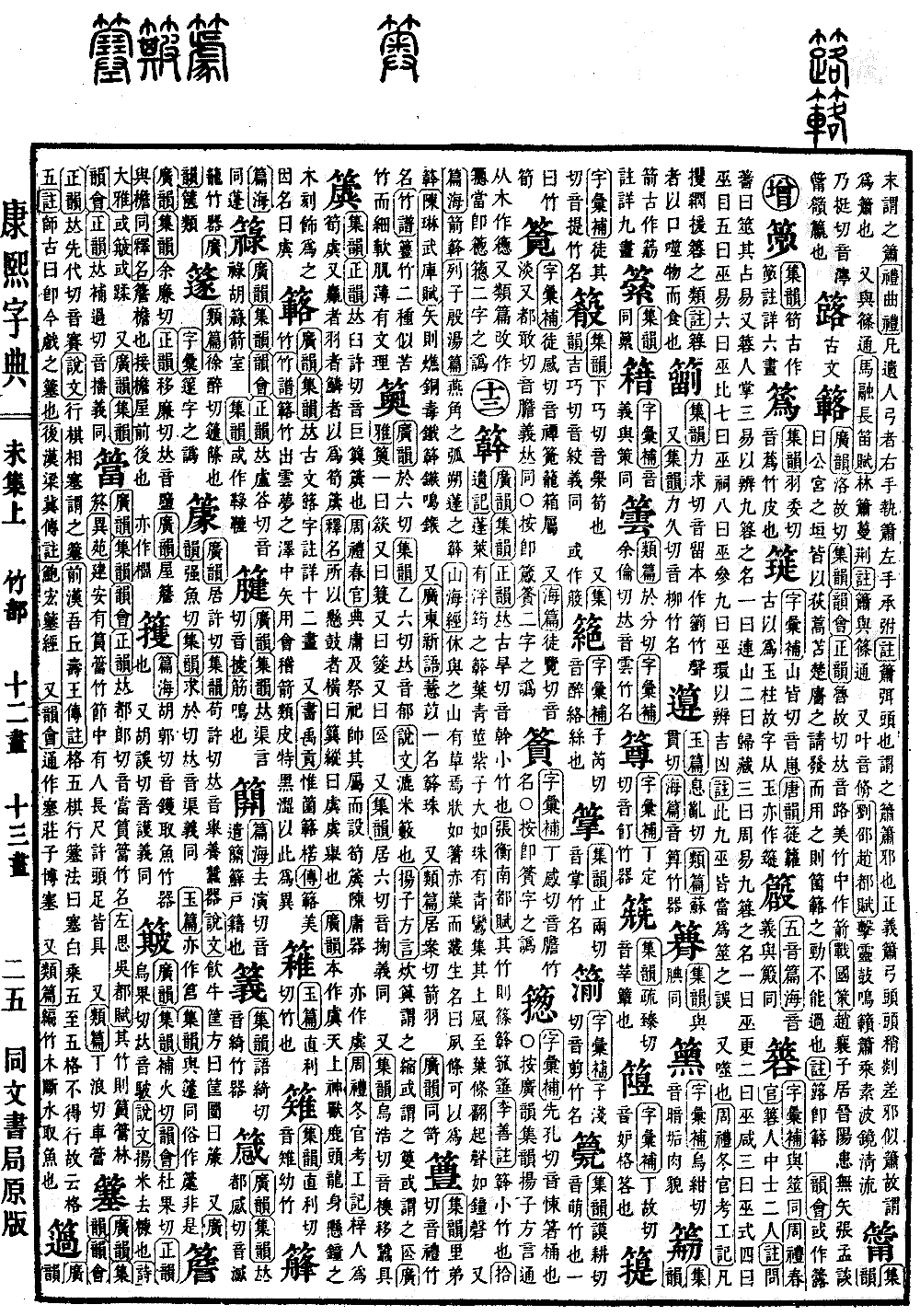
Wei Collection, Upper Volume
Radical: Bamboo (zhú)
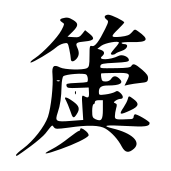
Ju
Kangxi strokes: 19
Page 901, Entry 32
According to the Collection Rhymes (Jiyun) and Correct Rhymes (Zhengyun), pronounced ju (rising tone), with the same pronunciation as ju (falling tone). It refers to the wooden frame used for hanging musical instruments such as bells and drums.
The Book of Rites (Zhouli), Spring Offices section, records that the official in charge of musical instruments would lead his subordinates to set up the wooden frames for hanging instruments during sacrificial ceremonies and arrange the commonly used utensils. It is also written in a variant form (ju).
The Book of Rites (Zhouli), Winter Offices, Artificers Record (Kaogongji), records that the master woodworkers (ziren) crafted the wooden frames for hanging musical instruments. These frames were decorated with figures of nude, feathered, and scaled animals.
Explanations of Names (Shiming) explains that for the frame used to hang drums, the horizontal beam is called sun and the upright pillar is called ju. Ju implies the meaning of to lift.
The Broad Rhymes (Guangyun) states it was originally written as ju. It is a divine beast from the heavens with the head of a deer and the body of a dragon. The wooden frames used to hang bells were carved with this image as a decoration, hence the name ju.
Verification: In the Book of Rites (Zhouli), Spring Offices, the text mentions the official in charge of utensils, and during sacrifices, he leads his subordinates to set up the sun and ju frames. Note that the official title is manager of standard utensils, therefore the word for utensil was added after the title in the original text, and the character for and was removed.