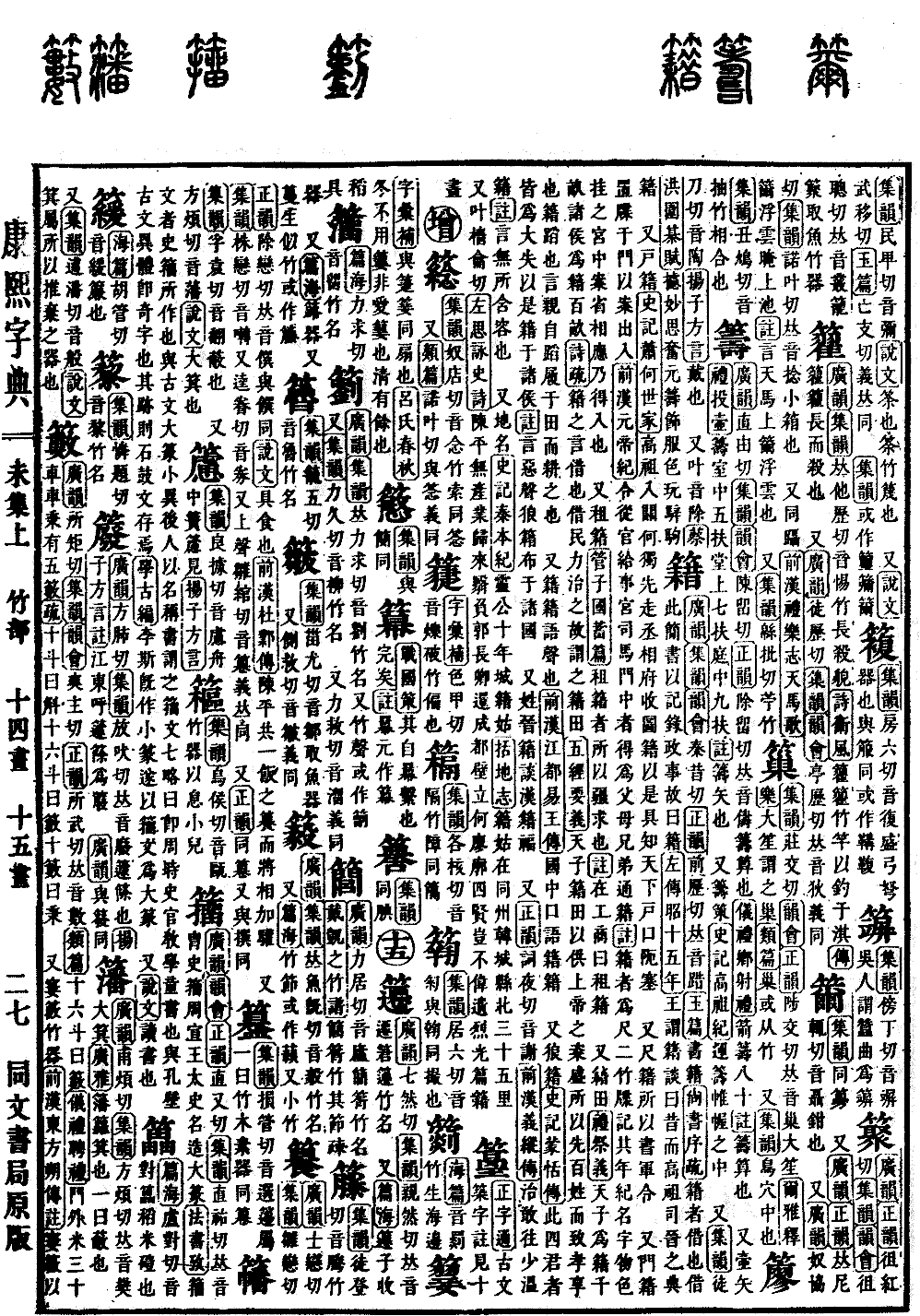
Wei Collection, Upper Volume
Radical: Bamboo (zhú)
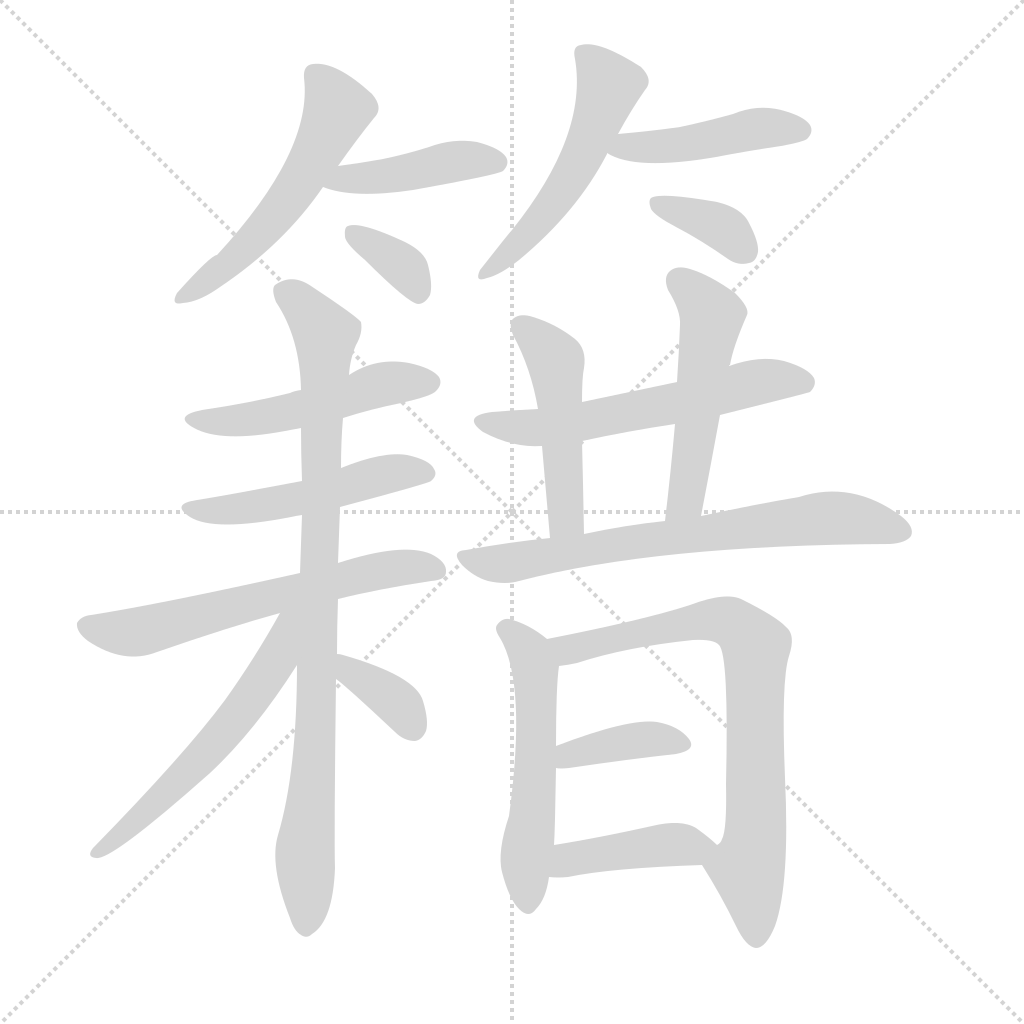
籍
Kangxi strokes: 20
Page 903, Entry 09
Pronounced ji
Jade Records (Yupian): Books.
Commentary on the Preface to the Book of Documents (Shangshu): Ji means to borrow. One borrows these books to record political affairs, which is why they are called ji.
Commentary on the Zuo Tradition (Zuozhuan), 15th year of Duke Zhao: The King of Zhou said to Ji Tan: Formerly, your ancestor was in charge of the archives of the State of Jin.
Also refers to household registers.
Records of the Grand Historian (Shiji): When the High Ancestor entered the Guanzhong region, Xiao He was the only one to first run to the chancellor's office to collect maps and household registers, which allowed him to gain a detailed understanding of the population and the strategic mountain passes of the world.
Also refers to chi-ji, used for writing military orders.
Also refers to men-ji. A roster placed at the palace gate to verify arrivals and departures.
Book of Han (Qianhan), Annals of Emperor Yuan: Ordered that officials serving at the palace's Sima Gate could handle the registration (tong-ji) for their parents and brothers.
Commentary: Ji is a bamboo strip one foot two inches long, recording age, name, and physical features; it is hung in the palace, and one can only enter if it matches.
Also refers to zu-ji.
Guanzi: Zu-ji is used for forcible collection.
Commentary: That which is collected from industry and commerce is called zu-ji.
Also refers to ji-tian (imperial fields).
Book of Rites (Liji), Meaning of Sacrifices: The Son of Heaven has one thousand acres of imperial fields, and the feudal lords have one hundred acres of imperial fields.
Commentary on the Book of Odes (Shijing): The meaning of ji is to borrow. It is to borrow the labor of the people to farm, which is why it is called ji-tian.
Essentials of the Five Classics (Wujing Yaoyi): The Son of Heaven farms the imperial fields to provide grain for the sacrifices to the Supreme Deity; this is to show filial piety and offer sacrifices before the common people. Ji means to tread upon; it refers to personally going into the fields to plow.
Also refers to ji-ji, describing a noisy crowd.
Book of Han (Qianhan), Biography of King Yi of Jiangdu: Within the country, the discussions were noisy and chaotic.
Also refers to lang-ji.
Records of the Grand Historian (Shiji), Biography of Meng Tian: These four sovereigns all had great faults, and thus their reputations were scattered and ruined among the feudal lords.
Commentary: This means their bad reputation was spread among the various states.
Also a surname. Ji Tan of the State of Jin, Ji Fu of the Han Dynasty.
Pronounced xie
Book of Han (Qianhan), Biography of Yi Zong: In handling affairs, he was resolute and severe, lacking gentleness and tolerance.
Commentary: This means there was no inclusiveness.
Also refers to a place name.
Records of the Grand Historian (Shiji), Basic Annals of Qin: In the tenth year of Duke Ling of Qin, the city of Jigu was built.
Geography of the Broad Land (Kuodizhi): Jigu is located thirty-five li north of Hancheng County, Tong Prefecture.
Also pronounced qiang (falling tone)
Zuo Si, Poem on History: Chen Ping had no property, and when he returned, he sheltered in a dilapidated hut by the city wall. Sima Xiangru returned to Chengdu, his house empty with only the four walls. Are these four worthies not great? Their legacy shines in the history books.
Textual research:
Guanzi, National Accumulation chapter: Zu-ji is used for forcible collection. According to the original text, the character for force (jiang) has been corrected to the standard character for force (qiang).