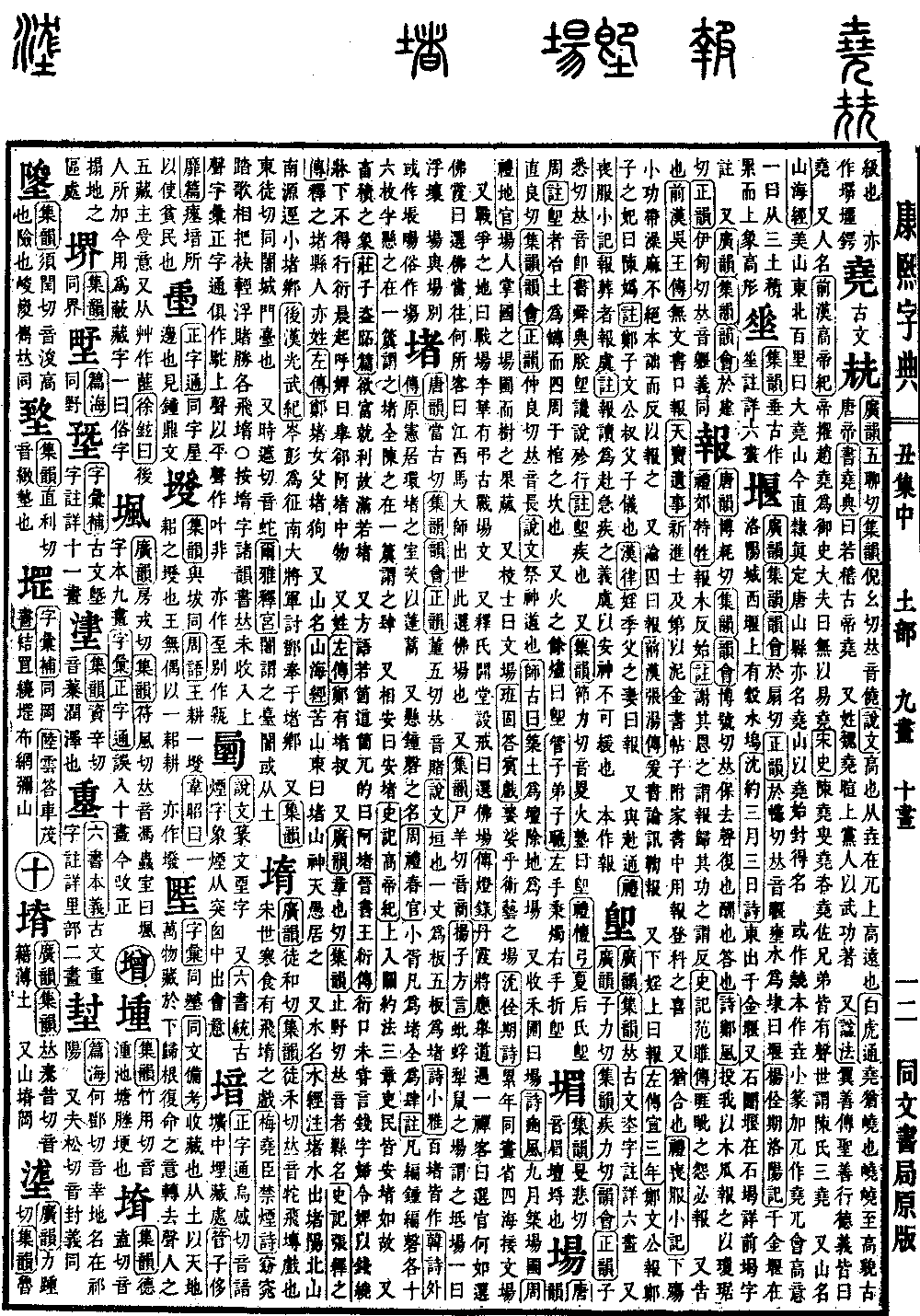
Chou Collection, Middle Volume
Radical: Earth (tǔ)
Kangxi Strokes: 12
Page 234, Entry 06
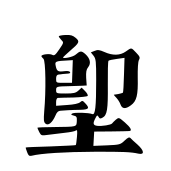
According to the Extensive Rhymes (Guangyun) and Collected Rhymes (Jiyun), this is the ancient form of the character ci. See the section on six strokes for detailed annotations.
Additionally, according to the Extensive Rhymes (Guangyun), pronounced ji (rising tone); according to the Collected Rhymes (Jiyun), pronounced ji (entering tone); according to the Rhyme Collection (Yunhui) and Correct Rhymes (Zhengyun), pronounced ji (entering tone).
From the Book of Documents (Shangshu), Chapter on the Canon of Yao (Shundian): I hate slanderous speech and destructive conduct. Note: Ji means to hate or loathe.
Additionally, according to the Collected Rhymes (Jiyun), pronounced ce (entering tone). Burning earth with fire to make it hard is called ji. From the Book of Rites (Liji), Chapter on the Rites of Tan Gong (Tanggong): The Xia dynasty used ji to surround the Zhou. Note: Ji refers to using baked earth to make bricks and building a burial chamber around the coffin.
Additionally, the ashes remaining after burning are called ji. From the Guanzi, Chapter on the Duties of Disciples (Dizizhi): With the left hand holding the candle, and the right hand breaking off the remaining burnt candle wick.
The original engraved edition of the character ji features the top component as the character ji (jì).
Textual Research: According to the Collected Rhymes (Jiyun), pronounced ce (entering tone). Fire-baked earth is called ji. Following the original text, fire-school has been corrected to fire-baked.
Note by Wang Hongyuan: The original top component of the character ji is written as the character ji (jì).