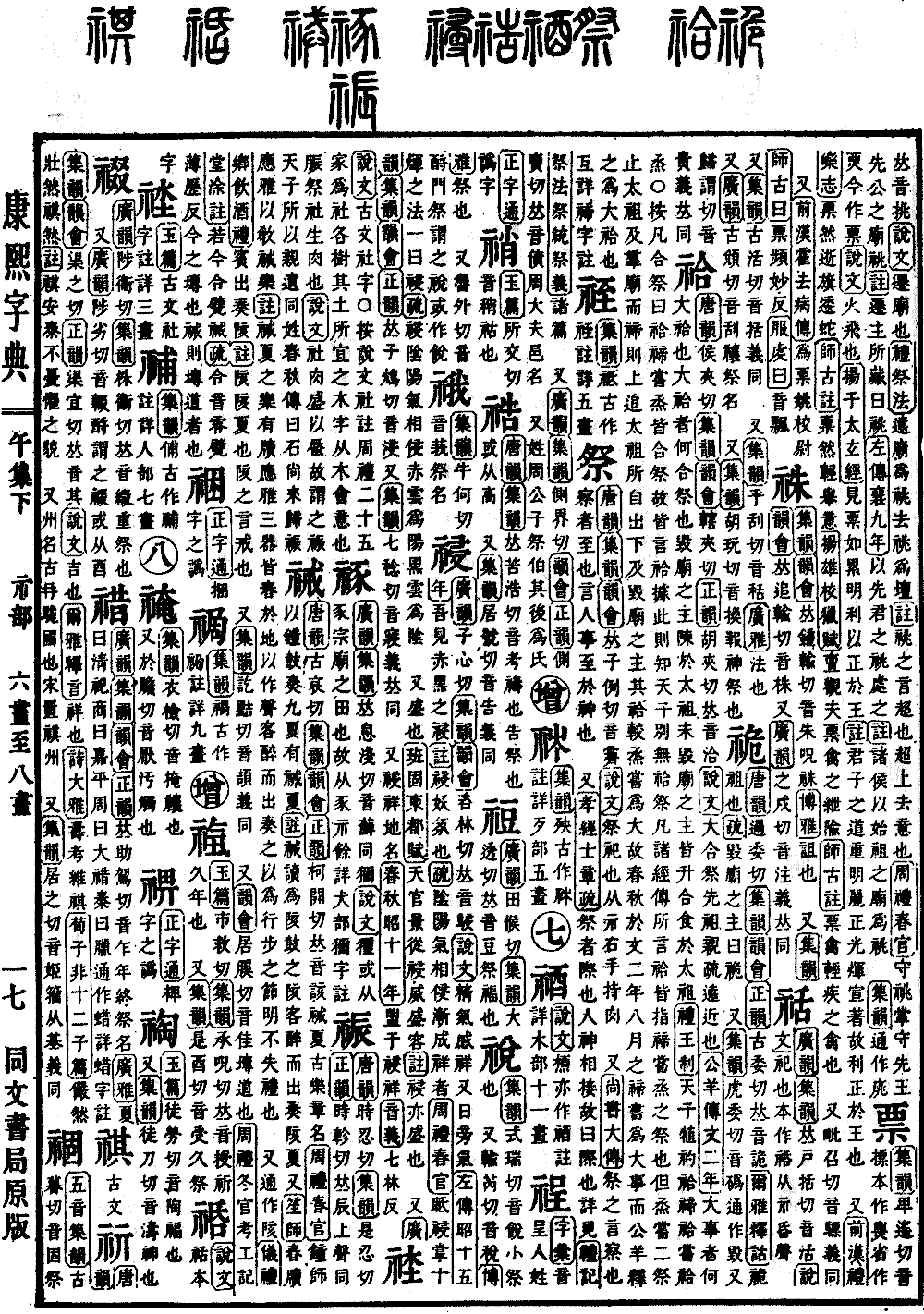
Wu Collection, Lower Volume
Radical: Spirit (shì)
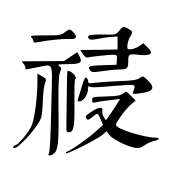
Character: jin
Kangxi Stroke Count: 12
Page 843, Entry 16
Broad Rimes (Guangyun): Pronounced zin
Collected Rimes (Jiyun) and Collection of Rimes (Yunhui): Pronounced zin; sound is qin.
Explanation from Explaining Graphs and Analyzing Characters (Shuowen): Essence and energy affecting auspiciousness. Also refers to energy appearing beside the sun.
Left Commentary (Zuozhuan), 15th Year of Duke Zhao: I saw the red and black jin.
Commentary: Jin refers to baleful vapors.
Sub-commentary: When yin and yang energies invade one another, they gradually form auspicious or ominous omens.
Rites of Zhou (Zhouli), Ministry of Spring: The official in charge of jin manages the laws of the ten splendors. The first is called jin.
Sub-commentary: Jin refers to the invasion of yin and yang energies. Red clouds are yang, and black clouds are yin.
Also means abundant.
Ban Gu, Eastern Capital Rhapsody (Dongdu Fu): The celestial officials follow the scenery; the jin majesty is of grand appearance.
Commentary: Jin also means abundant.
Also Broad Rimes (Guangyun), Collected Rimes (Jiyun), Collection of Rimes (Yunhui), and Correct Rimes (Zhengyun): Pronounced jin.
Also Collected Rimes (Jiyun): Pronounced qin. Meaning is the same.
Also Jinxiang, a place name.
Spring and Autumn Annals (Chunqiu), 11th Year of Duke Zhao: Swore an alliance at Jinxiang.
Sound and Meaning: Pronounced qin.