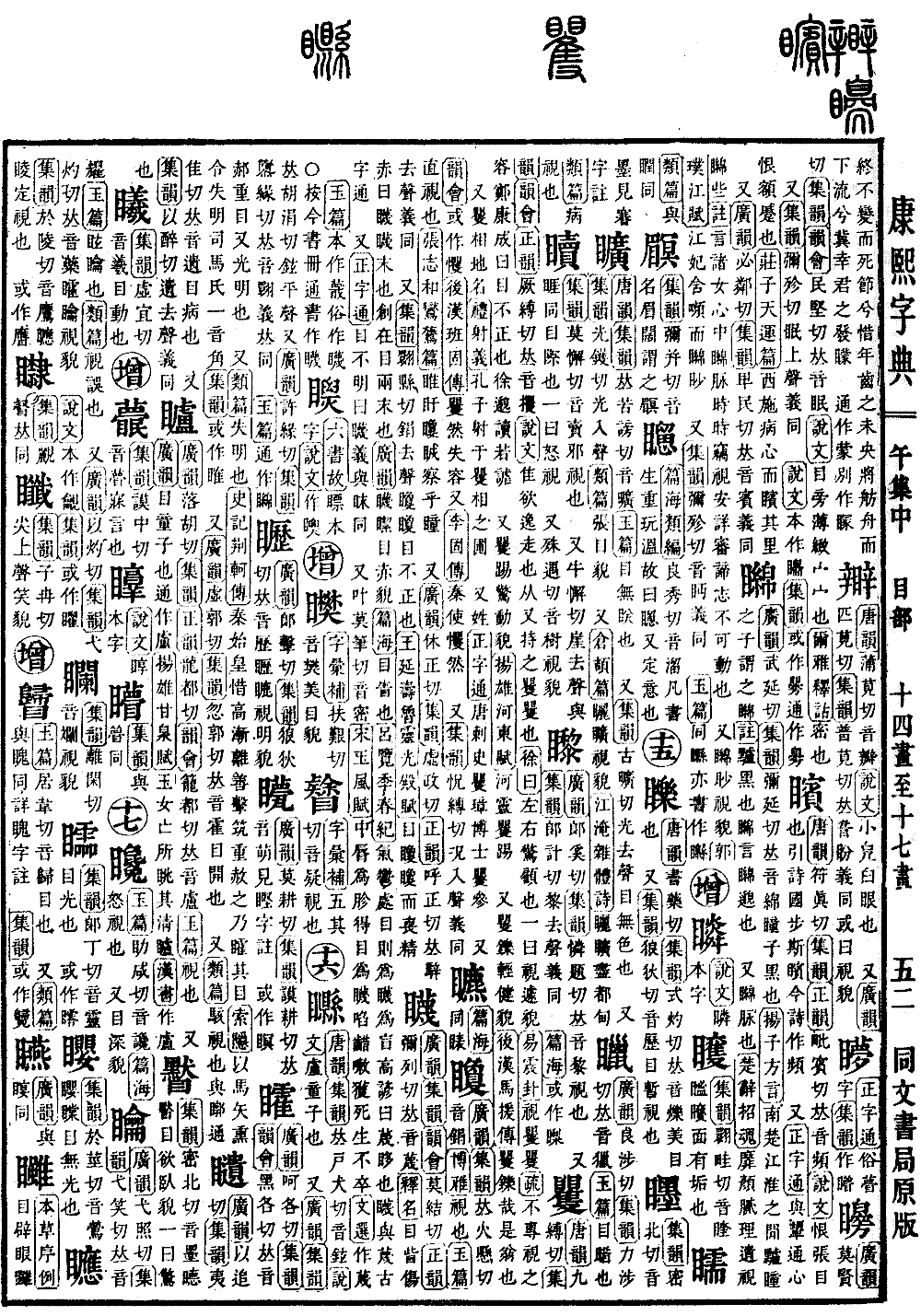
Wu Collection, Middle Volume
Radical: Eye (mù)
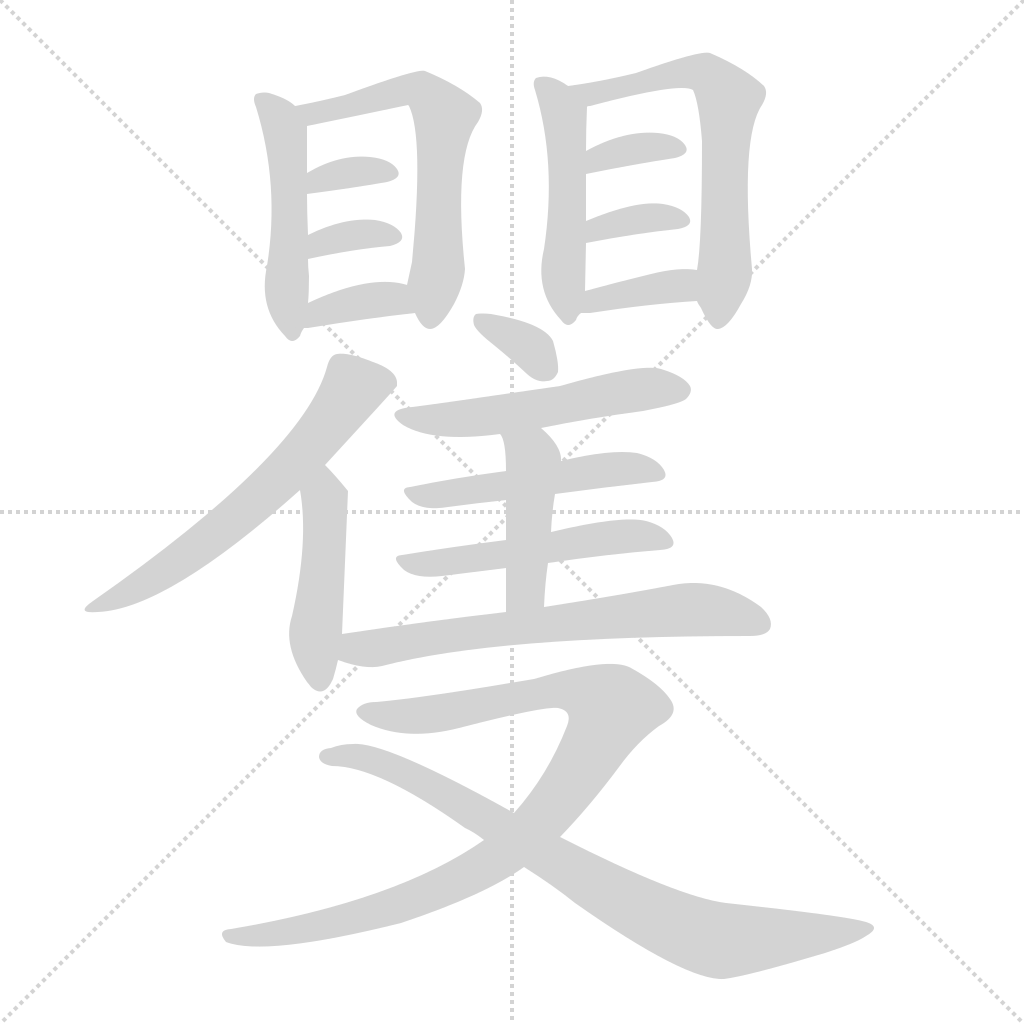
Character: Jue
Kangxi stroke count: 20
Page 820, Entry 17
Pronounced jue.
According to the Explaining Graphs and Analyzing Characters (Shuowen Jiezi), it refers to a bird desiring to escape. Formed from the radical for hand (you), indicating the act of holding, and representing a frightened look. Xu Kai comments: glancing left and right in alarm. Another interpretation: a hurried appearance when looking.
As stated in the Book of Changes (Yijing), in the Trigram for Thunder (Zhen gua): "Looking about with a startled, restless gaze." The commentary notes: the appearance of not looking directly. Zheng Kangcheng says: it means the eyes are not focused. Xu Miao reads it as if it were the word for teasing (xue).
Also appears in the term jueti, describing a startled or agitated appearance. In the Rhapsody of Hedong (Hedong Fu) by Yang Xiong: "The spirit of the river appeared startled and agitated."
Also appears in the term jueshuo, describing a light and vigorous appearance. In the Biography of Ma Yuan from the History of the Later Han (Hou Hanshu): "How vigorous and spirited this old man is!"
Also, Juexiang is a place name. In the Meaning of Archery (Sheyi) from the Book of Rites (Liji): "Confucius practiced archery in the gardens of Juexiang."
Also a surname. According to the Comprehensive Dictionary of Characters (Zhengzitong): Tang dynasty prefect Jue Zhang and scholar Jue Can.
Also, according to the Collection of Rhymes (Yunhui), sometimes written in a variant form (jue). In the Biography of Ban Gu from the History of the Later Han (Hou Hanshu): "Startled, he lost his composure." In the Biography of Li Gu: "The envoy was startled."
Also, according to the Collection of Rhymes (Jiyun), pronounced kuang (entering tone). The meaning is the same.