Si Collection, Lower Volume
Radical: Dog (quǎn)
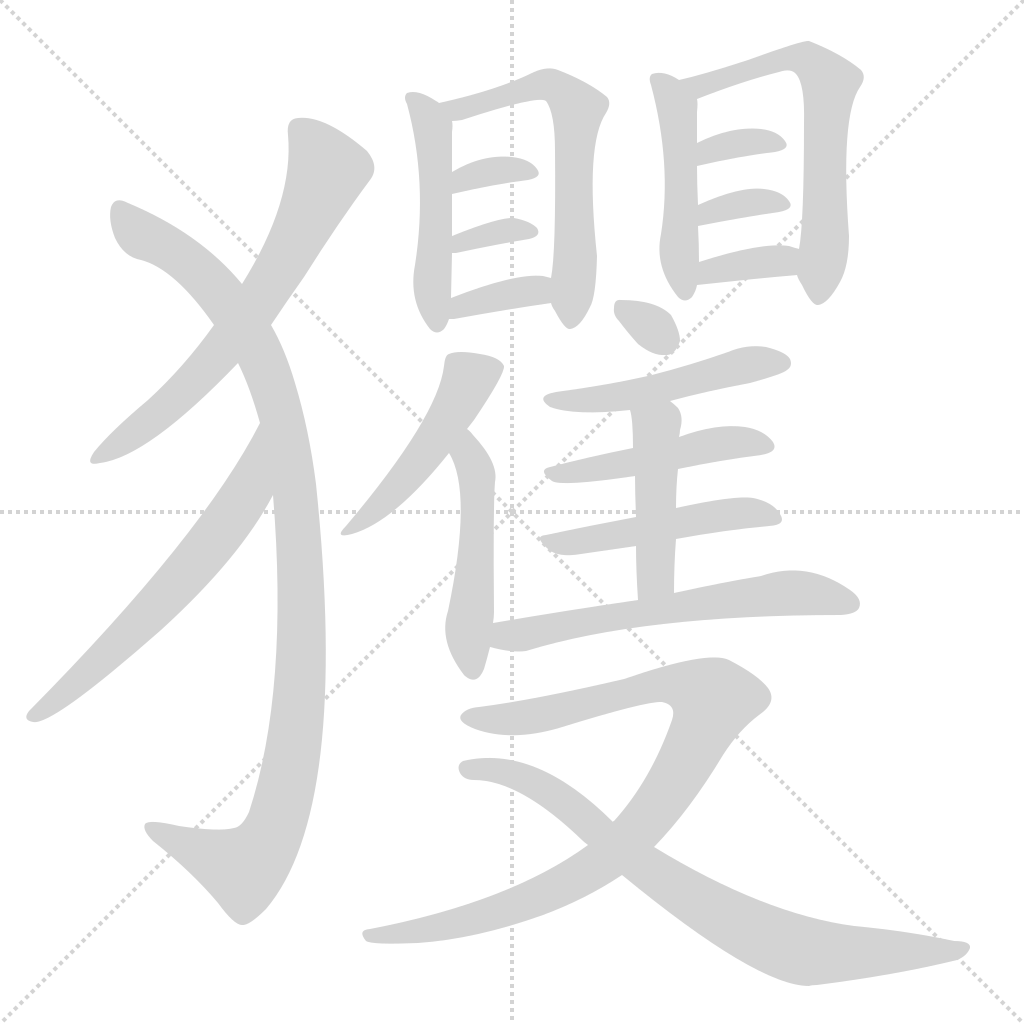
Character: Jue
Kangxi Strokes: 24
Page 722, Entry 04
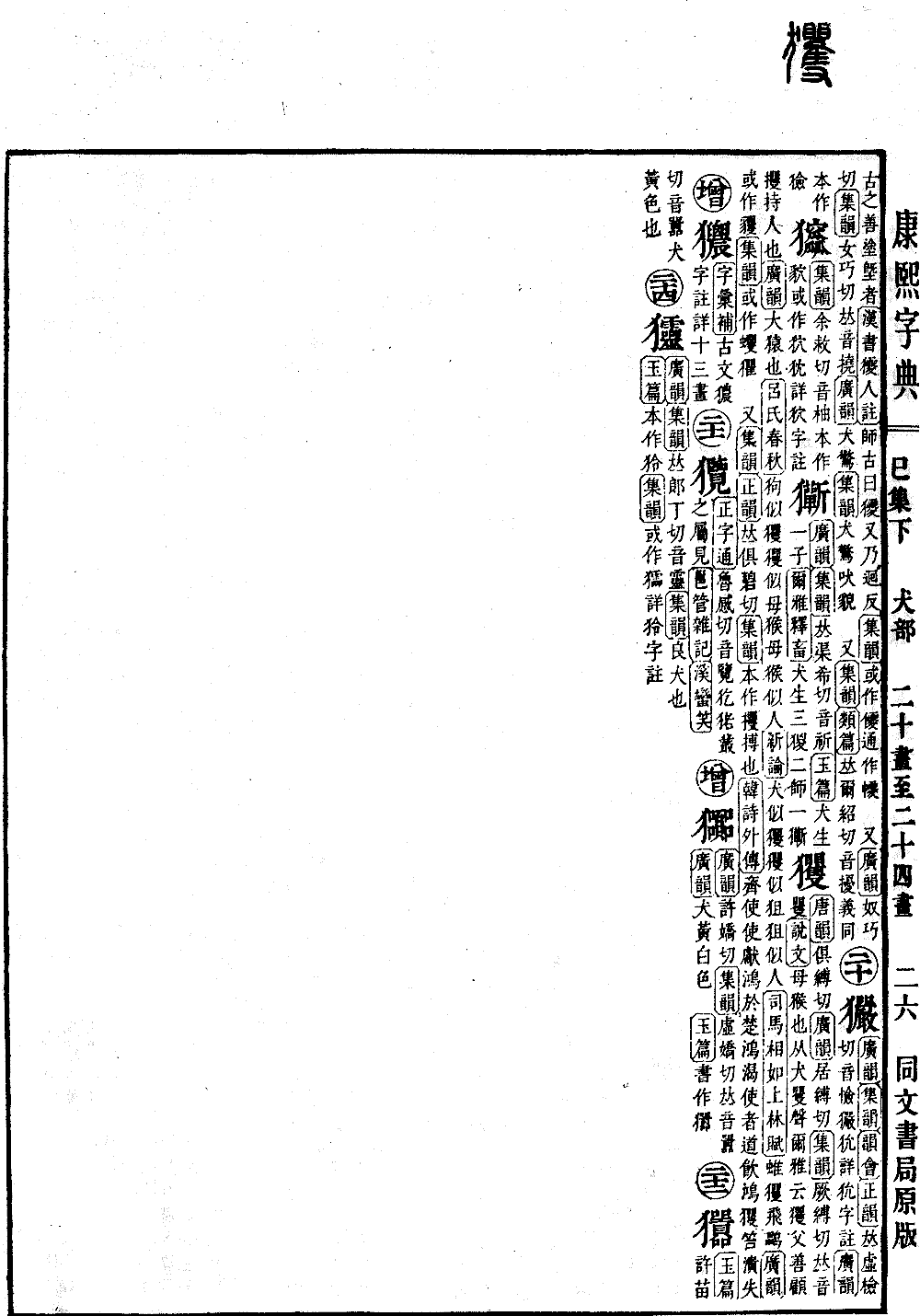
Pronounced jue. According to the Shuowen Jiezi (Dictionary of Explained Characters), it is a type of macaque. Formed from the radical for dog with a phonetic component suggesting looking around. The Erya (Approaching Elegance) states that the male jue is adept at looking back and grabbing people. According to the Guangyun (Broad Rhymes), it is a large ape. The Master Lu's Spring and Autumn Annals (Lüshi Chunqiu) states that dogs resemble the jue, the jue resembles the macaque, and the macaque resembles a human. The New Discourse (Xinlun) states that a dog resembles a jue, a jue resembles a monkey, and a monkey resembles a human. Sima Xiangru's Rhapsody on the Shanglin Park (Shanglin Fu) mentions the snub-nosed monkey and the jue. The Guangyun (Broad Rhymes) notes a variant form (jue). The Jiyun (Rhyme Collection) notes a variant form (ju). Also, according to the Jiyun (Rhyme Collection) and the Zhengyun (Correct Rhymes), pronounced bi. Originally written as a variant form (jue), meaning to seize or pounce. The Han Family Commentary (Han Shi Waizhuan) records that an envoy from Qi was sent to present a swan to Chu. The swan was thirsty, and as the envoy allowed it to drink, the jue struck it, causing it to escape.