Si Collection, Middle Volume
Radical: Fire (huǒ)
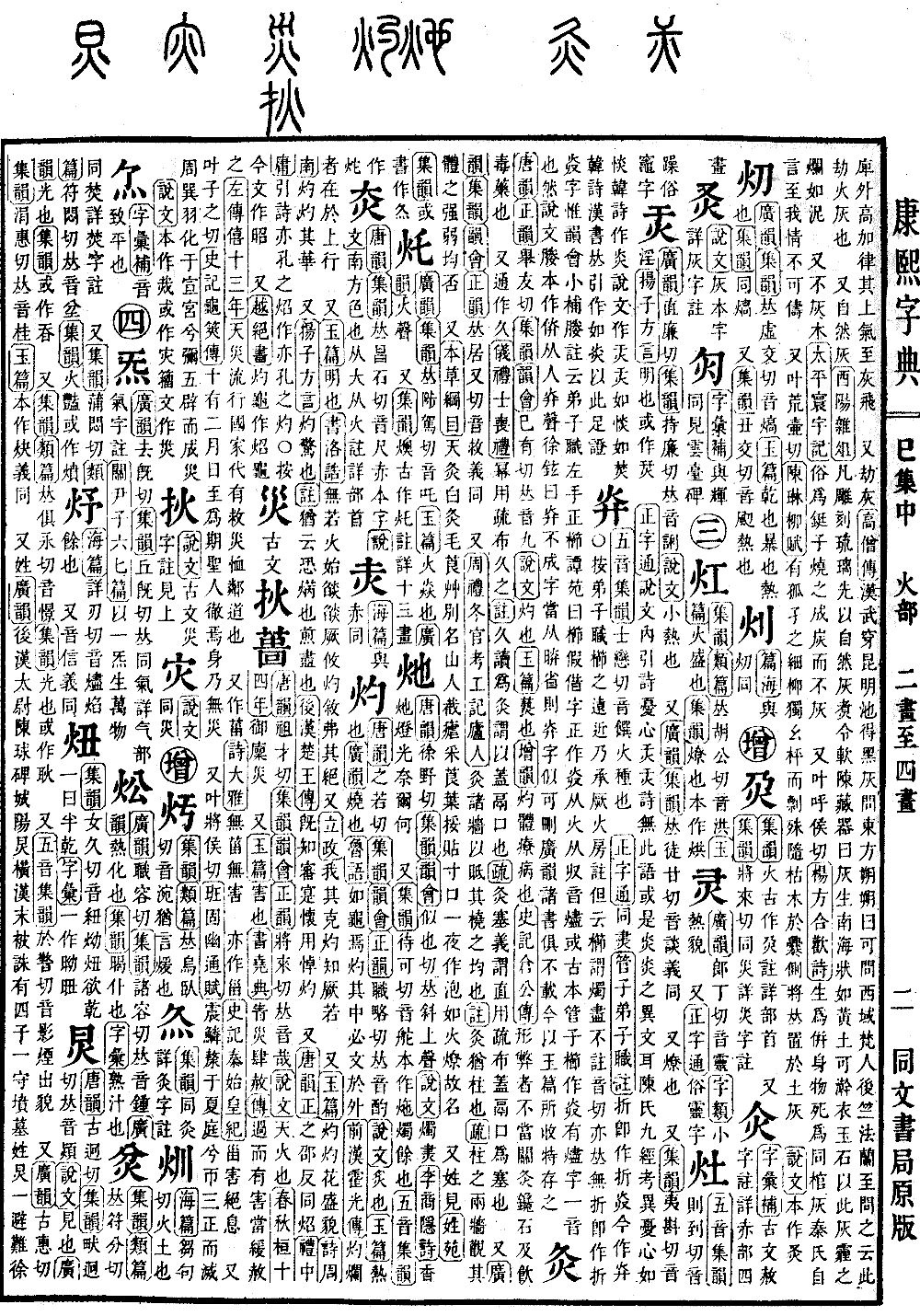
灸
Kangxi strokes: 7
Page 666, Entry 12
Pronounced jiǔ.
Shuowen Jiezi (Dictionary of Explanations of Characters): To cauterize.
Yupian (Jade Chapters): To cauterize.
Zengyun (Additional Rhymes): To cauterize the body to treat illness.
Records of the Grand Historian (Shiji): Those whose constitution is weak should not be subjected to cauterization, acupuncture, or the ingestion of toxic medicinal substances.
Also written as a variant form (jiǔ).
Book of Etiquette and Ceremonial (Yili): Cover the sacrificial vessel with coarse cloth to stop it up.
Commentary: The word for stop is read as cauterize. It refers to using coarse cloth to cover the opening of the vessel to act as a plug.
Sub-commentary: To cauterize means to stop up; it means simply using coarse cloth to cover the vessel opening as a seal.
Pronounced jiù. The meaning is the same.
Record of Trades (Kaogongji) in the Rites of Zhou (Zhouli): Prop it against the wall to observe if the curvature is uniform.
Commentary: To cauterize is synonymous with to prop.
Sub-commentary: To prop against the two walls to observe whether the structure is strong or weak and if it is uniform.
Compendium of Materia Medica (Bencao Gangmu): Tianjiu and Baijiu are alternative names for the buttercup plant. Mountain dwellers gathering these leaves to treat malaria rub them onto the wrist pulse; overnight, they create blisters like burns, hence the name.
Also a surname. See the Genealogy of Surnames (Xingyuan).
Jiyun (Collection of Rhymes): Sometimes written in a variant form.