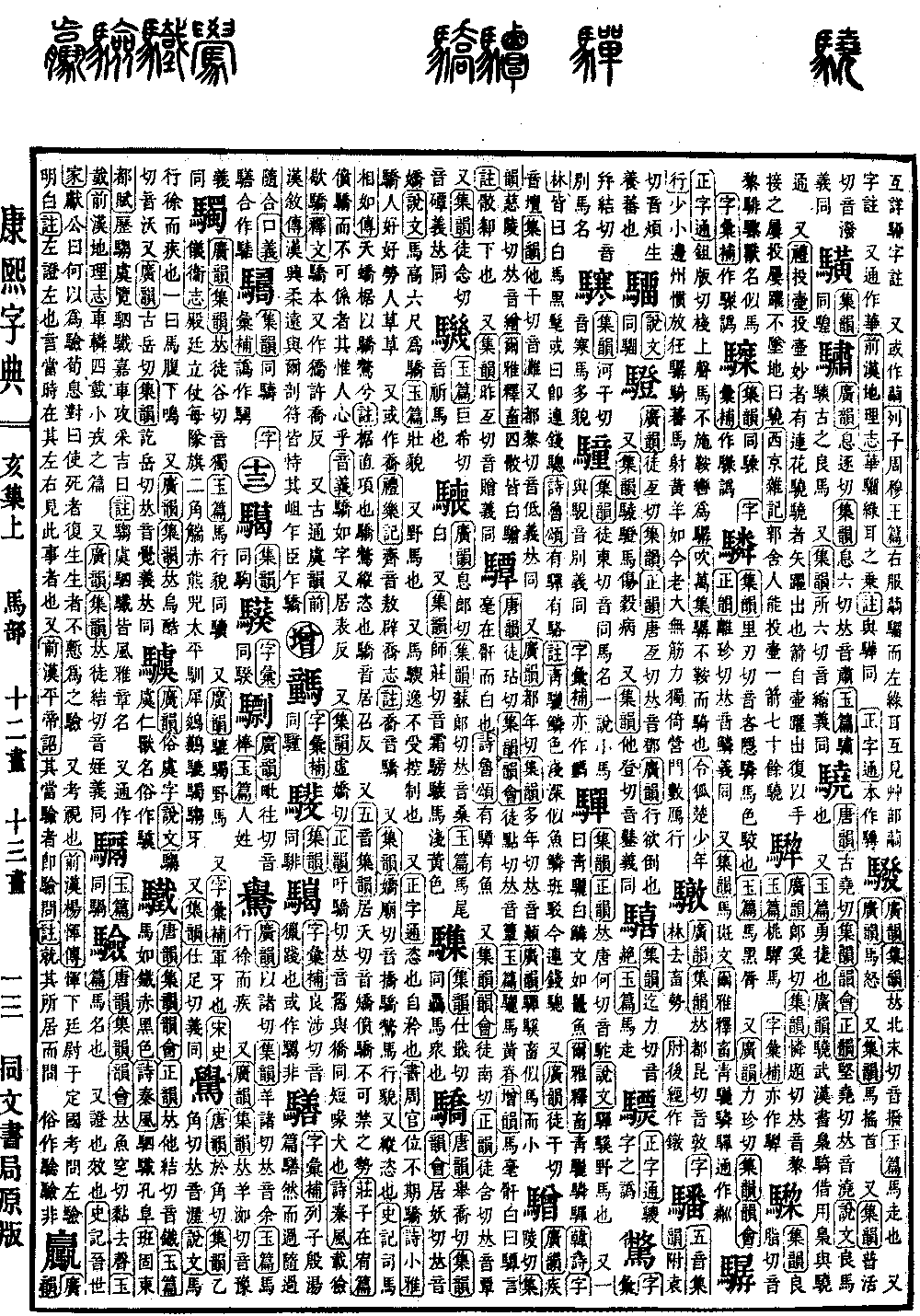
Hai Collection, Upper Volume
Radical: Horse (mǎ)
Entry: jiao
Kangxi strokes: 22
Page 1445, Entry 01
Pronounced jiao.
Shuowen Jiezi (Explanation of Script and Analysis of Characters): A horse six feet tall is called jiao.
Yupian (Jade Chapters): A robust and strong appearance. Also refers to wild horses. Also refers to a horse running wildly and uncontrolled.
Zhengzitong (Comprehensive Dictionary of Characters): Means indulgence; arrogant and conceited.
Book of Zhou (Zhou Guan): If one's status is high, it is easy to become indulgent.
Book of Odes (Shijing): Those who achieve their ambitions are arrogant and self-satisfied; those who suffer setbacks are worried and depressed.
Sometimes written in a variant form (qiao).
Book of Rites (Liji): The music of the state of Qi is arrogant and deviant, leading to indulgent intentions.
Annotation: Qiao is pronounced the same as jiao.
Pronounced jiao. Jiao-ao, the appearance of a horse galloping. Also refers to being unconstrained and indulgent.
Records of the Grand Historian (Shiji): Rising and falling, bending and stretching, unconstrained and indulgent.
Annotation: Ju means to stretch out the neck. Jiao-ao means to be unconstrained and indulgent. Jiao is pronounced jiao.
Pronounced jiao. Refers to a state of excitement and indulgence that cannot be curbed.
Zhuangzi (Zhuangzi): That which is excited and indulgent and cannot be restrained is perhaps only the human heart.
Sound and Meaning: Jiao is pronounced as its primary sound. Also pronounced jiao.
Pronounced xiao. Same as the character (xiao). Refers to a short-muzzled hunting dog.
Book of Odes (Shijing): Carrying long-muzzled and short-muzzled hunting dogs.
Explanation of Texts: Some versions of jiao are written as (xiao). Pronounced xiao.
Also rhymed with the Yu rhyme in ancient times.
Book of Han (Hanshu): The Han dynasty rose to appease distant lands and issued tallies to them. They all relied on the precarious terrain, sometimes submitting and sometimes being arrogant.
Examination of the text: In Records of the Grand Historian (Shiji), the phrase should be written as the original text with the two characters meaning low and high added. Changed the character to its variant form.