You Collection, Upper Volume
Radical: Speech (yán)
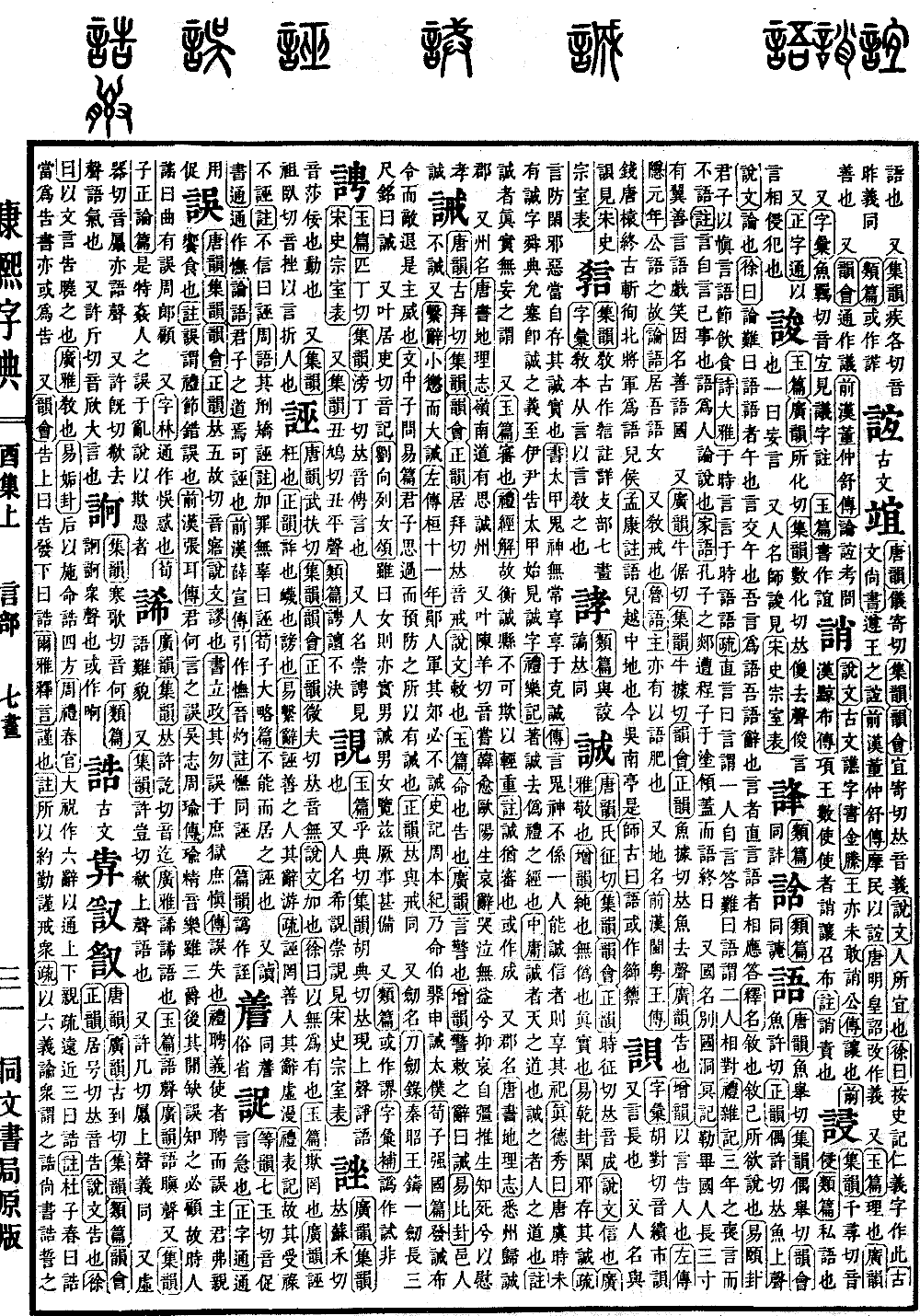
Jie
Kangxi strokes: 14
Page 1163, Entry 13
Tang Yun: Pronounced jie
Jiyun, Yunhui, Zhengyun: Pronounced jie
The pronunciation is the same as the character for戒.
Shuowen: Meaning an official order.
Yupian: Meaning to command or to admonish.
Guangyun: Meaning to use words to warn.
Zengyun: Words used to alert and admonish are called jie.
Book of Changes (Yijing), Bi Hexagram: People within the city walls do not admonish one another (yet they naturally become attached).
Also, Xici: To receive a small punishment and thus gain a great warning.
Zuo Tradition (Zuozhuan), Duke Huan, Year 11: The army of the state of Yun is stationed in the suburbs, they will certainly not be on guard.
Records of the Grand Historian (Shiji), Annals of Zhou: Thereupon he ordered Bo Jiong to repeatedly admonish the grand steward.
Xunzi, Chapter on a Powerful State: To issue admonitions and promulgate orders such that the enemy retreats is the power of the sovereign.
Wenzhongzi, Chapter on Asking about the Changes: The superior person reflects on faults and guards against them beforehand, therefore there is the word jie.
Zhengyun: Identical to the character for 戒.
Also refers to the name of a sword.
Daojian Lu: King Zhao of Qin forged a sword three feet long, with an inscription naming it Jie.
Also rhymes with the sound ji.
Liu Xiang, Eulogy for Notable Women: Although it speaks of the standards for women, it is actually an admonitory mirror for men. If both men and women read these, affairs will be perfectly complete.
Also, Leipian: Sometimes written in a variant form.
Zihui Bu: Miswritten as a variant form, which is incorrect.