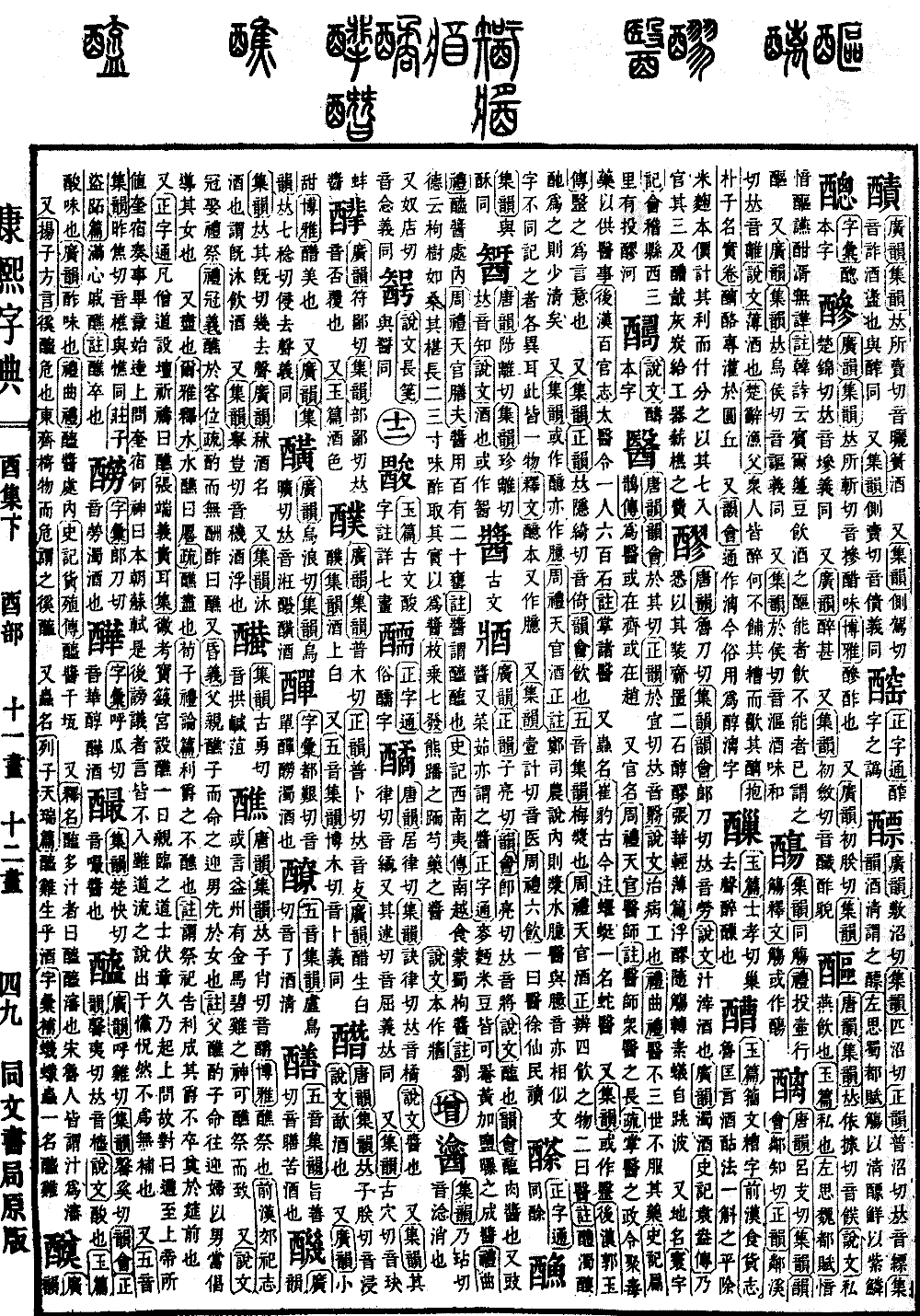
You Collection, Lower Volume
Radical: Wine (yǒu)
Page 1287, Entry 01
Ancient form. Guangyun (Guangyun) and Zhengyun (Zhengyun) translate as jiang; Yunhui (Yunhui) translates as jiang. Pronounced jiang. According to the Shuowen (Shuowen), it refers to a fermented paste. Yunhui states that this refers to meat paste. It also refers to fermented soybean paste. It is also used to describe pickled vegetables. The Zhengzitong (Zhengzitong) notes that wheat, flour, rice, and beans can all be fermented with a starter, then salted and dried in the sun to create this paste. The Book of Rites (Liji) states: Vinegars and fermented pastes are kept in the inner chambers. The Rites of Zhou (Zhouli) states: One hundred and twenty jars of fermented paste are used by the dietetic officials. The commentary states: Fermented paste refers to vinegar and salted meat pastes. The Records of the Grand Historian (Shiji) states: The people of the Southern Yue ate the gou-fermented paste of Shu. The commentary says: Liu De states that the gou tree resembles a mulberry, its fruit is two to three inches long and sour in taste; the fruit is gathered to make this paste. Mei Cheng's Seven Stimuli (Qifa) states: The braised bear paw with peony-infused paste. In the Shuowen, it was originally written as a different form. The character for braised (nao) originally contained the components for foot and from.