Hai Collection, Middle Volume
Radical: Bird (niǎo)
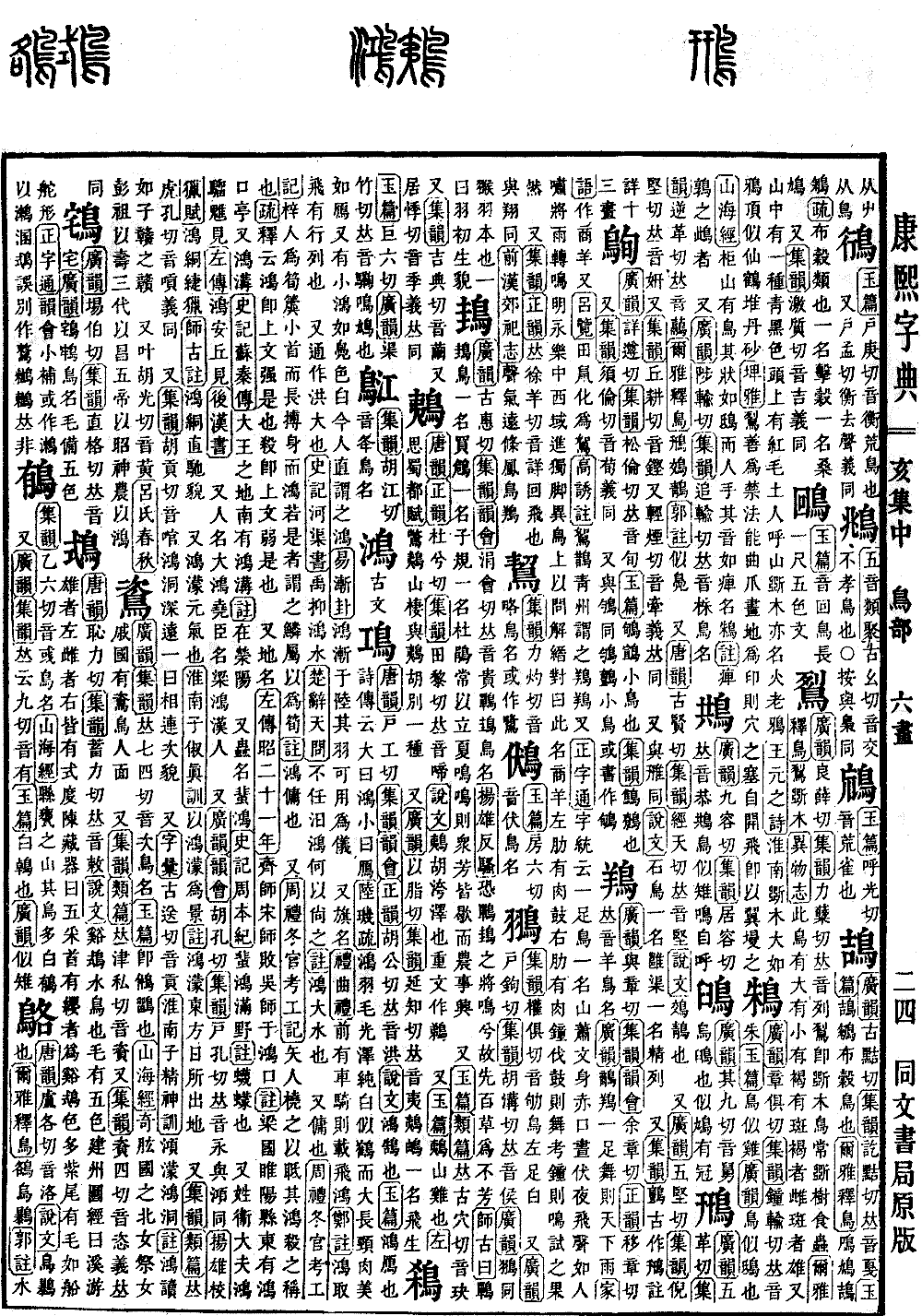
Hong; Kangxi strokes: 17; Page 1488, Entry 20
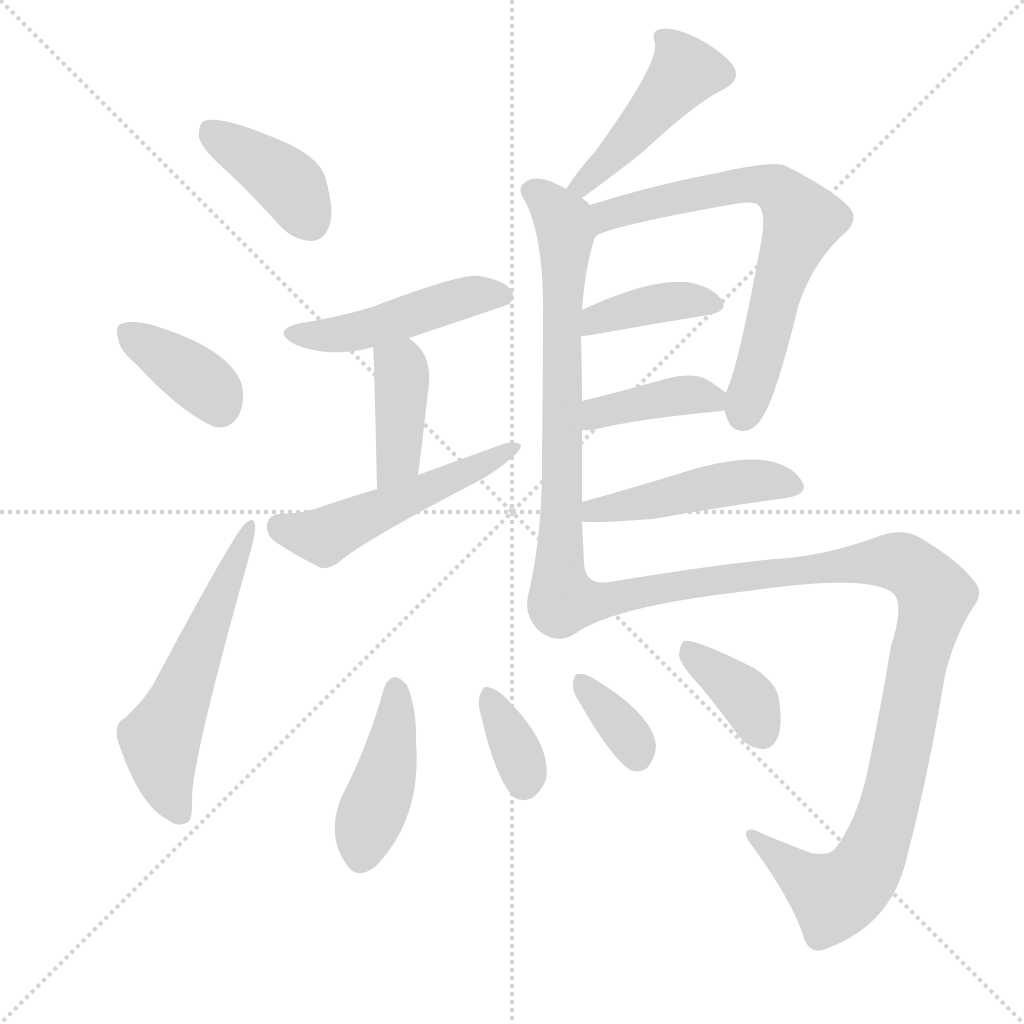
Pronounced hóng.
In Shuo Wen Jie Zi (Explaining Graphs and Analyzing Characters): A swan. In Yu Pian (Jade Chapter): A wild goose. The commentary on the Book of Odes (Shijing) states: The large ones are called hong, the small ones are called yan. Lu Ji’s commentary states: The plumage of the hong is glossy and pure white; it resembles a crane but is larger, with a long neck, and its meat is as delicious as that of a hawk. There is also a small hong similar to a wild duck, white in color, which people today call simply hong.
In the Book of Changes (Yijing), Gradual Hexagram: The wild goose gradually proceeds to the land; its feathers can be used for ornamentation.
Also a flag name. In the Book of Rites (Liji), Songs of Propriety (Quli): If there are chariots and cavalry ahead, then carry the flying hong banner. The Zheng commentary notes: The hong is chosen because they fly in ranks.
Also used interchangeably with hong; meaning great. In the Records of the Grand Historian (Shiji), Treatise on Rivers and Canals: Yu suppressed the great waters. In the Songs of Chu (Chuci), Heavenly Questions: If he were not in charge of the turbulent great waters, how could he be honored? The commentary states: Hong means great water.
Also means wide/broad. In the Rites of Zhou (Zhouli), Winter Official, Artificers' Record: The carpenter making the chime-stand has a small head and a long body, circular in profile and broad, this is called the scaly-type, used for the chime-stand. The commentary states: Hong means broad.
Also, in the Rites of Zhou, Winter Official, Artificers' Record: The arrow-maker bends it to check the balance of its broadness and narrowness. The sub-commentary explains: Hong refers to the strength mentioned above, and narrow refers to the weakness mentioned above.
Also a place name. In the Zuo Tradition (Zuo Zhuan), 21st Year of Duke Zhao: The armies of Qi and Song defeated the army of Wu at Hongkou. The commentary notes: There is a Hongkou Pavilion east of Suiyang County in the State of Liang.
Also Honggou. In the Records of the Grand Historian (Shiji), Biography of Su Qin: Your Majesty’s territory has the Honggou canal to the south. The commentary notes: It is located in Xingyang.
Also an insect name. Feihong. In the Records of the Grand Historian (Shiji), Annals of Zhou: Feihong filled the wilderness. The commentary notes: These are tiny gnat-like insects.
Also a surname. The official of Wey, Hongli Tui, appears in the Zuo Tradition (Zuo Zhuan). Hong Anqiu appears in the History of the Later Han (Hou Hanshu).
Also a person’s name. Da Hong, a minister of Emperor Yao. Liang Hong, a man of the Han dynasty.
Pronounced hǒng. Identical to hong (an expansive or surging appearance). In Yang Xiong’s Rhapsody on Hunting (Yulie Fu): Rapid and unrestrained. The Shigú commentary notes: Hongtong describes a direct, galloping appearance.
Also Hongmeng, primordial energy. In the Huainanzi, Explanation of Genuine Reality (Chuzhen Xun): Using Hongmeng as the bright pillar. The commentary notes: It refers to the wilderness of the east where the sun rises.
Also pronounced hǒng. Same meaning as above.
Also pronounced hǒng. Hongdong, profound and distant. Another interpretation says it describes things connected in sequence.
Also pronounced gòng. In the Huainanzi, Instructions on the Spirit (Jingshen Xun): Hongmeng and Hongdong. The commentary notes: Hong is read like the gong in Zigan.
Also rhyming as huáng. In the Huainanzi, Lu’s Spring and Autumn Annals (Lüshi Chunqiu): Peng Zu was long-lived, the three dynasties were prosperous, the five emperors were illustrious, and Shennong was great.