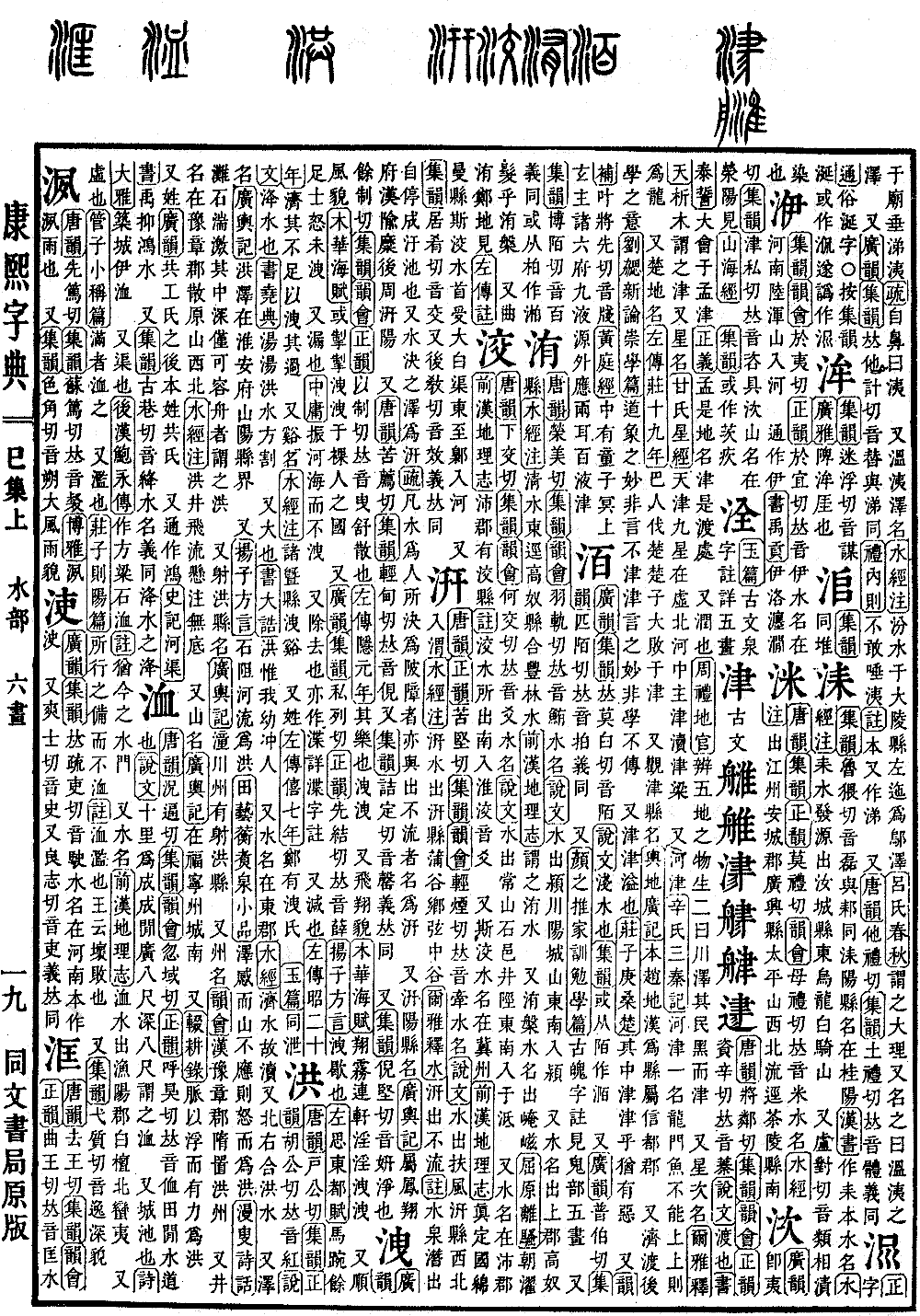
Si Collection, Upper Volume
Radical: Water (shuǐ)
Hong; Kangxi stroke count: 10; Page 621, Entry 21
Pronounced hóng.
As defined in Explaining Graphs and Analyzing Characters (Shuowen): The surging of floodwaters.
As cited in Book of Documents (Shujing), Canon of Yao: The vast floodwaters were currently spreading.
Also means great.
As cited in Book of Documents (Shujing), Great Announcement: Greatly consider me, a young and immature person.
Also a river name, located in Dong Commandery.
As cited in Commentary on the Water Classic (Shuijing): The old channel of the Ji River, further north, merges on the right with the Hong River.
Also a marsh name.
As cited in Record of Universal Geography (Guangyuji): Hong Lake, located on the border of Shanyang County, Huai'an Prefecture.
Also, according to Model Sayings (Fangyan) by Yang Xiong: Stones obstructing a river current, creating rapids, are called hong.
As cited in Small Treatise on Boiling Spring (Zhuquan xiaopin) by Tian Yiheng: When the marshes respond but the mountains do not, it rages and becomes a hong.
As cited in Poetic Talks by the Leisurely Elder (Mansou shihua): Where rocks in the shallows cause turbulent rapids, and the depth is only enough to accommodate a boat, it is called a hong.
Also Shehong, a county name.
As cited in Record of Universal Geography (Guangyuji): Tongchuan Prefecture contains Shehong County.
Also a prefecture name.
As cited in Collection of Rhymes (Yunhui): The Han dynasty Yuzhang Commandery, renamed Hong Prefecture during the Sui dynasty.
Also a well name, located northwest of Sanyuan Mountain in Yuzhang Commandery.
As cited in Commentary on the Water Classic (Shuijing zhu): The Hong Well has flying currents, pouring suspended into a bottomless depth.
Also a mountain name.
As cited in Record of Universal Geography (Guangyuji): Located south of the city of Funing Prefecture.
Also, as cited in Records After Tilling (Chuogenglu): A pulse that is floating and forceful is called hong.
Also a surname.
As cited in Broad Rhymes (Guangyun): Descendants of the Gonggong clan, originally with the surname Gong.
Also used interchangeably with hong (meaning wild goose or great).
As cited in Records of the Grand Historian (Shiji), Treatise on the River and Canals: Yu suppressed the great floods.
Also, according to Collected Rhymes (Jiyun): Pronounced jiàng. A river name. The meaning is the same as the jiàng in the surging of floodwaters.