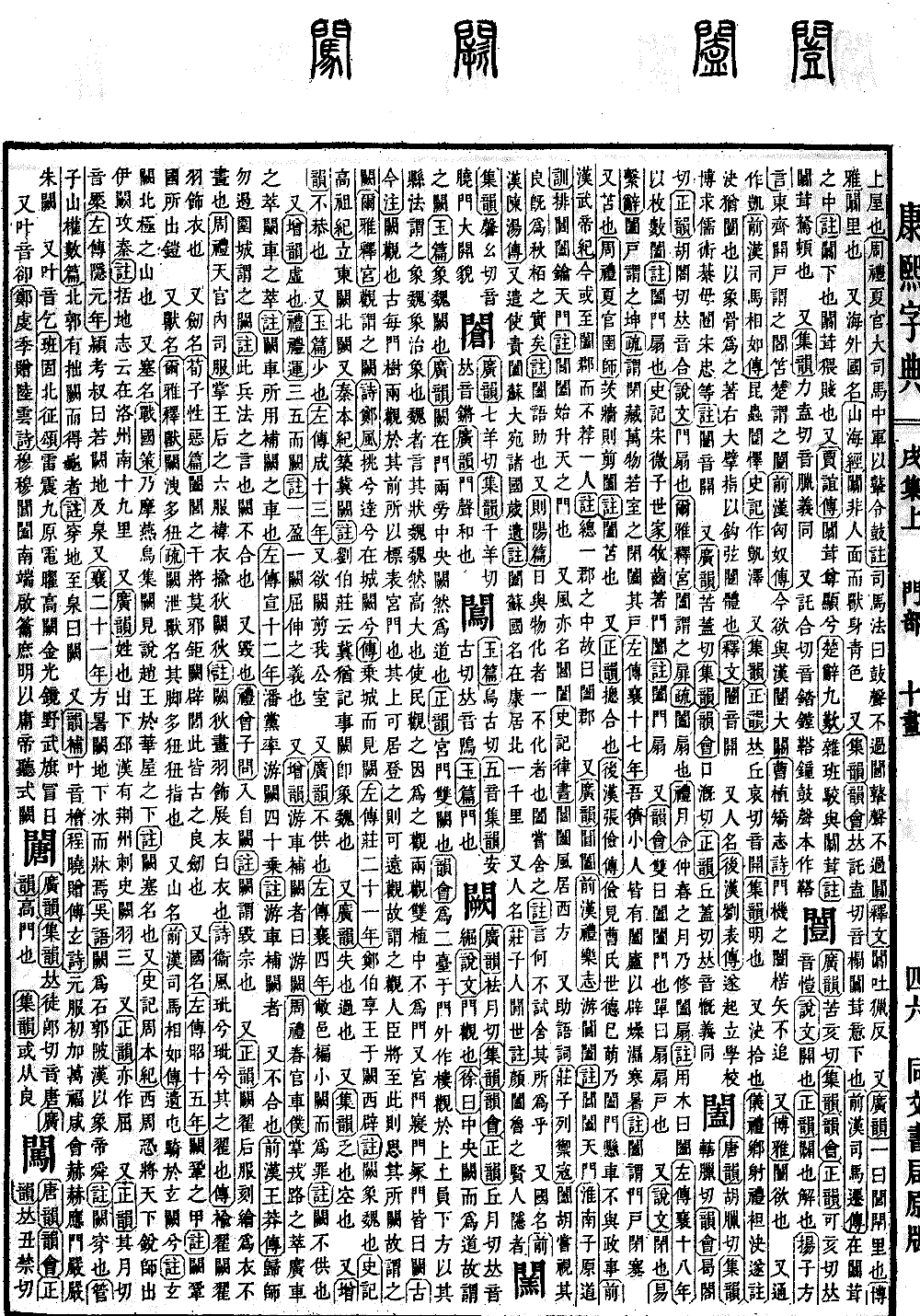
Xu Collection, Upper Volume
Radical: Gate (mén)
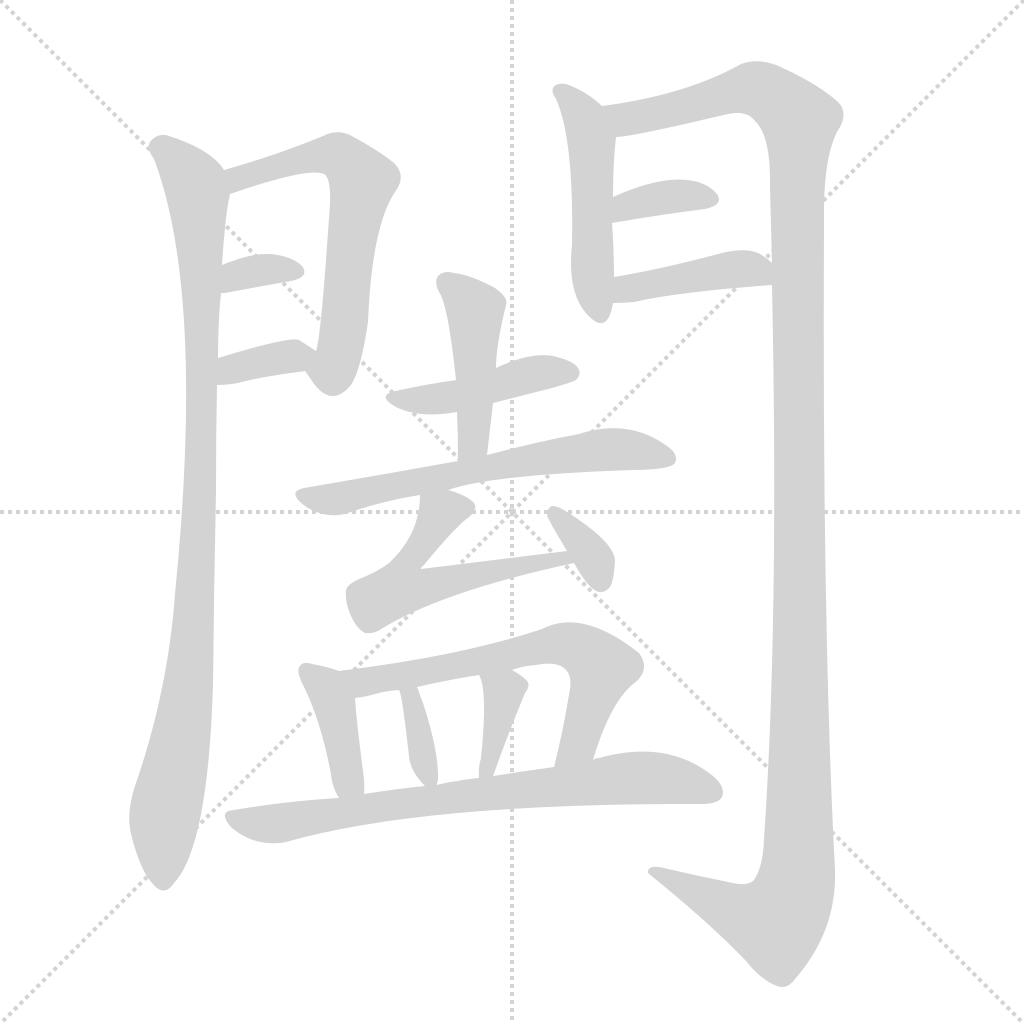
闔
Kangxi strokes: 18
Page 1340, Entry 02
Pronounced he.
According to the Explaining Graphs and Analyzing Characters (Shuowen Jiezi), it refers to a door leaf.
According to the Approach to the Classics (Erya), in the chapter interpreting palaces, a door leaf is called he.
The commentary explains that he is a door leaf.
According to the Book of Rites (Liji), in the monthly ordinances for the second month of spring, one should repair the door leaves.
The commentary states that when made of wood, it is called he.
According to the Zuo Commentary (Zuo Zhuan), in the eighteenth year of Duke Xiang, one counts the door leaves using sticks.
The commentary states that he refers to a door leaf.
According to the Records of the Grand Historian (Shiji), in the biography of the House of Weizi of Song, one stands by the door leaf.
The commentary states that he is a door leaf.
Furthermore, according to the Rhyme Collection (Yunhui), a double door is called he, meaning to close the door. A single door is called shan, meaning to screen the house.
Furthermore, according to the Explaining Graphs and Analyzing Characters (Shuowen Jiezi), it means to close.
According to the Book of Changes (Yijing), in the commentary on the statements, to close the door is called kun.
The sub-commentary explains that this refers to closing and storing all things, just as a room closes its door.
According to the Zuo Commentary (Zuo Zhuan), in the seventeenth year of Duke Xiang, we humble people all have closed houses to avoid dryness, moisture, cold, and heat.
The commentary states that he refers to the closing and blocking of doors.
Also refers to thatching.
According to the Rites of Zhou (Zhouli), regarding the summer official and the groom master, when thatching a wall, one clips the thatch.
The commentary states that he refers to thatch.
Also, according to the Orthodoxy of Rhymes (Zhengyun), it means total or combined.
According to the Book of the Later Han (Hou Hanshu), in the biography of Zhang Jian, Jian saw that the virtues of the Cao family had already begun to sprout, so he closed his gate, retired from office, and did not participate in political affairs.
According to the Book of the Former Han (Qian Hanshu), in the annals of Emperor Wu, now some reach the entire commandery without recommending a single person.
The commentary states that it refers to the entirety of a commandery, thus it is called he jun.
Also, according to the Broad Rhymes (Guangyun), refers to Changhe.
According to the Book of the Former Han (Qian Hanshu), in the treatise on music, roaming through Changhe.
The commentary states that Changhe is the gate of heaven.
According to the Huainanzi, pushing open Changhe and unlocking the gate of heaven.
The commentary states that Changhe is the gate where one first ascends to heaven.
Also, a wind. It is also called Changhe.
According to the Records of the Grand Historian (Shiji), in the treatise on the pitch pipes, the Changhe wind resides in the west.
Also, a modal particle.
According to the Zhuangzi, why not try to look at its excellence; it is already the fruit of the autumn cypress.
The commentary states that he is a modal particle.
Also, in the section on Ze Yang, one who changes with things is one who does not change; why not try to release it.
The commentary states that this means why not try to release what one is doing.
Also, a country name.
According to the Book of the Former Han (Qian Hanshu), in the biography of Tang, he sent envoys to demand the annual tribute from countries like Hesu and Dayuan.
The commentary states that Hesu is a country name, located one thousand li north of Kangju.
Also, a person's name.
According to the commentary on the Zhuangzi, Yan He was a virtuous hermit of Lu.
Verification: In the Rites of Zhou (Zhouli), regarding the summer official and the groom master, the text originally read clip the thatch. We note that the character for clip should have the feather radical below; it has been corrected to the standard form.