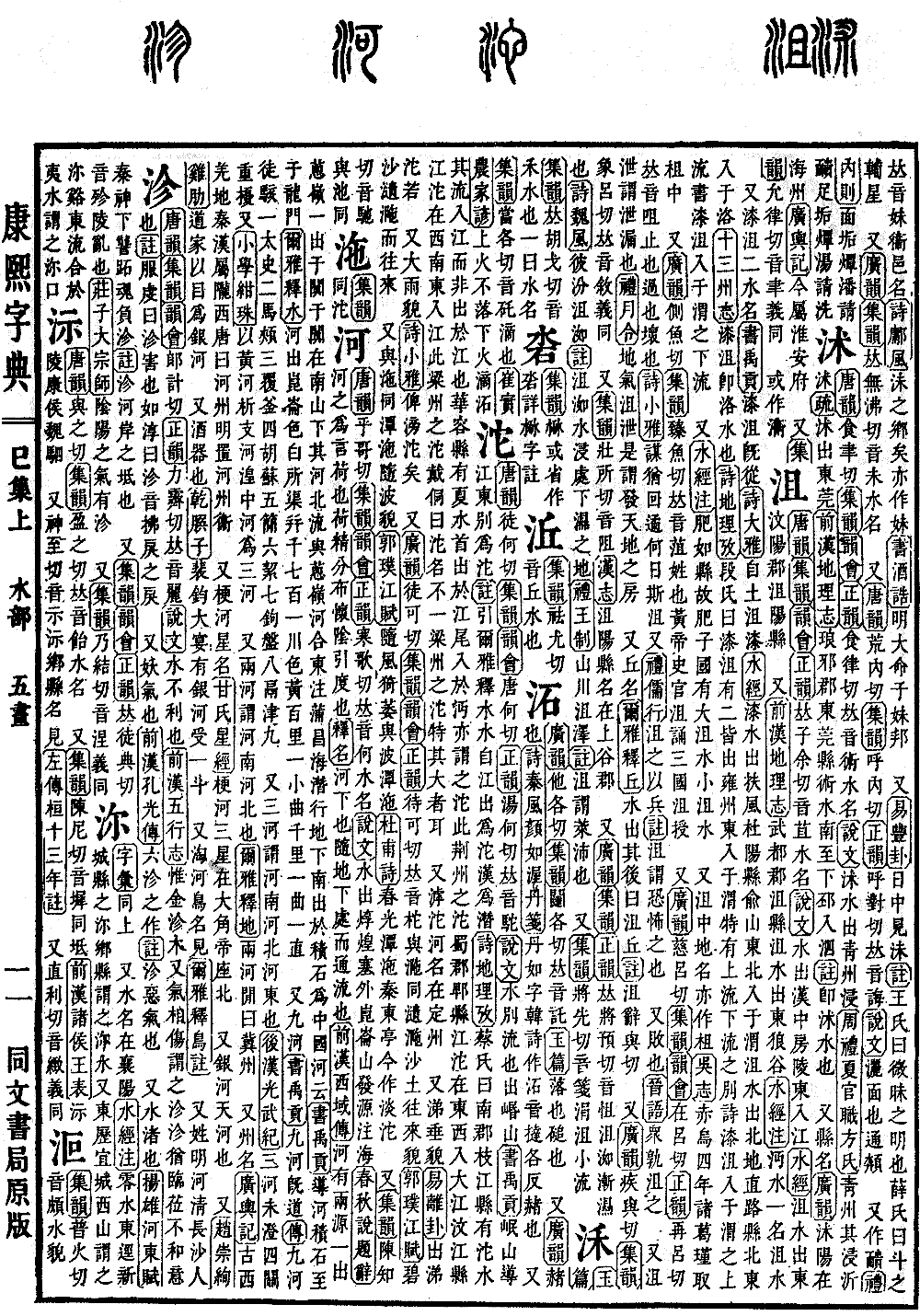
Si Collection, Upper Volume
Radical: Water (shuǐ)
Page 613, Entry 09
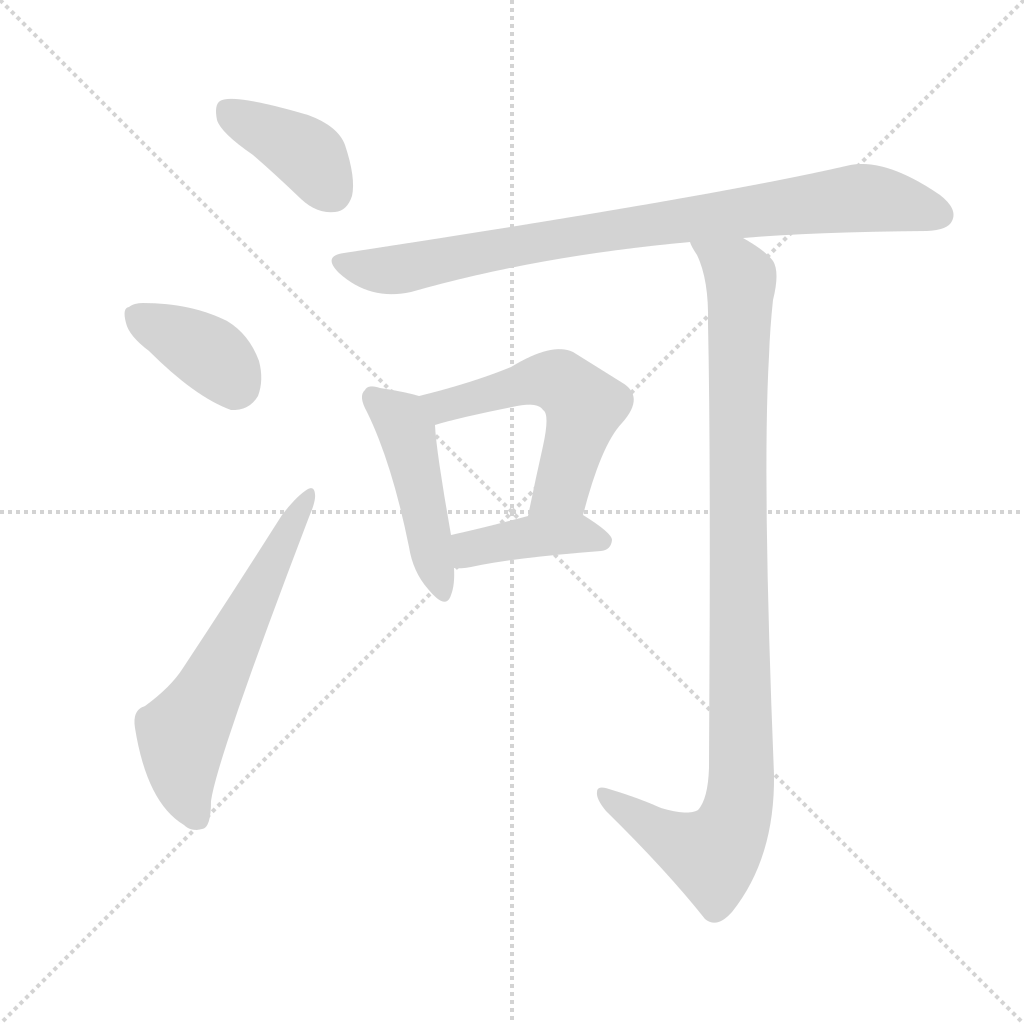
Pronounced he. Homophonous with he. The name of a river.
Explaining the Meaning of Characters (Shuowen Jiezi): The Yellow River originates from the Kunlun Mountains beyond the Dunhuang frontier, flows from its source, and eventually empties into the sea.
Spring and Autumn Annals: Discourse on Names (Chunqiu Shuo Tici): The term he signifies to carry. It flows like the veins of a lotus leaf, bearing yin energy and guiding its circulation.
Explanation of Names (Shiming): The term he carries the meaning of downward. It flows by following the low-lying terrain.
History of the Former Han (Qian Hanshu): The Yellow River has two sources: one originates in the Onion Mountains (Congling), and the other in Yutian. Yutian is situated at the foot of the Southern Mountains; its river flows north, joins with the river from the Onion Mountains, flows east into Lake Puchang, and then flows underground. It emerges southward from the Jishi Mountains, which is the Yellow River of China.
Book of Documents (Shangshu): The regulation of the Yellow River began at the Jishi Mountains and extended to the Longmen Mountains.
Literary Expositor (Erya): The Yellow River originates in the Kunlun Mountains; its water is white in color. It gathers 1,700 tributaries, after which its water turns yellow. The river channel has a small bend every hundred li and a major bend or a straight section every thousand li.
There is also the mention of the Nine Rivers.
Book of Documents (Shangshu): All nine river channels have been dredged.
Commentary: The nine rivers are: first, the Tuhai River; second, the Taishi River; third, the Majia River; fourth, the Fufu River; fifth, the Husu River; sixth, the Jian River; seventh, the Jie River; eighth, the Goupan River; and ninth, the Gejin River.
There is also the term Three Rivers, referring to the regions of Henan, Hebei, and Hedong.
Book of the Later Han (Hou Hanshu): The Three Rivers region was not yet stable, and the border passes were being harassed.
Also, Collection of Elementary Learning (Xiaoxue Ganzhu): The Three Rivers are identified as the Yellow River, the Xizhi River, and the Huangzhong River.
There is also the term Two Rivers, referring to the East River and the West River.
Literary Expositor (Erya): The region between the two rivers is called Jizhou.
There is also a province named Hezhou.
Records of Universal Geography (Guangyu Ji): In ancient times, it was the territory of the Western Qiang. During the Qin and Han dynasties, it belonged to the Longxi Commandery. During the Tang dynasty, it was called Hezhou. During the Ming dynasty, the Hezhou Guard was established.
There is also a star named Genghe.
Mr. Gan's Classic of Stars (Gan Shi Xingjing): The Genghe star consists of three stars located to the north of the Arcturus star and the Emperor's Seat star.
There is also the Milky Way, which is the Celestial River.
Also, Zhao Chongxuan's Chicken Ribs (Ji Lei): Daoists refer to the eyes as the Milky Way.
There is also a wine vessel called the Milky Way.
Qianzi: When Pei Jun held a grand banquet, there was a wine vessel called the Milky Way, which could hold one dou of wine.
There is also a bird named the Taohe. See the commentary on the Literary Expositor (Erya).
There is also the surname He. During the Ming dynasty, there was a person named He Qing who was from Changsha.
The character is composed of the radical for moon and the phonetic component for ke.
Critical Revision: The Two Rivers refer to the East River and the West River. The Literary Expositor (Erya) states that the region between the two rivers is called Jizhou. Note: The commentary on the Literary Expositor states, from the East River to the West River, which does not refer to Henan and Hebei. The original text has been corrected from Henan and Hebei to East River and West River.