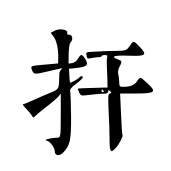
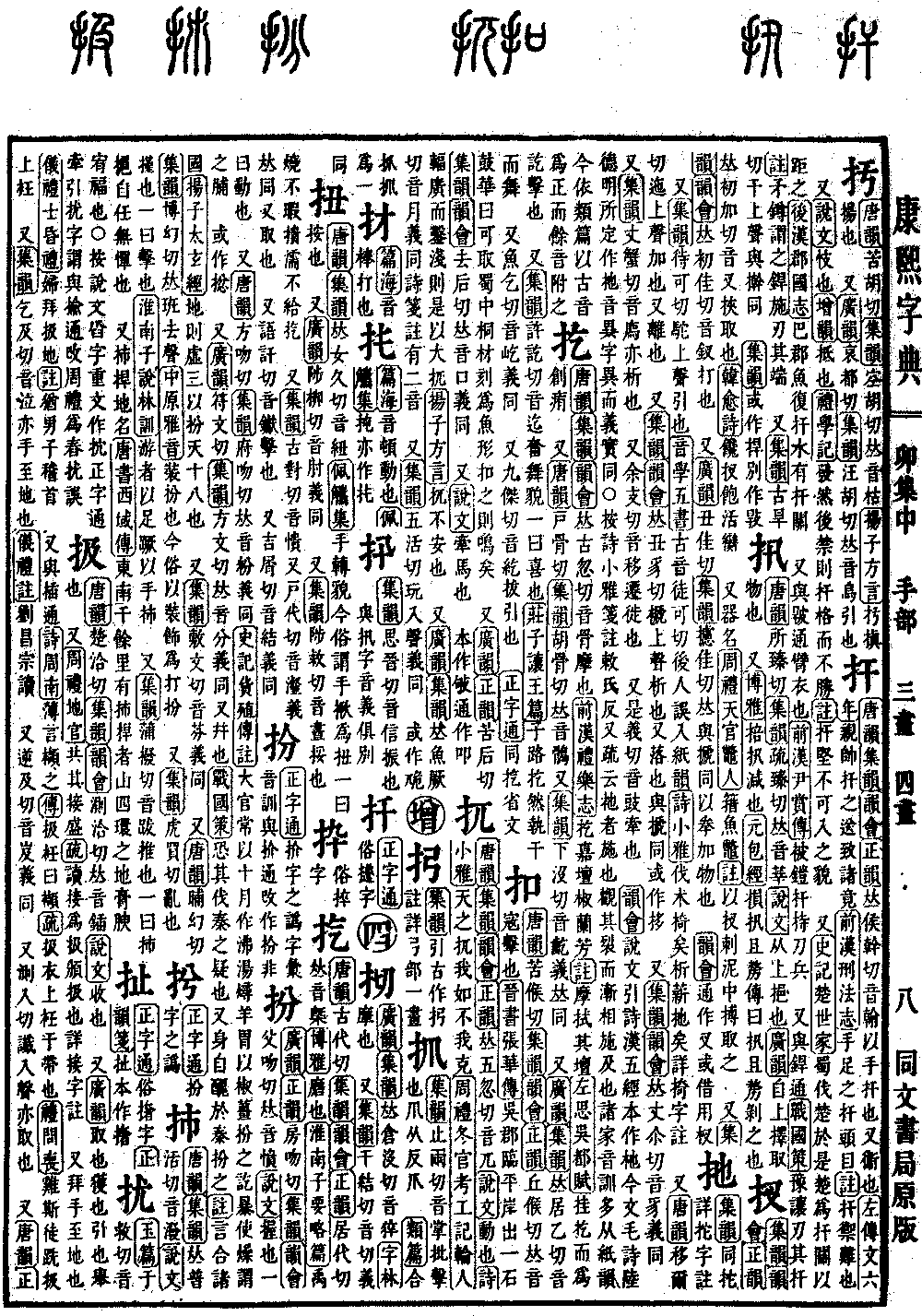
Mao Collection, Middle Volume. Radical: Hand (shǒu). Kangxi stroke count: 7. Page 418, Entry 02.
According to Tang Rhymes (Tangyun), Jiyun, Rhyme Compilation (Yunhui), and Zheng Yun, the word is pronounced han (falling-rising tone). It means to use one's hands to ward off something. It also carries the meaning of to protect or defend.
In the Commentary of Zuo (Zuo Zhuan), Wen Year 6: Personally leading troops to protect him, escorting him all the way to the border.
In the History of the Former Han (Qianhan Shu), Treatise on Law: Hands and feet are used to protect the head and eyes. The commentary notes that this refers to warding off danger.
According to the Explaining Graphs and Analyzing Characters (Shuowen), it means to go against or to be stubborn.
According to the Expanded Rhymes (Zengyun), it means to resist or conflict with.
In the Book of Rites (Liji), Record of Learning (Xueji): If one waits until events have already occurred before attempting to prohibit them, then the resistance will be great and the measures difficult to implement. The commentary notes that this describes a state of being so fortified that it is difficult to enter.
In the Records of the Grand Historian (Shiji), House of Chu: When the State of Shu attacked the State of Chu, Chu established the Han Pass to resist them.
In the History of the Later Han (Houhan Shu), Treatise on Geography: In Yufu County of Ba Commandery, there is the Han River, where the Han Pass is located.
It is also interchangeable with the character meaning arm guard or sleeve protector. In the History of the Former Han (Qianhan Shu), Biography of Yin Shang: Wearing armor and arm guards, holding swords and weapons.
It is also interchangeable with the character meaning to weld (hàn). In the Strategies of the Warring States (Zhanguo Ce): Yu Rang attached a sharp blade to the end of his spear handle. The commentary notes that the end of a spear or halberd handle is called a weld, referring to the attachment of a blade at the tip.
According to Jiyun, it is pronounced gan (rising tone). It is synonymous with the character meaning to roll out dough. Jiyun notes that it is sometimes written in a variant form (hàn). It is also written in other variant forms (kě).