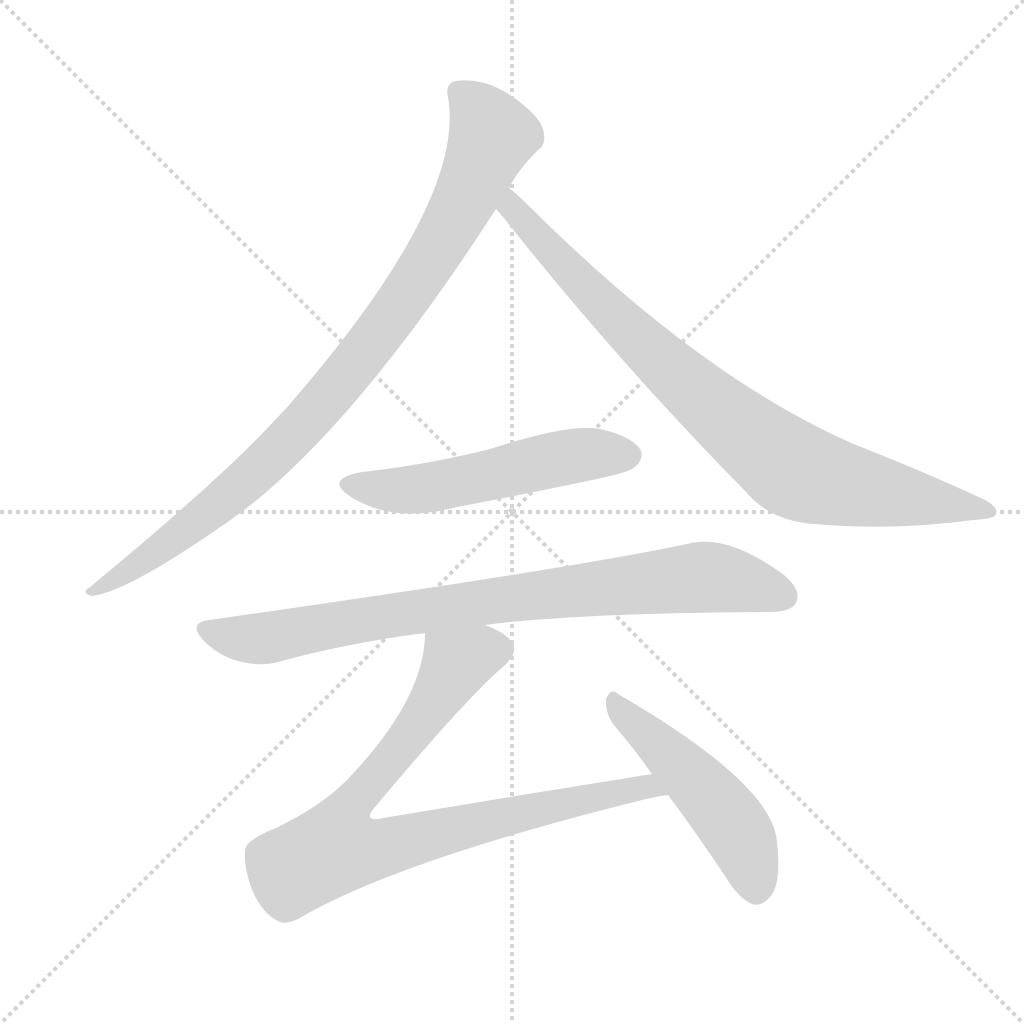
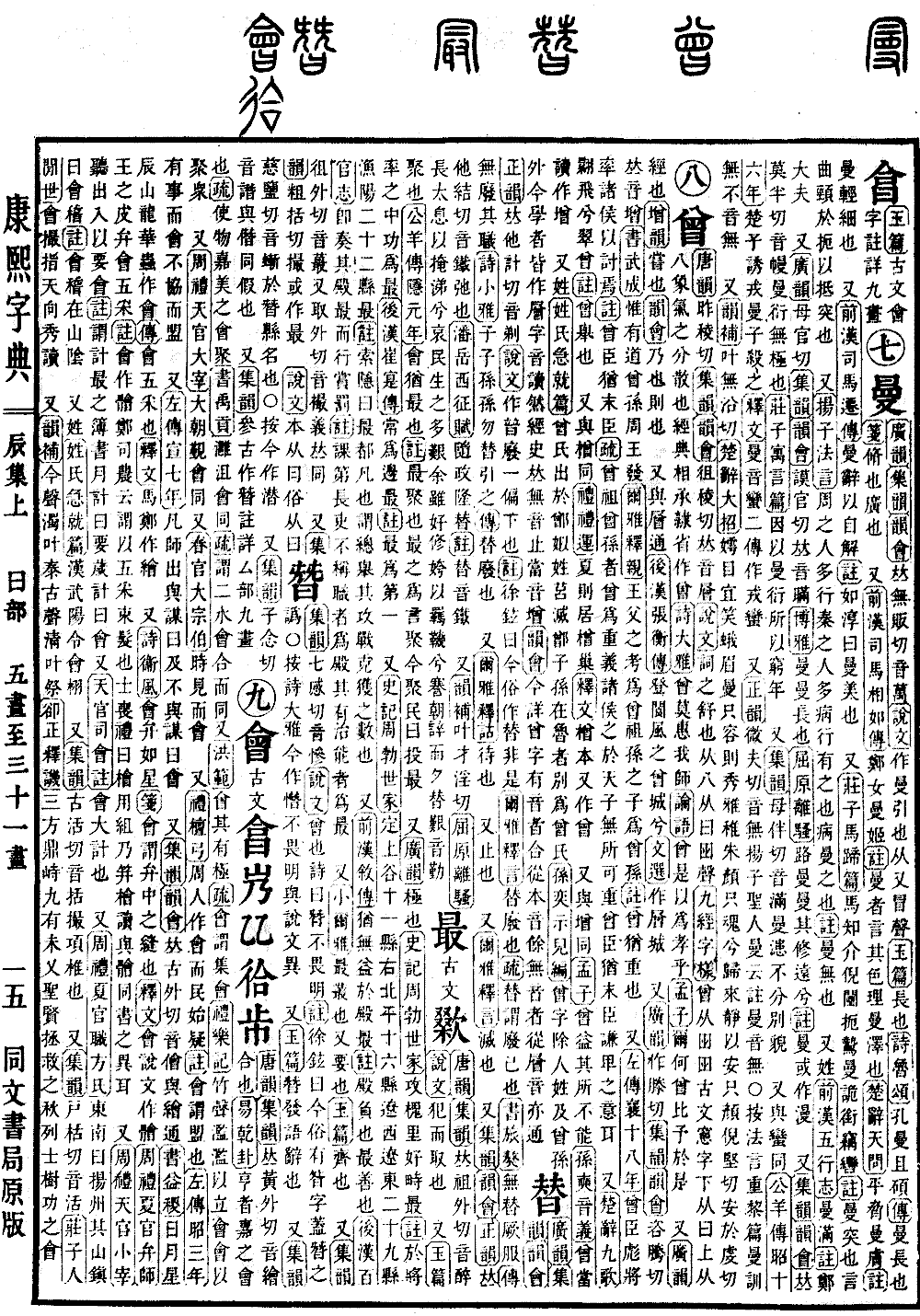
Chen Collection, Upper Volume. Radical: Sun (rì). Kangxi strokes: 13. Page 503. Ancient character form.
According to Tang Rhymes (Tangyun) and Collection of Rhymes (Jiyun), it is pronounced hui. Meaning to gather or to converge.
Book of Changes (Yijing), Hexagram Qian: "The successful one is the convergence of excellence." Commentary: This means bringing things together in a beautiful way.
Book of Documents (Shujing), Tribute of Yu (Yugong): "The Yong and Ju rivers meet." Commentary: Refers to two rivers converging and flowing in the same direction.
Also, in the Great Plan (Hongfan): "Gather their extremes." Commentary: Hui refers to an assembly.
Book of Rites (Liji), Record of Music (Yueji): "The sound of bamboo is broad; broadness is used to establish the assembly, and the assembly is used to gather the masses."
Also, Rites of Zhou (Zhouli), Offices of Heaven (Tianguan), Grand Administrator (Dazai): "The great court audience and meeting of dukes."
Also, Rites of Zhou (Zhouli), Offices of Spring (Chunguan), Grand Master of Ceremonies (Dazongbo): An irregular audience of feudal lords is called a hui.
Also, Book of Rites (Liji), Tan Gong: "The Zhou people instituted the hui, and the people began to have doubts." Note: Hui refers to a covenant or alliance.
Zuo Tradition (Zuozhuan), Year 3 of Duke Zhao: "If there is an affair and there is a meeting, but no agreement, then there is a league."
Also, Zuo Tradition (Zuozhuan), Year 7 of Duke Xuan: Whenever one sends troops to participate in planning, it is called ji; if one does not participate in planning, it is called hui.
Also, Collection of Rhymes (Jiyun) and Rhyme Collection (Yunhui), pronounced kuai. Interchangeable with the character for painting (hui).
Book of Documents (Shujing), Yi and Ji (Yiji): "The sun, moon, stars, mountains, dragons, and variegated creatures are depicted as hui." Commentary: Hui refers to multi-colored patterns. Gloss: The versions of Ma Rong and Zheng Xuan write this as the character for painting.
Also, Book of Odes (Shijing), Odes of Wei (Weifeng): "The seams of the cap are like stars." Note: Hui refers to the seams of a leather cap. Gloss: Hui, the Shuo Wen dictionary writes it as a different form.
Rites of Zhou (Zhouli), Offices of Summer (Xiaguan), Cap Master (Bianshi): "The king's leather cap is decorated with five-colored hui." Note: Hui is written as a different form. Zheng Sinong says: It refers to using five-colored silk ribbons to bind the hair. The Rites of Mourning (Shisangli) says: Bind the hair with silk ribbons, then insert a hairpin. The character huai is pronounced the same as this character, but written differently.
Also, Rites of Zhou (Zhouli), Offices of Heaven (Tianguan), Minor Administrator (Xiaozai): "Listen to the income and expenditure with the yao and hui." Note: Refers to account books for recording and auditing; monthly statistics are called yao, annual statistics are called hui.
Also, Rites of Zhou (Zhouli), Offices of Heaven (Tianguan), Auditor (Sihui) note: Hui refers to major statistical records.
Also, Rites of Zhou (Zhouli), Offices of Summer (Xiaguan), Geography Official (Zhifangshi): "To the southeast is Yangzhou; its mountain stronghold is called Kuaiji." Note: Mount Kuaiji is on the north side of the mountain.
Also, used as a surname. Essentials of Surnames (Xingshi Jijuan Pian): During the Han dynasty, there was a magistrate of Wuyang County named Hui Xu.
Also, Collection of Rhymes (Jiyun), pronounced kuo. Refers to the hui-cuo, which is the cervical vertebra.
Also, Collection of Rhymes (Jiyun), pronounced huo. Zhuangzi, In the World of Men (Renjianshi): "The hui-cuo points to the heavens." Xiang Xiu reads it this way.
Also, Rhyme Supplement (Yunbu): The modern pronunciation is voiced, rhyming with the word tai. The ancient pronunciation is unvoiced, rhyming with the word ji.
Que Zheng, Explanation of Criticism (Shiji): "The three powers stand like tripods; the nine regions are not yet governed. In this autumn of sages and worthies providing salvation, the knights establish the merit of a hui."
Textual research: In Offices of Spring, Grand Master of Ceremonies: "Time to see and meet." Note: The original text "and meet" should be corrected to "called meet."
In Collection of Rhymes: "Pronounced kuo. The cervical vertebra." Note: The original text should have the character hui added before the character cuo.