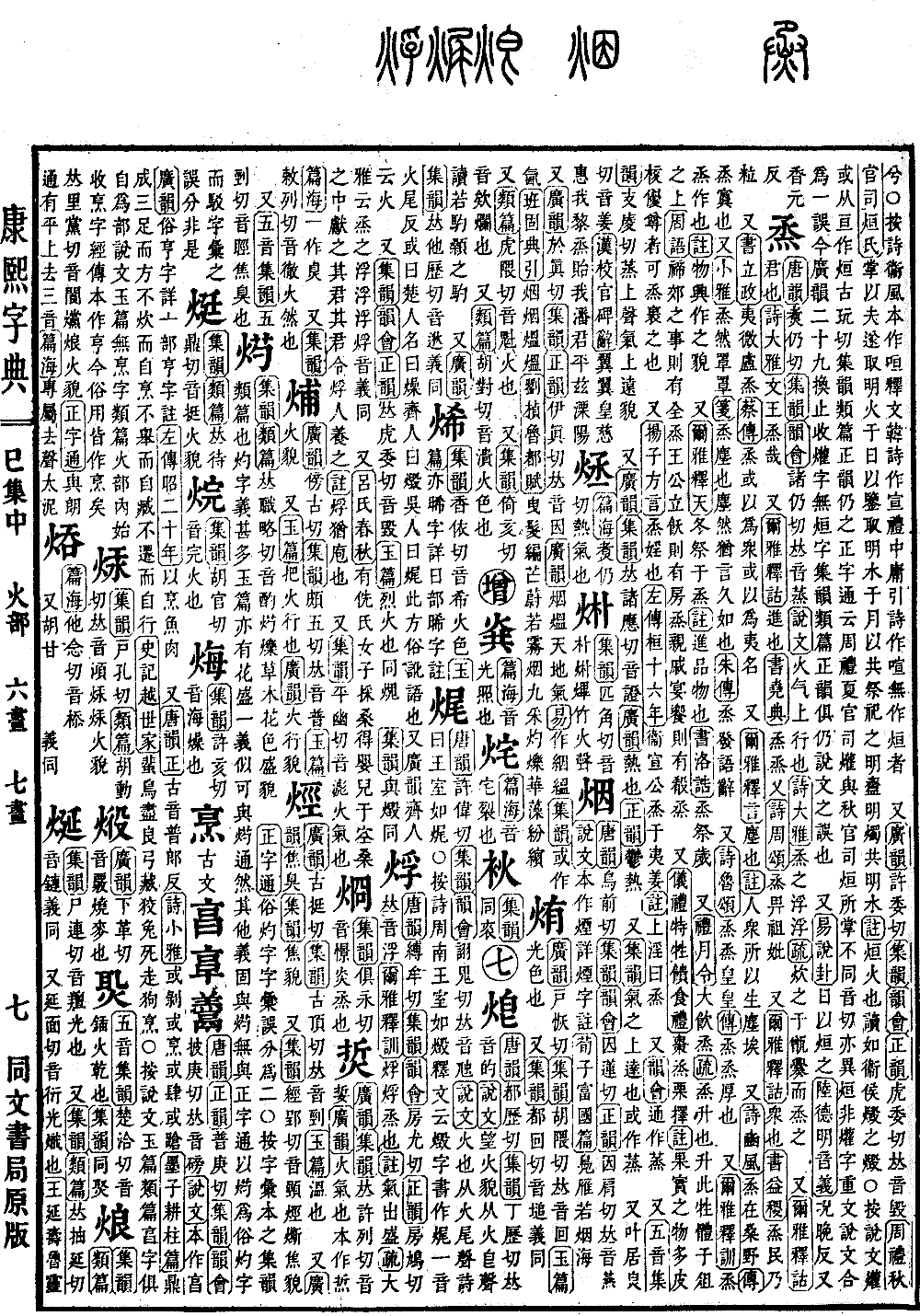
Si Collection, Middle Volume. Radical: Fire (huǒ). Kangxi stroke count: 11. Page 671, Entry 21.
In ancient texts, it is written as a variant form (xiāng).
Tangyun and Zhengyun state it is pronounced peng. Jiyun and Yunhui state it is pronounced pi geng, with a pronunciation similar to pang.
Shuowen Jiezi originally wrote it as xiāng.
Guangyun states this is a vulgar form of the character heng. For a detailed explanation, see the annotations for the character heng under the Radical: Lid (tóu).
Zuo Zhuan (Zuozhuan), twentieth year of Duke Zhao, contains the usage: "Used to boil fish and meat."
Additionally, Tangyun Zheng records the ancient pronunciation as peng.
Book of Odes (Shijing), Lesser Odes of the Kingdom (Xiaoya), contains: "Some are flayed and some are boiled, some are displayed and some are arranged."
Mozi (Mozi), Gengzhu chapter, records: "The tripod is cast with three legs and a square shape; it boils without needing fire, it stores itself without needing to be lifted, and it travels without needing to be moved."
Records of the Grand Historian (Shiji), House of Goujian of Yue, contains: "When the flying birds are all gone, the good bow is stored away; when the crafty rabbits are dead, the hunting dog is boiled."
Note: In Shuowen Jiezi, Yupian, and Leipian, the character xiāng is listed as an independent radical. Shuowen Jiezi and Yupian do not contain the character peng. The character peng only begins to appear in the Fire (huǒ) radical section of Leipian. In classical scriptures, it was originally written as heng, but in contemporary usage, it is commonly written as peng.
Textual research: Regarding the phrase "Some are flayed and some are boiled, some are displayed and some are arranged" in the Book of Odes (Shijing), Lesser Odes of the Kingdom (Xiaoya), the original text has been corrected to read as jiang qiang.