Xu Collection, Upper Volume
Radical: Gate (mén)
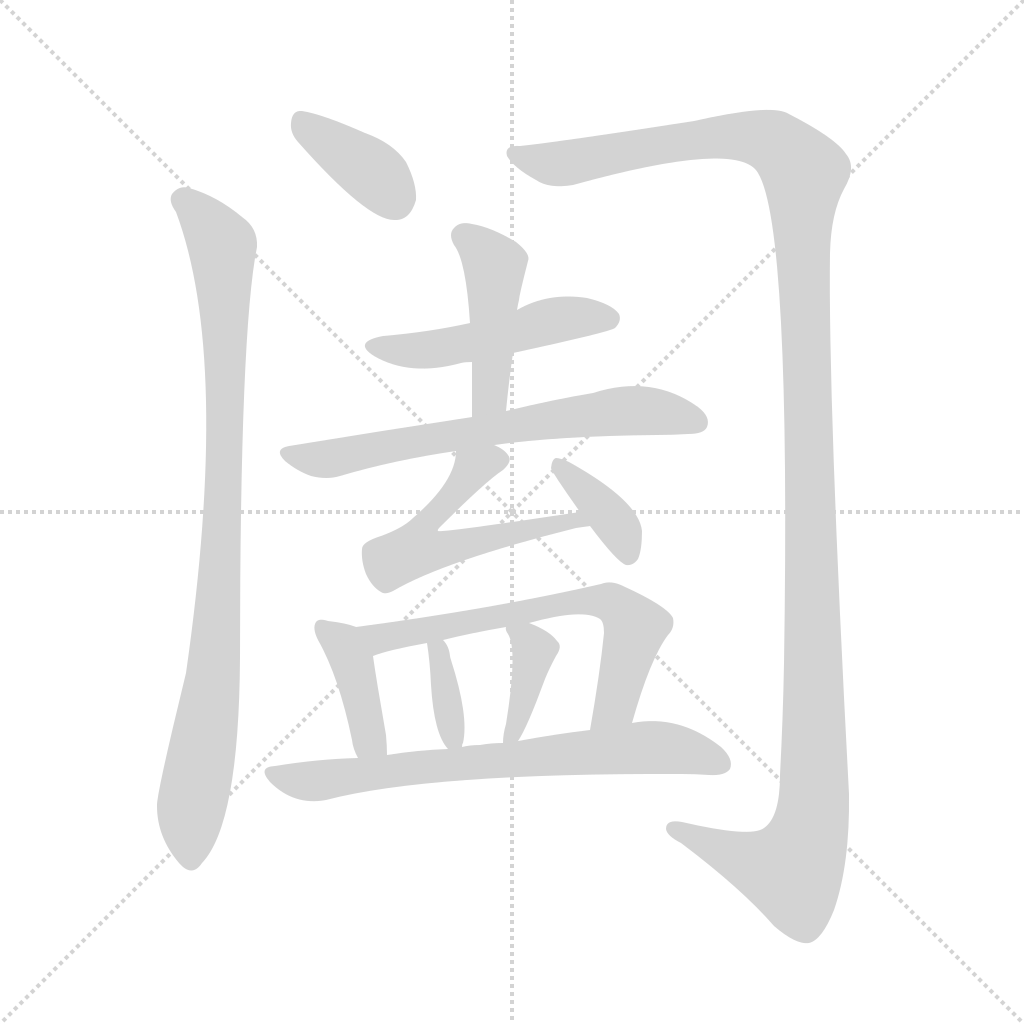
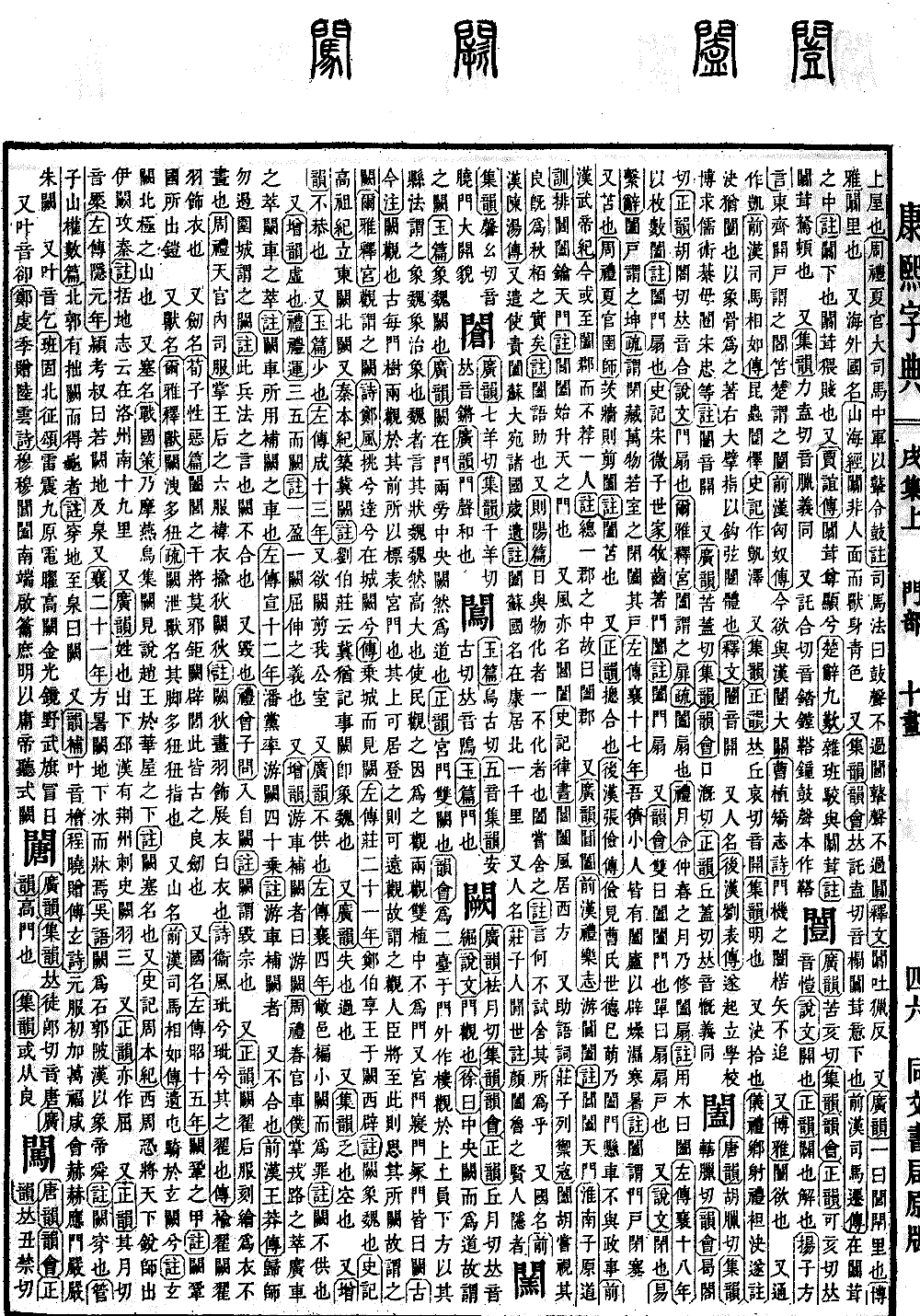
闔; Kangxi strokes: 18; Page 1340
Pronounced he.
Shuowen Jiezi (Dictionary of Explaining and Analyzing Characters): A door leaf.
Erya, Explanation of Palaces (Erya): A door leaf is called a he.
Commentary: He means a door leaf.
Book of Rites (Liji), Monthly Ordinances: In the month of mid-spring, repair the door leaves.
Note: Those made of wood are called he.
Zuo Tradition (Zuozhuan), Eighteenth Year of Duke Xiang: Count the door leaves with sticks.
Note: He means a door leaf.
Records of the Grand Historian (Shiji), House of Weizi of Song: Mu Chi stood by the door leaf.
Note: He means a door leaf.
Also, Dictionary of Rhymes (Yunhui): A double-leaf door is called he, which means to close the door. A single-leaf door is called shan, which means a door leaf.
Also, Shuowen Jiezi (Dictionary of Explaining and Analyzing Characters): To close.
Book of Changes (Yijing), Appended Statements: Closing the door is called kun.
Commentary: This refers to closing and storing all things, just as a room closes its door.
Zuo Tradition (Zuozhuan), Seventeenth Year of Duke Xiang: We small people all have houses to avoid dryness, moisture, cold, and heat.
Note: He refers to the closing of a door.
Also refers to covering.
Rites of Zhou (Zhouli), Summer Officials, Grooming Master: Use thatch to cover the walls.
Note: He means a thatch covering.
Also, Correct Rhymes (Zhengyun): To collect or summarize.
Book of the Later Han (Hou Hanshu), Biography of Zhang Jian: Zhang Jian saw that the signs of the Cao family holding power for generations had appeared, so he closed his door and ceased participating in government affairs.
Book of the Former Han (Hanshu), Annals of Emperor Wu: Now there are some who do not recommend a single person in the entire commandery.
Note: It covers the entire commandery, which is why it is called hejun.
Also, Guangyun (Broad Rhymes): Changhe.
Book of the Former Han (Hanshu), Treatise on Rites and Music: Wandering in Changhe.
Note: Changhe is the gate of heaven.
Huainanzi, Original Way Training: Push open Changhe and open the gate of heaven.
Note: Changhe is the gate through which one begins to ascend to heaven.
Also refers to wind. It is also called changhe.
Records of the Grand Historian (Shiji), Treatise on Harmonics: The Changhe wind is located in the west.
Also functions as a modal particle.
Zhuangzi, Lie Yukou: Why not try looking at its essence? It is already the fruit of the autumn cypress.
Note: He is a modal particle.
Also, Zeyang Chapter: He who changes daily with external things has a constant place in his heart; why not try abandoning his actions?
Note: This means why not try abandoning what he is doing.
Also a country name.
Book of the Former Han (Hanshu), Biography of Tang: Also sent envoys to reprimand countries like Hesu and Dayuan for their annual tributes.
Note: Hesu is a country name. It is located one thousand li north of Kangju.
Also a person's name.
Zhuangzi, In the World of Men, Annotation: Yan He, a virtuous hermit from the State of Lu.