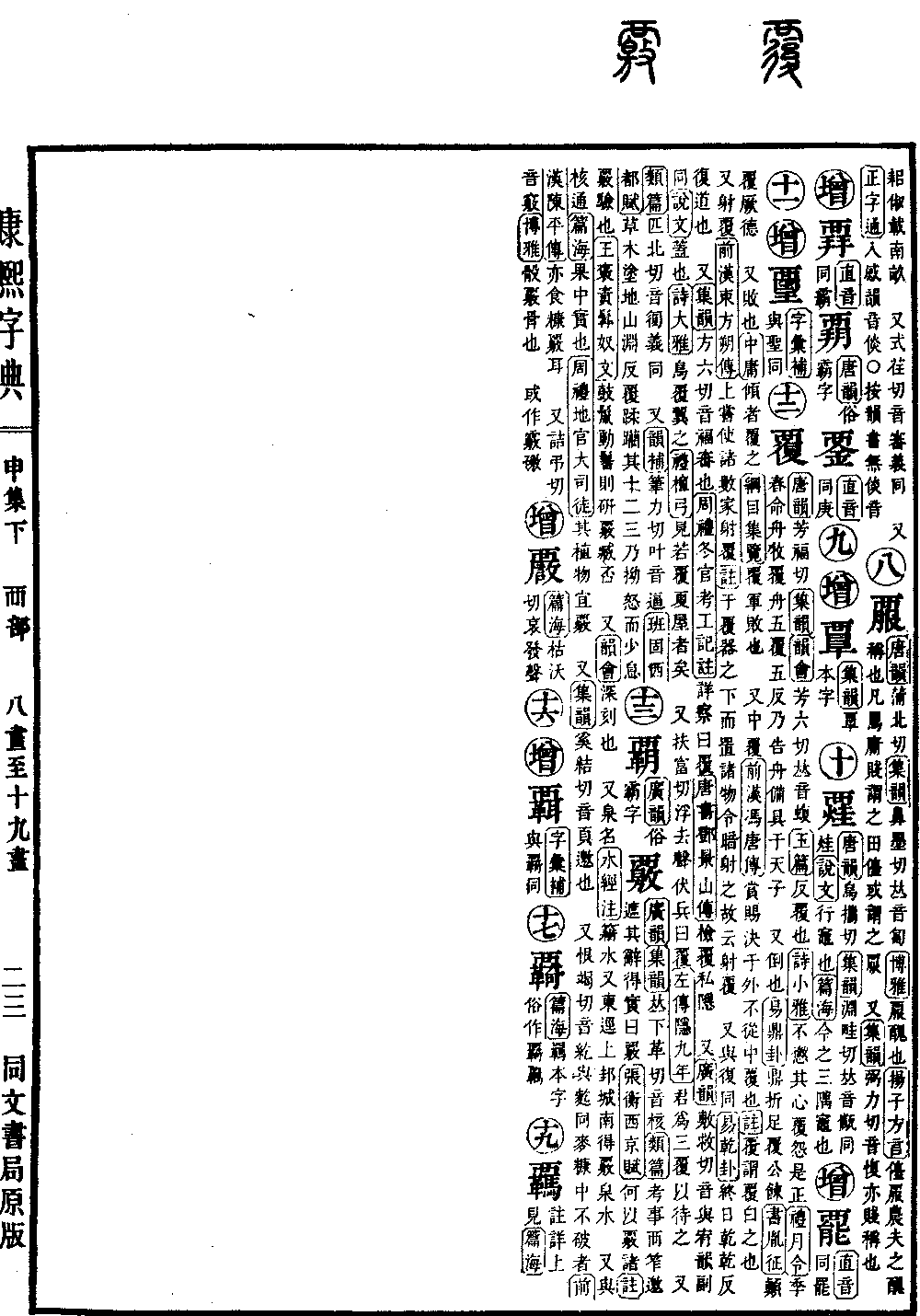
Shen Collection, Lower Volume
Radical: Cover (yà)
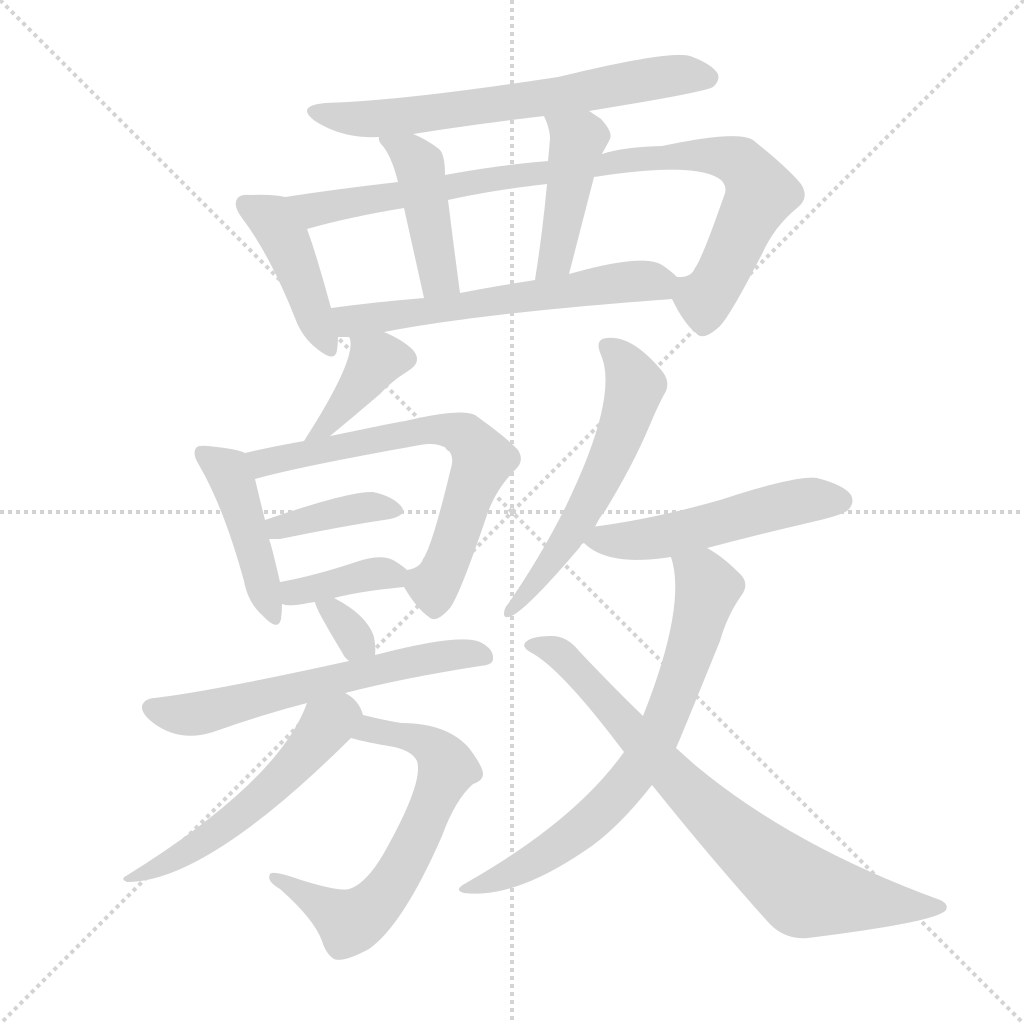
Character: he
Kangxi Stroke Count: 19
Page 1129, Entry 11
According to Guangyun (Broad Rhymes) and Jiyun (Collected Rhymes), pronounced he (rising tone).
According to Leipian (Classified Chapters), to examine facts and inquire from many sides until the truth is obtained is called he.
Zhang Heng, Western Metropolis Rhapsody (Xijing Fu): How can one verify (he) it?
Commentary: He means to verify.
Wang Bao, Text Reproaching the Bearded Slave: Moving the beard and hair, then meticulously examining the good and bad.
Also, according to Yunhui (Collection of Rhymes), it means profound or severe.
Also, the name of a spring.
Commentary on the Classic of Waterways (Shuijing Zhu): The Ji River flows eastward, passing south of the Shanggui city wall, where it receives the He Spring.
Also interchangeable with he (nut/seed).
According to Pianhai (Sea of Chapters), the hard shell of a fruit.
Rites of Zhou (Zhouli), Office of the Earth, Grand Minister of Instruction: Its plants are suitable for bearing fruits with hard shells.
Also, according to Jiyun, pronounced ye (falling tone). It means to invite.
Also, pronounced he (entering tone), same as he. Refers to unbroken grains found in wheat bran.
Book of Han (Hanshu), Biography of Chen Ping: Only eating husks and wheat bran.
Also, pronounced qiao (falling tone).
According to Guangya (Expanded Er-ya), touhe refers to bones.
Sometimes written in a variant form (qiao).
Verification: In Rites of Zhou, Office of the Earth, Grand Minister of Instruction, the phrase its plants are suitable for he has been updated to include the character for objects as per the original text.