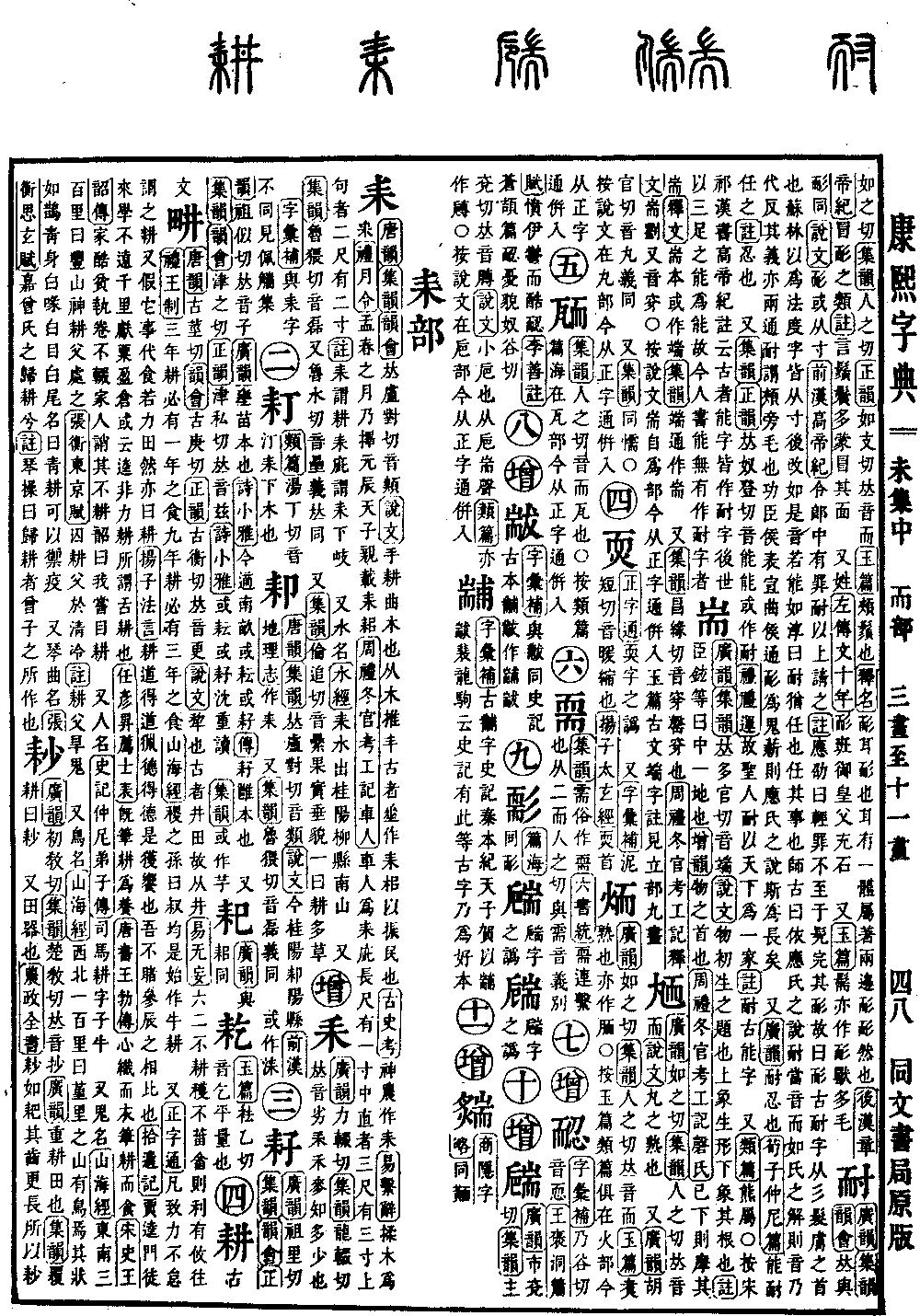
Wei Collection, Middle Volume
Radical: Plow (lěi)
Kangxi strokes: 10
Page 962, Entry 23
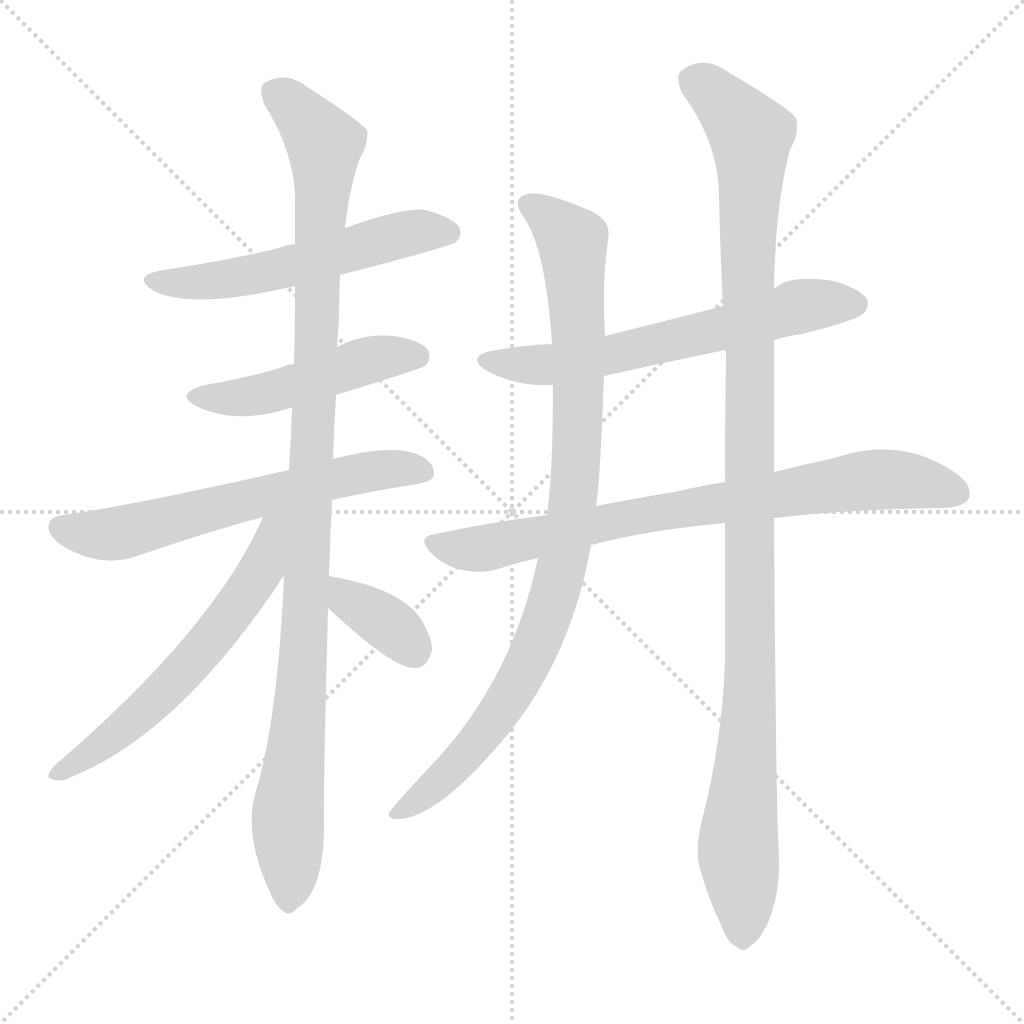
In ancient texts, it is written as a variant form (gēng).
Pronounced gēng.
Defined in Explaining Graphs and Analyzing Characters (Shuowen Jiezi) as turning over soil with a plow. In ancient times, the well-field system was implemented, hence the character is derived from the character for well.
I Ching (Yijing), Hexagram Wuwang, Line 2: If one does not plow and sow, one should not expect a harvest; if one does not clear the wild land, one should not expect to acquire mature fields. Thus, it is favorable to have a destination.
Book of Rites (Liji), Royal Regulations (Wangzhi): Records that after three years of plowing and sowing, one must have stored one year of grain; after nine years of plowing and sowing, one must have stored three years of grain.
Classic of Mountains and Seas (Shanhaijing): Records that the grandson of Ji, named Shujun, was the first person to use oxen to plow fields.
Correct Standard of Characters (Zhengzitong): Any effort made without slackening can be called plowing.
It also refers to using other tasks to make a living, similar to the effort of farming, also called plowing.
Yangzi: Discourse on Models (Fayan): Plowing and weeding through the Way leads to the acquisition of the Way; hunting for virtue leads to the acquisition of virtue. This is the true harvest. I do not see how the Orion star and the Scorpius star can be aligned together.
Record of Missing Matters (Shiyiji): Records that students of Jia Kui came to study from over a thousand miles away, bringing gifts of millet that filled his granaries. Some said that Jia Kui did not plow with physical labor, but made a living by teaching with his tongue, which is known as tongue-plowing.
Ren Fang: Memorial Recommending Scholars (Jianshibiao): States that one maintains a livelihood through brush-plowing.
Book of Tang (Tangshu), Biography of Wang Bo: States that one weaves with their heart to obtain clothing, and plows with a brush to obtain food.
History of Song (Songshi), Biography of Wang Shao: Records that Wang Shao’s family was very poor, yet he never set aside his books. His family mocked him for not plowing the fields. Wang Shao said: I am plowing and studying with my eyes.
Also used as a person's name.
Records of the Grand Historian (Shiji), Biographies of Confucius's Disciples: Records Sima Geng, courtesy name Ziniu.
Also the name of a spirit.
Classic of Mountains and Seas (Shanhaijing): Records that three hundred miles to the southeast lies Feng Mountain, where a spirit named Gengfu resides.
Zhang Heng: Eastern Capital Rhapsody (Dongjingfu): States that Gengfu was imprisoned in cold water. Annotation explains: Gengfu is a spirit that causes drought.
Also the name of a bird.
Classic of Mountains and Seas (Shanhaijing): Records that one hundred miles to the northwest is Jinli Mountain, which is home to a bird shaped like a magpie with a blue body, white beak, white eyes, and white tail. It is named Qinggeng and can ward off plagues.
Also the name of a zither melody.
Zhang Heng: Rhapsody on Reflecting on the Mystery (Sixuanfu): Praises the ambition of Zengzi to retire and plow. Annotation explains: The Zither Manual (Qincao) records that the melody Returning to Plow was composed by Zengzi.