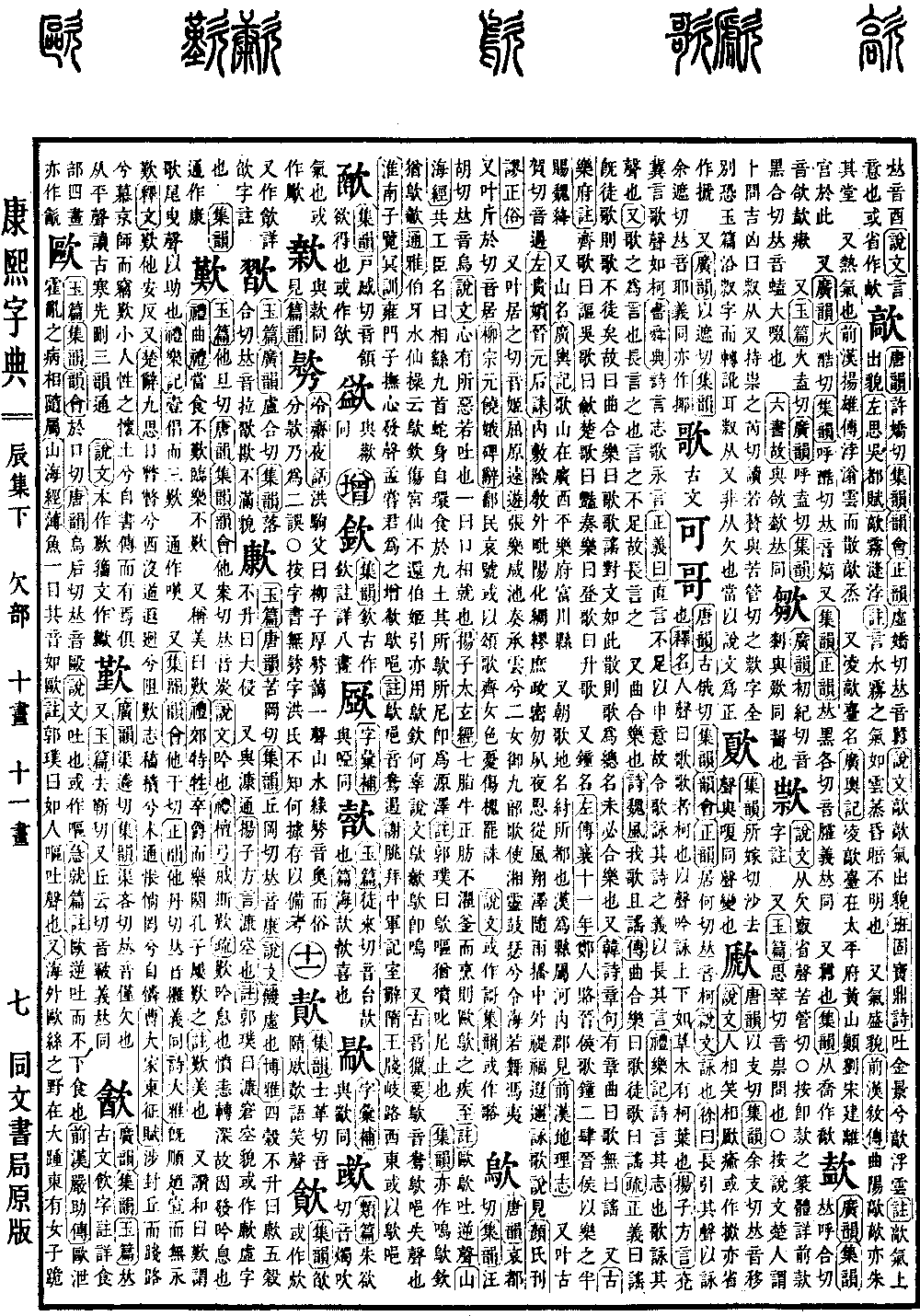
Chen Collection, Lower Volume
Radical: Lack (qiàn)
Kangxi Strokes: 14
Page 571, Entry 07
Ancient form: ke (resembling brother). Tang Dynasty Rhymes: pronounced ge. Collected Rhymes, Rhyme Compendium, Correct Rhymes: pronounced he (level tone), sounds like ke.
Explanation of Characters (Shuowen Jiezi): To chant.
Xu states: To lengthen and draw out the voice to chant.
Explanation of Names (Shiming): Human vocalization is called ge. Ge is like a branch (ke); by chanting the voice up and down, it is like the branches and leaves of plants.
Yang Xiong's Regional Expressions (Fangyan): In the Yan and Ji regions, singing is called ge, with a sound like ke.
Book of Documents (Shujing), Canon of Shun: Poetry expresses intent, singing lengthens the words.
Correct Meaning (Zhengyi): Straight speech is insufficient to fully express intent, therefore one sings the meaning of the poem to lengthen the words.
Book of Rites (Liji), Record of Music: Poetry expresses its intent, singing chants its sounds.
Also: To sing is to lengthen the speech. If speech is insufficient, one lengthens the speech. It also refers to a melody set to music.
Book of Odes (Shijing), Odes of Wei: I sing and chant.
Commentary: A melody set to music is called ge; singing without music is called yao.
Sub-commentary: Correct Meaning states: Since yao is singing without music, ge must be with music. This is the distinction between ge and yao in juxtaposition; when used separately, ge is the general term and does not necessarily require music.
Also: Han Shi Zhangju: That which has structure and melody is called ge; that without is called yao.
Also: Notes on Ancient Music Bureau (Gu Yuefu): Songs of Qi are called ou; songs of Wu are called yu; songs of Chu are called yan. Performing music is called dengge or shengge.
Also: Name of a bell.
Zuo Tradition (Zuo Zhuan), 11th Year of Duke Xiang: The people of Zheng bribed the Marquis of Jin with two sets of chime bells, and the Marquis of Jin bestowed half of the music upon Wei Jiang.
Also: Name of a mountain.
Comprehensive Records of Geography (Guangyu Ji): Ge Mountain, located in Fuchuan County, Pingle Prefecture, Guangxi.
Also: Zhaoge, a place name, the capital of King Zhou of Shang. In the Han Dynasty, it was a county belonging to Henei Commandery. See History of the Former Han (Qianhan), Treatise on Geography.
Also: Pronounced guo (falling tone).
Zuo Si, Eulogy for the Empress of Jin: Inside, she spread feminine teachings; outside, she assisted in solar transformation. She handled various administrative affairs meticulously day and night. Her grace flew with the wind, and her kindness spread with the rain. Inside and outside enjoyed peace and blessings, and far and near sang praises. (Explanation found in Yan Zhitui, Correcting Errors and Customs).
Also: Pronounced ji (level tone).
Qu Yuan, Distant Wandering: Performing the music of Xianchi and playing the Chengyun, the two maidens attend the Nine Shao, singing, commanding the Xiang spirit to pluck the zither, and ordering the sea god to dance like Feng Yi.
Also: Pronounced ju (level tone).
Liu Zongyuan, Rhymed Prose for Rao E: The people of Bo wailed and mourned, some singing hymns. The women of Qi were troubled by sorrow, harming the locust trees and stopping the executions.
Explanation of Characters (Shuowen Jiezi): Sometimes written as ge.
Collected Rhymes: Sometimes written as ge.