Wu Collection, Upper Volume
Radical: Jade (yù)
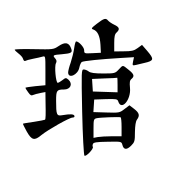
Guan; Kangxi stroke count: 13; Page 735, Entry 05
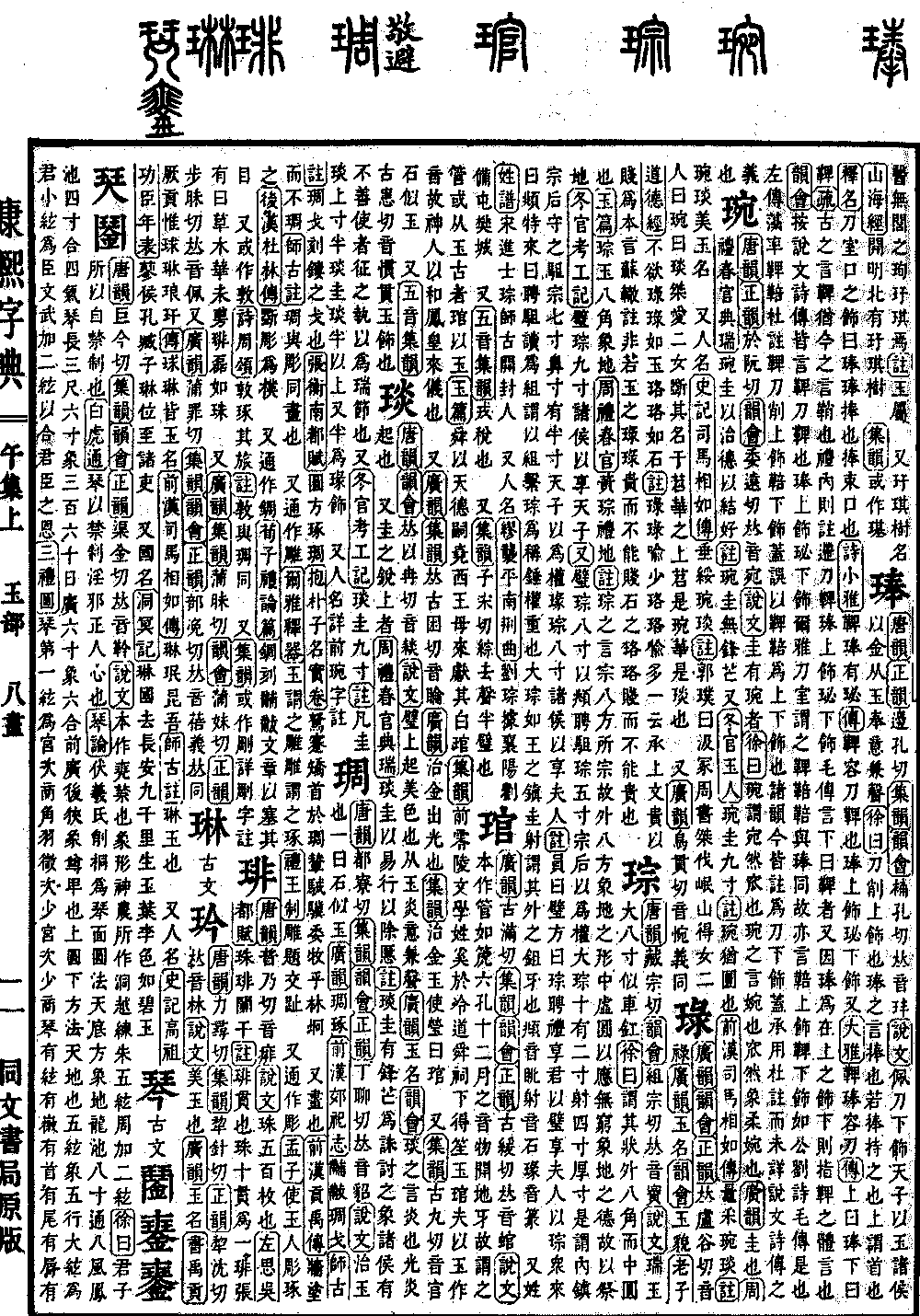
According to the Extensive Dictionary of Sounds (Guangyun), pronounced guan. According to the Collected Dictionary of Sounds (Jiyun), the Rhyme Collection (Yunhui), and the Correct Rhymes (Zhengyun), pronounced guan. According to the Explaining Graphs and Analyzing Characters (Shuowen), it was originally written as the character for pipe/tube. It is like a six-holed flute, representing the sounds of the twelve months, symbolizing the opening of seeds within the earth, hence it is called a pipe. Sometimes it is written with the jade radical. In ancient times, the pipe was made of jade. According to the Jade Compendium (Yupian), when Shun succeeded Yao by the virtue of heaven, the Queen Mother of the West came to present her white jade pipe. According to the Collected Dictionary of Sounds (Jiyun), a former scholar of Lingling with the surname Xi found a sheng instrument made of jade pipes at the Shun shrine in Lengdao; because jade was used to create the sound, the spirits and humans were harmonized, and the phoenix came to perform its rites.
Also, according to the Extensive Dictionary of Sounds (Guangyun) and the Collected Dictionary of Sounds (Jiyun), pronounced gun. According to the Extensive Dictionary of Sounds (Guangyun), to refine metal until it shines. According to the Collected Dictionary of Sounds (Jiyun), to polish metal or jade until it is lustrous is called guan.
Also, according to the Collected Dictionary of Sounds (Jiyun), pronounced guan. A stone resembling jade.
Also, according to the Five Sounds Collected Dictionary (Wuyin Jiyun), pronounced guan. To string jade ornaments together.