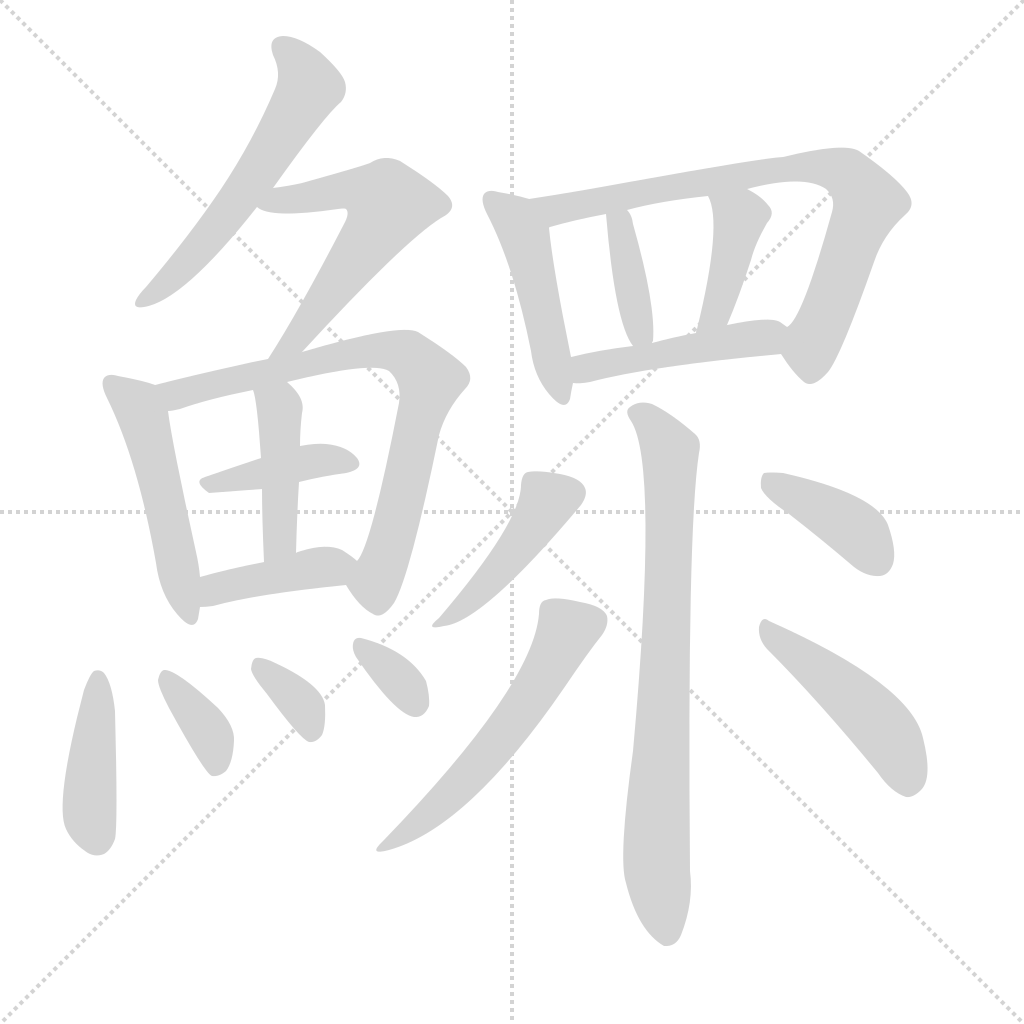
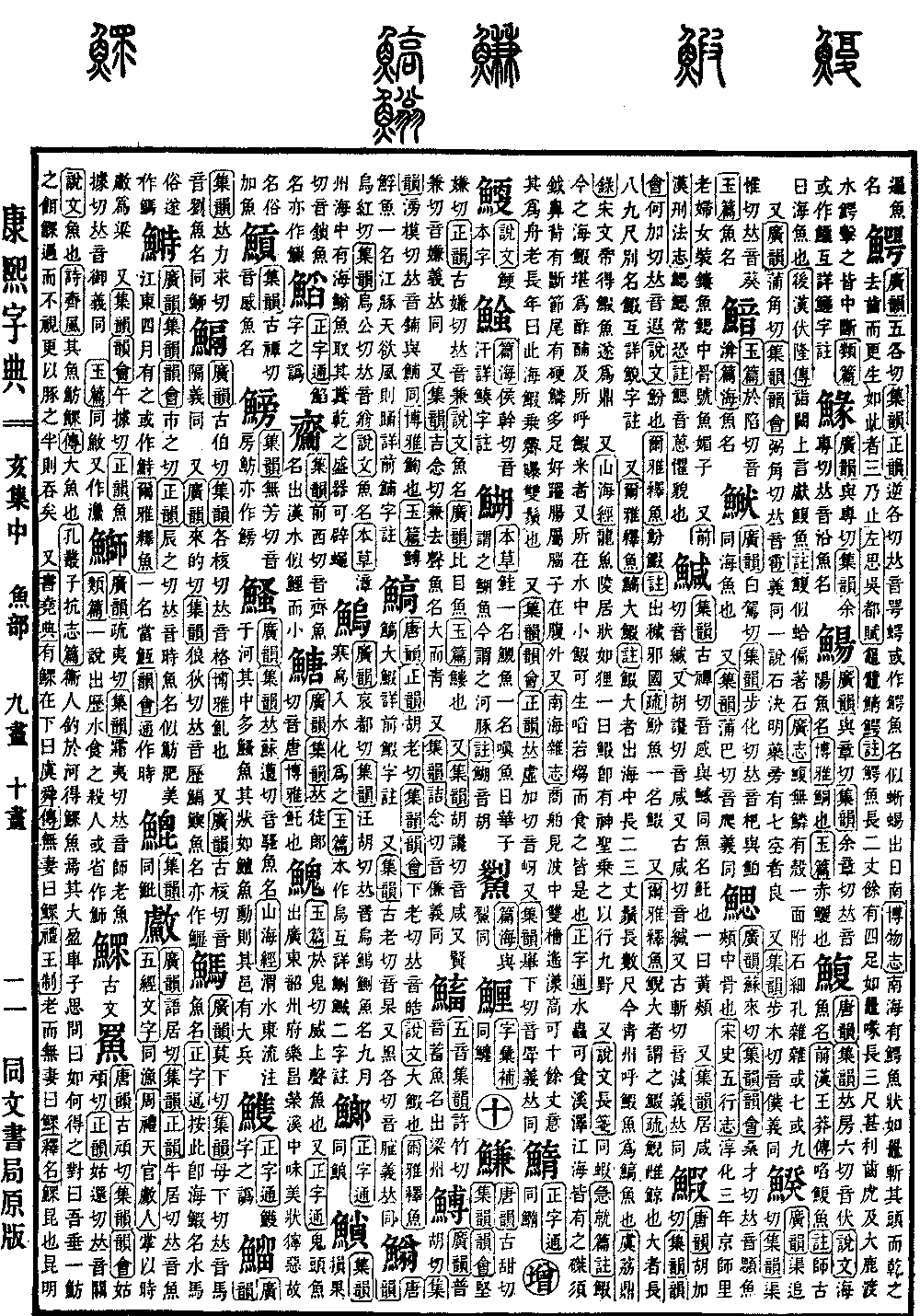
Hai Collection, Middle Volume
Radical: Fish (yú)
Character: Guan
Kangxi strokes: 21
Page 1475, Entry 40
Ancient character interpretation: According to the Tang Rhyme, pronounced guan. According to the Collected Rhymes (Jiyun) and the Rhyme Anthology (Yunhui), pronounced guan. According to the Correct Rhyme (Zhengyun), pronounced guan. The pronunciation is the same as guan. The Explaining Graphs and Analyzing Characters (Shuowen Jiezi) defines it as a type of fish. In the Book of Odes (Shijing), Qi Odes (Qi Feng), there is the line: The fish are bream and guan. Mao’s Commentary (Mao Zhuan) notes that this refers to a large fish. The Kong Family Records (Kongcongzi), Resistance of Ambition Chapter, records: A man in the State of Wei was fishing in the Yellow River and caught a guan fish so large it could fill a carriage. Zisi asked him: How did you catch it? The man replied: At first I used a bream as bait, but the guan fish passed by without looking; later I changed to half a piglet as bait, and it swallowed the hook. Also, the Book of Documents (Shangshu), Canon of Yao (Yaodian), records: There is a guan among the people called Yu Shun. Kong’s Commentary (Kong Zhuan) explains: Someone without a wife is called guan. The Book of Rites (Liji), Royal Regulations (Wangzhi), states: An old man without a wife is called guan. Explaining Names (Shiming) explains: Guan means kun. Kun means bright. One is so worried and distressed that one cannot sleep, and the eyes are always wide open. Therefore, the character is composed with the fish radical, because a fish’s eyes are never closed. The White Tiger Hall Discussions (Baihu Tong) states: The character guan represents a state of being alone and without support, having no relatives, while gua means few. Also, according to the Collected Rhymes (Jiyun), pronounced kun. It is the same as the character kun. The Erya (Erya), Explaining Fish Commentary (Shiyu Shu), states: Guan refers to fish fry. Guan and kun have different character forms, but were likely interchangeable in ancient times. It is also interchangeable with the character guan. The Erya (Erya), Explaining Words (Shigu), explains: Guan means sickness. Zheng Qiao’s Commentary (Zheng Qiao Zhu) states: Guan is the same as guan. Also, according to the Extensive Rhymes (Guangyun) and Collected Rhymes (Jiyun), pronounced guan. It is the appearance of looking. Sometimes also written in a variant form. Also, the rhyme follows the zhen category. The Songs of Chu (Chuci), Heavenly Questions (Tianwen), contains the lines: Shun was pained at home, why did his father treat him as a widower. Yao did not unite with Yao, how were the two daughters intimate.