You Collection, Upper Volume
Radical: See (jiàn)
Kangxi Strokes: 25
Page 1138, Entry 14
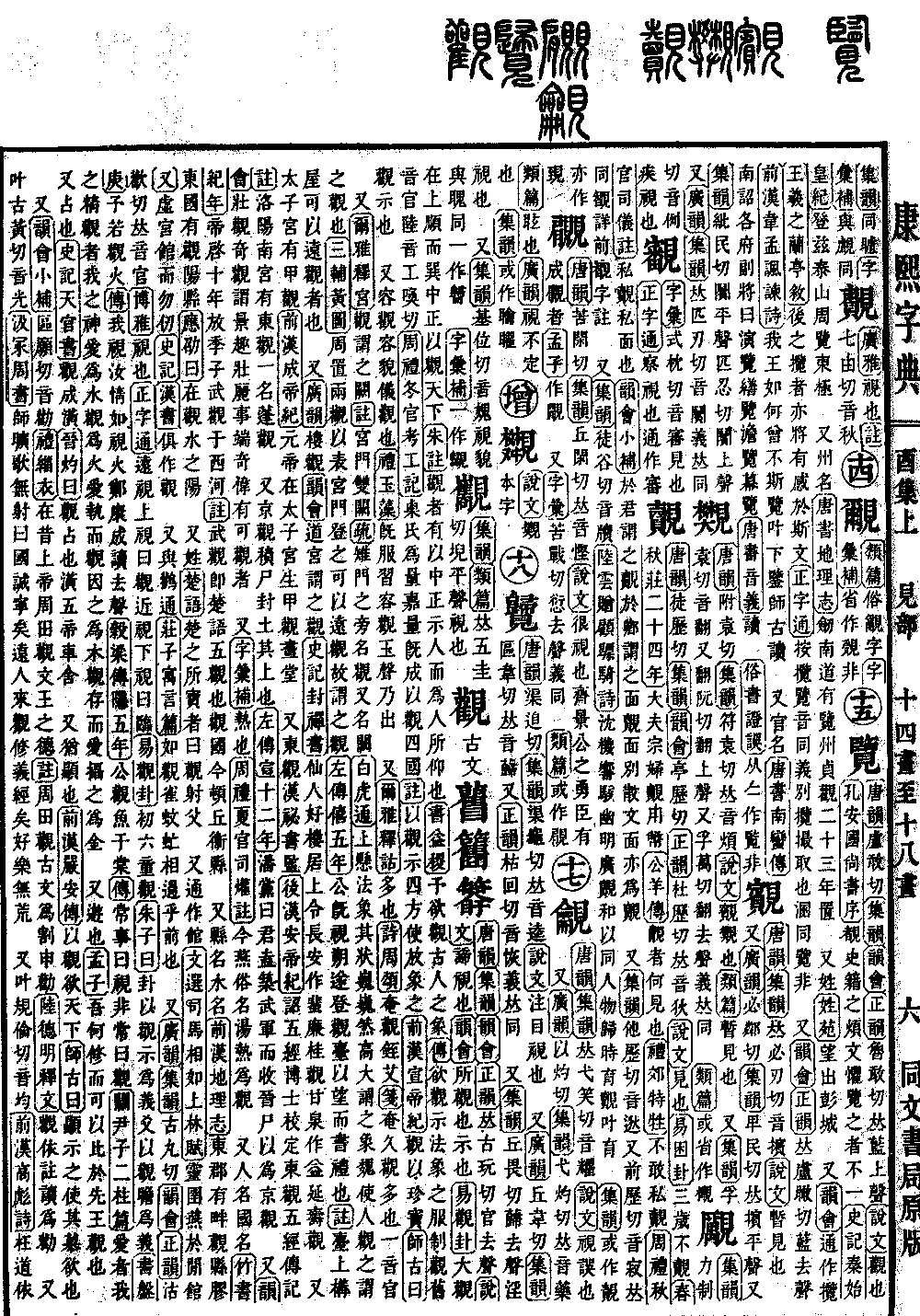
Ancient text. Pronounced guan (departing tone). According to the Explaining and Analyzing Characters (Shuowen Jiezi), to look carefully. According to the Collection of Rhymes (Yunhui), the object observed; to display. In the Book of Changes (Yijing), Guan Hexagram: The great vision is above; submissive yet humble, observing the world with the way of the center and correctness. Zhu Xi's commentary: Guan refers to displaying oneself to others through the way of the center and correctness, so as to be revered. In the Book of Documents (Shujing), Yiji section: I wish to see the images of the ancients. Commentary: I wish to view and display the ritual garments and institutional standards. Guan was historically pronounced guan; Lu Deming's phonetic gloss is gong (first tone) and huan (first tone). In the Rites of Zhou (Zhouli), Winter Official, Artificers' Record: The officer manufactures measuring vessels. Once the standard measuring vessels are made, they are used to display to the feudal states of the four directions. Commentary: Used to show to the four directions so they may imitate the production. In the History of the Former Han (Qian Han Shu), Chronicle of Emperor Xuan: To display precious treasures for others to see. Shigu says: Guan means to display. Also refers to appearance or demeanor. In the Book of Rites (Liji), Jade Pattern: One should only go out after dressing neatly, practicing one's demeanor, and ensuring the sound of the jade pendants is harmonious. Also, according to the Erya (Erya), Meaning of Words: Many. In the Book of Odes (Shijing), Zhou Eulogies: For a long time seeing many reaping sickles. Jian commentary: Yan means long-lasting. Guan means many. Another pronunciation is guan (first tone). Also, according to the Erya, Meaning of Names of Palaces: A watchtower is called a que. Commentary: The towers on both sides of a palace gate. Sub-commentary: The side of the Zhi Gate is called a guan. Also called a que. In the White Tiger Hall Discussions (Baihu Tong), because legal decrees and images are hung above, and the shape is tall and majestic, it is called xiangwei. People view it, therefore it is called a guan. In the Three Capitals Yellow Map (Sanfu Huangtu), the Zhou dynasty established two watchtowers to mark the palace gate. One can climb them to look into the distance, therefore they are called guan. In the Zuo Tradition (Zuo Zhuan), fifth year of Duke Xi: After the ruler held the ancestral rites and heard state affairs on the first day of the month, he climbed the watchtower to observe the clouds and record them, which is in accordance with ritual. Commentary: A building constructed upon a terrace for viewing distant things. Also, according to the Extensive Dictionary of Rhymes (Guangyun): A storied building or temple. According to the Collection of Rhymes (Yunhui), Daoist temples are called guan. In the Records of the Grand Historian (Shiji), Treatise on the Feng and Shan Sacrifices: Immortals like to dwell in high buildings; the Emperor ordered the construction of the Feilian Guan and Gui Guan in Chang'an, and the Yiyanshou Guan in Ganquan. Also, the Crown Prince's palace had the Jia Guan. In the History of the Former Han, Chronicle of Emperor Cheng: When Emperor Yuan was in the Crown Prince's palace, he was born in the Jia Guan Painted Hall. Also, Dong Guan was the secretarial archive of the Han dynasty. In the History of the Later Han (Hou Han Shu), Chronicle of Emperor An: An edict ordered the Five Classics scholars to collate the Five Classics commentaries at the Dong Guan. Commentary: The southern palace of Luoyang had the Dong Guan. Another name is Peng Guan. Also, Jing Guan is a high tumulus formed by piling up enemy corpses and covering them with earth. In the Zuo Tradition, twelfth year of Duke Xuan: Pan Dang said: Why does the ruler not build a camp and collect the corpses of the Jin army to construct a Jing Guan? Also, according to the Collection of Rhymes (Yunhui), zhuangguan or qiguan refers to majestic scenery or strange and magnificent events worth viewing. Also, according to the Supplement to the Categorized Dictionary (Zihuibu), it also means guan (a beacon fire). In the Rites of Zhou, Summer Official, Director of Beacons commentary: In the current customs of the Yan region, hot water is called guan. Also used for personal names or country names. In the Bamboo Annals (Zhushu Jinian), tenth year of Emperor Qi: Banished the younger son Wuguan to the west of the river. Commentary: Wuguan is the Five Guan mentioned in the Discourses of Chu (Chu Yu). The state of Guan is in the present-day Dunqiu Wei County. Also a county name and a water name. In the History of the Former Han, Treatise on Geography: Dong Commandery has Panguan County; Jiaodong Kingdom has Guanyang County. Ying Shao says: Located north of the Guan River. Also a surname. In the Discourses of Chu: Among the treasures valued by the state of Chu, there was a person named Guan Shefu. Also used interchangeably with guan (lodging/hall). In the Selections of Refined Literature (Wenxuan), Sima Xiangru's Rhapsody on the Shanglin Park: The spirits dwell peacefully in the halls. Also: Leaving the palace halls empty and unfilled. The Records of the Grand Historian and the History of the Former Han both write it as guan. Also interchangeable with guan (stork). In the Zhuangzi (Zhuangzi), Chapter of Metaphors: Just like watching sparrows, mosquitoes, and gadflies flying past. Also, according to the Extensive Dictionary of Rhymes (Guangyun) and Collection of Rhymes (Yunhui), pronounced guan (first tone). According to the Boya (Boya): To see. According to the Correct Meaning of Characters (Zhengzitong): Looking from a distance or looking upward is called guan; looking from a close distance or looking downward is called lin. In the Book of Changes, Guan Hexagram, initial six line: Viewing like a child. Zhu Xi says: The hexagram means to display, the line means to observe. In the Book of Documents, Pan Geng section: I look at your situation as clearly as looking at a fire. Commentary: I look at your situation as clearly as looking at a fire. Zheng Kangcheng reads it in the departing tone. In the Guliang Tradition (Guliang Zhuan), fifth year of Duke Yin: Duke Yin of Lu observed fishing in Tang. Commentary: Ordinary events are called shi, extraordinary events are called guan. In the Guan Yinzi (Guan Yinzi), Two Pillars chapter: Love is my essence, guan is my spirit. Love is water, guan is fire. If love is persistent and one observes, it combines to form wood. If guan exists and there is love, it gathers to form metal. Also means to travel or tour. In the Mencius (Mengzi): How can I cultivate myself to compare with the tours of the former kings? Also means to divine or observe. In the Records of the Grand Historian, Treatise on the Celestial Offices: Observing the Cheng Huang star. Jin Zhuo says: Guan means to divine or observe; Huang is the carriage house of the Five Emperors. Also means to appear or manifest. In the History of the Former Han, Biography of Yan An: Used to manifest desires to the world. Shigu says: To display to them and make them yearn for it. Also, according to the Supplement to the Collection of Rhymes: Pronounced quan (departing tone). In the Book of Rites, Black Robes: Formerly the Emperor observed the virtues of King Wen in detail and encouraged him. Commentary: Zhou Tian Guan, in ancient script is written as ge shen quan. Lu Deming, Explication of Text: Guan, according to the commentary, is read as quan. Also rhyming with guang (first tone). In the Collected Zhou Books (Jizhong Zhou Shu), Shi Kuang sang the Wushe mode, saying: The state is truly peaceful, and people from afar come to view it. To cultivate morality is to make it a common law; to love music but not neglect one's duties. Also rhyming with jun (first tone). In the History of the Former Han, poem by Gao Biao: Violating the proper path to cling to the powerful, and there is nothing to view. The noble integrity of the ancestors should be followed forever. Also rhyming with juan (first tone). In Fu Yi's Seven Stimuli: Investigating deep things, exhausting similar categories, nothing is not extensively viewed. Bright and beautiful, the world respects his words. Also rhyming with juan (departing tone). In Yang Xiong's Ganquan Rhapsody: The great mansions are as tortuous and strange as clouds and waves, gathering many materials to build a tower. Looking up high, the eyes grow dizzy and see nothing. Also, Book of Odes, Lesser Odes: Those bream and dace, caught and viewed, are indeed many. Jian commentary: Guan means many. Han Poetry (Han Shi) writes it as du. Correction: Zhu Xi's commentary does not contain the statement that guan rhymes with zhu. Rhyming with zhang and yu is the pronunciation of the character zhe, not guan. I have revised it to: Also, Book of Odes, Lesser Odes: Those bream and dace, caught and viewed, are indeed many. Jian commentary: Means many. Han Poetry writes it as du.