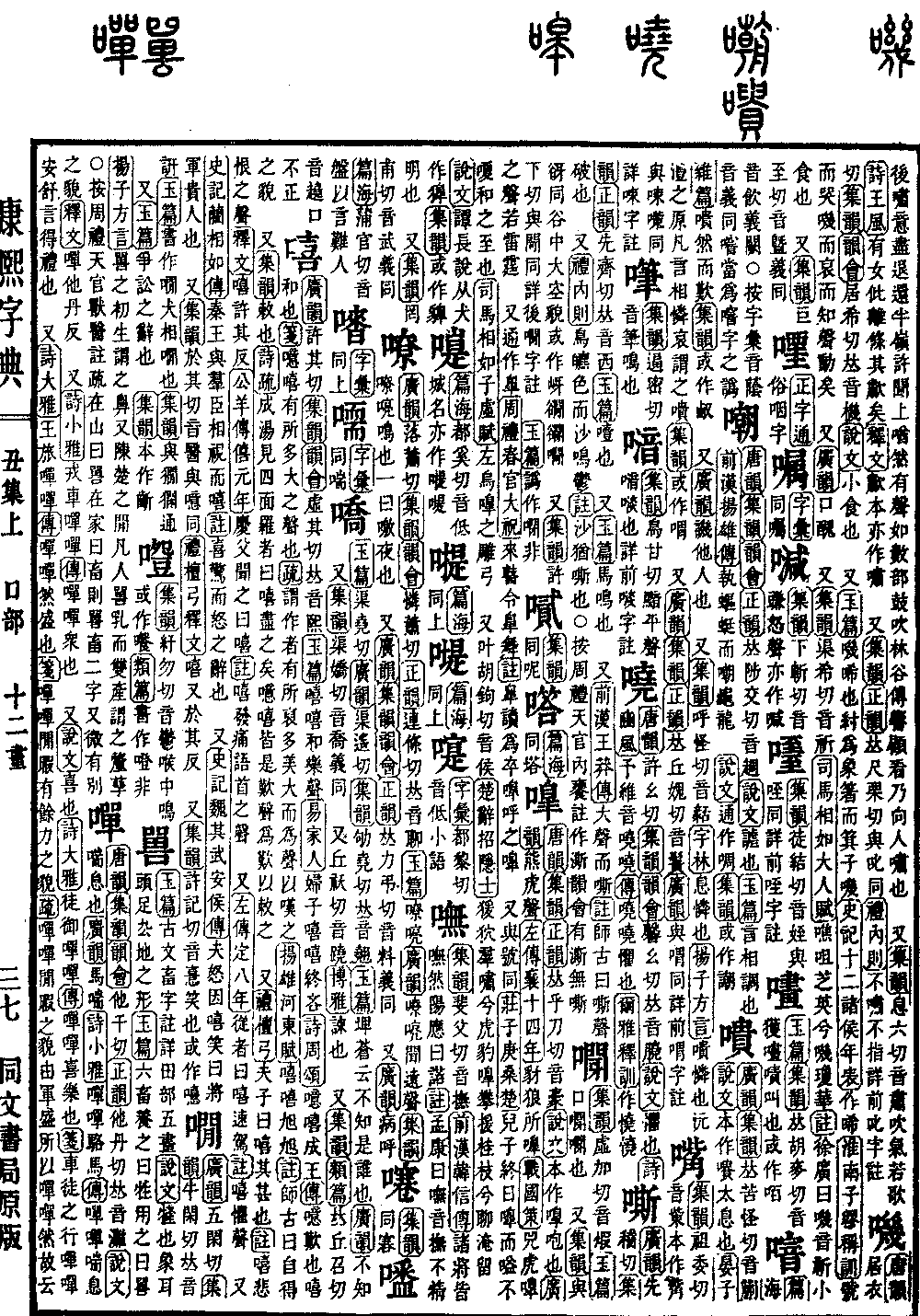
Chou Collection, Upper Volume
Radical: Mouth (kǒu)
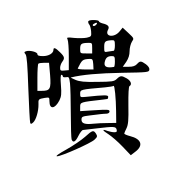
kui
Kangxi strokes: 15
Page 207, Entry 09
Broad Rhymes (Guangyun) and Collected Rhymes (Jiyun): pronounced kuai.
Origin of Characters (Shuowen): originally written as [variant], meaning to sigh deeply.
Master Yan (Yanzi): Miscellaneous Chapters (Zapian): Sighed with a deep breath.
Collected Rhymes (Jiyun): sometimes written as [variant].
Broad Rhymes (Guangyun): to ridicule others.
Collected Rhymes (Jiyun): pronounced kuai.
Word Forest (Zilin): to pity or love.
Master Yang (Yangzi): Regional Dialects (Fangyan): Kui means to pity; in the regions of the Yuan and Li rivers, whenever one speaks of pitying or mourning someone, it is called kui.
Collected Rhymes (Jiyun): sometimes written as kui.
Broad Rhymes (Guangyun), Collected Rhymes (Jiyun), and Correct Rhymes (Zhengyun): pronounced kui.
Broad Rhymes (Guangyun): same as kui. Refer to the previous note for the character kui.