Hai Collection, Middle Volume
Radical: Bird (niǎo)
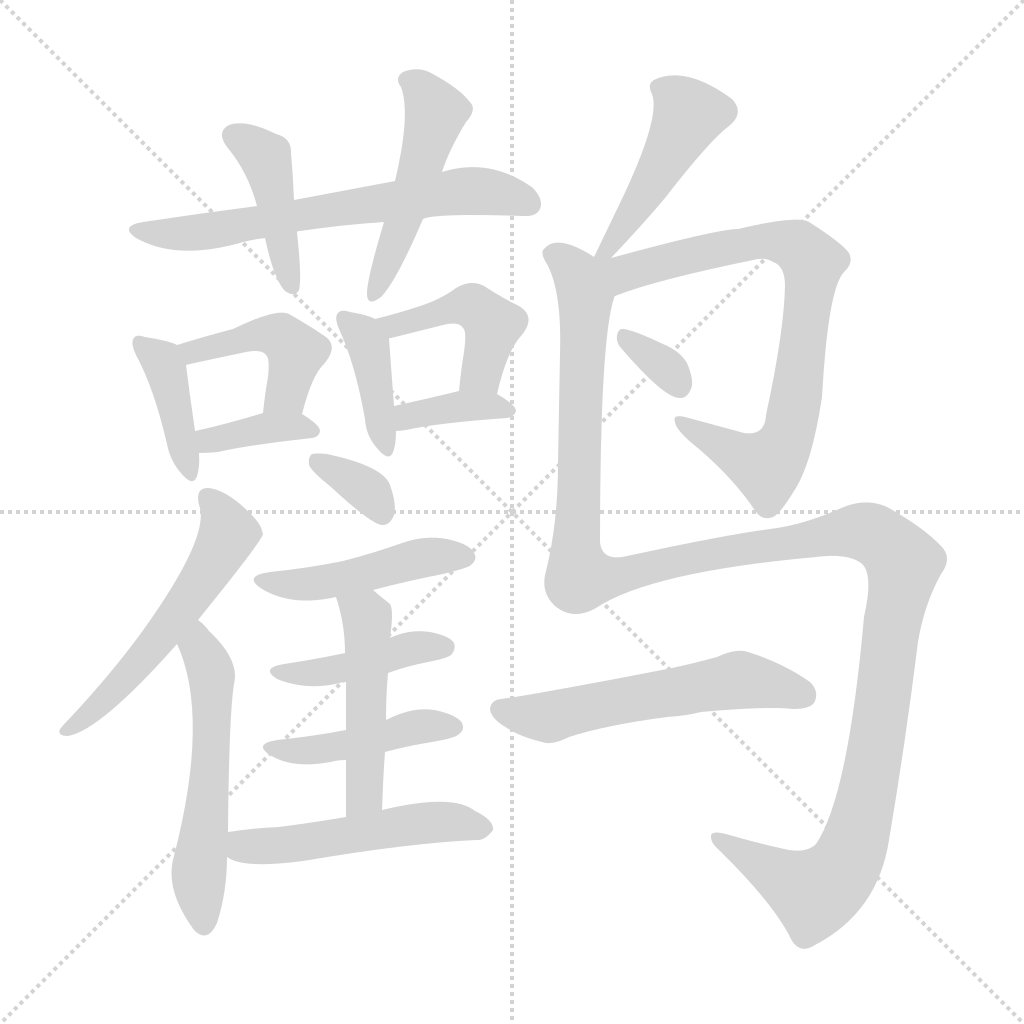
Character: Stork
Kangxi Strokes: 29
Page 1504, Entry 01
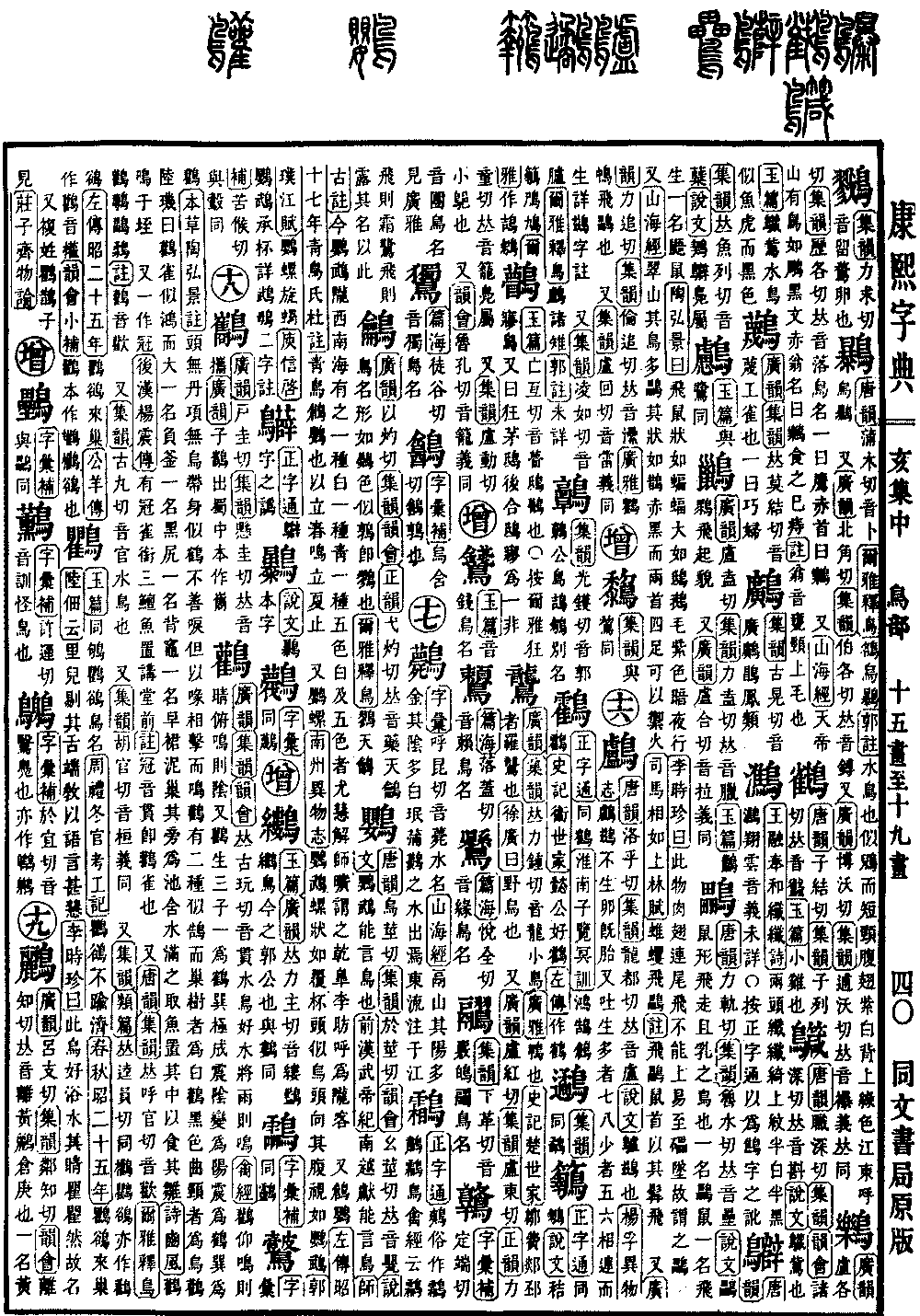
Guangyun, Jiyun, and Yunhui dictionaries state it is pronounced guan (falling tone). It is a water bird. It likes water and cries when rain is approaching. The Classic of Birds (Qin Jing) states that when a stork cries with its head raised, it will be clear, and when it cries with its head lowered, it will be overcast. Furthermore, the stork gives birth to three young; one becomes a crane. When the wind (xun) reaches its extreme, it transforms into thunder (zhen); the yin changes into yang, thus thunder becomes a crane and wind becomes a stork.
The commentator Tao Hongjing of the Materia Medica (Bencao) notes: Its head lacks red coloring, its neck has no black band, its body resembles a crane, and it does not cry well, but clacks its beak together to make a sound. There are two types of storks: those that resemble the pelican and nest in trees are called white storks, and those with black feathers and curved necks are called black storks. Lu Ji stated: The stork resembles a wild goose but is larger. It is also called pot-bearer (fu-fu), black-rump (hei-kao), stove-back (bei-zao), and early-skirt (zao-qun). They build nests of mud and make a pond beside them, filling it with water and placing fish inside to feed their chicks.
Book of Odes (Shijing), Odes of Bin: The stork cries on the anthill.
It is also written as the character for crown (guan). Book of the Later Han (Houhan Shu), Biography of Yang Zhen: A crown-bird held three large carp in its beak and placed them before the lecture hall. The commentary states: Crown is pronounced guan (falling tone), which is the same as the stork.
Tangyun and Jiyun dictionaries state it is pronounced huan (level tone). Er Ya, Interpretation of Birds: The stork (huan-qi) is the same as the (fu-rou). The commentary states: Stork is pronounced huan (level tone).
Jiyun dictionary states it is pronounced guan (level tone). It is a water bird.
Jiyun dictionary states it is pronounced huan (level tone). The meaning is the same.
Jiyun and Leipian dictionaries state it is pronounced quan (rising tone). It is the same as the crested myna (qu-yu), which is also written as (guan-yu). Zuo Commentary (Zuo Zhuan), 25th Year of Duke Zhao: The crested mynas came to nest. The Gongyang Commentary uses the character for stork, pronounced quan (rising tone). The Yunhui Xiaobu dictionary states that the crested myna was originally written as (qu-yu).