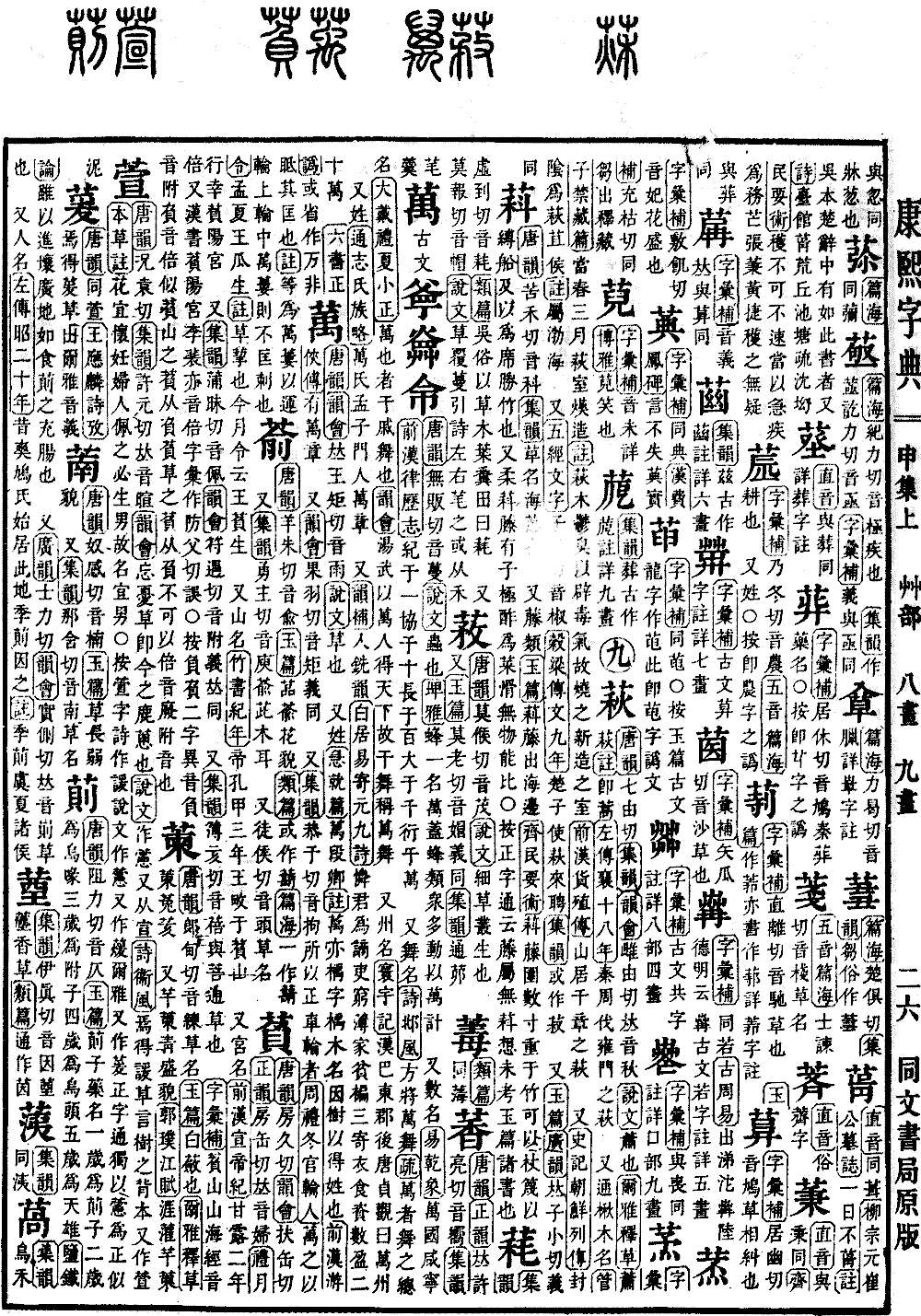
Shen Collection, Upper Volume
Radical: Grass (cǎo)
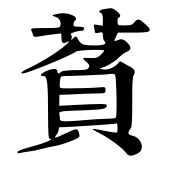
Fu
Kangxi strokes: 15
Page 1042, Entry 39
Pronounced fu (falling tone).
Book of Rites (Liji), Monthly Ordinances (Yueling): In the first month of summer, the snake gourd grows. Note: This is the plant qia. Now the Monthly Ordinances state: The wangfu grows.
Also, a mountain name. Bamboo Annals (Zhushu Jinian): In the third year of Emperor Kongjia, the king hunted at Mount Fu.
Also, a palace name. History of the Former Han (Qianhan shu), Biography of Emperor Xuan: In the second year of the Ganlu era, he visited Fuyang Palace.
Also, pronounced pei (falling tone).
Also, pronounced fu (falling tone). The meaning is the same.
Also, pronounced bei (falling tone). Interchangeable with pu. A grass.
Dictionary Supplement (Zihuibu): Regarding Mount Fu, the Classic of Mountains and Seas (Shanhaijing) records the pronunciation as bei. Regarding the Fuyang Palace in the History of the Han, Li Pei also records the pronunciation as bei. The Dictionary Supplement records it as fang-fu, which is an error. Note: The characters fu and bei have different pronunciations. Fu is pronounced fu (falling tone), and bei is pronounced bei (falling tone). It seems the fu in Mount Fu follows the pronunciation of bei, while the fu in the plant fu follows the pronunciation of fu (falling tone). The pronunciation of fu (falling tone) should not be discarded because of the pronunciation of bei. The character qia was originally written with the component qie.