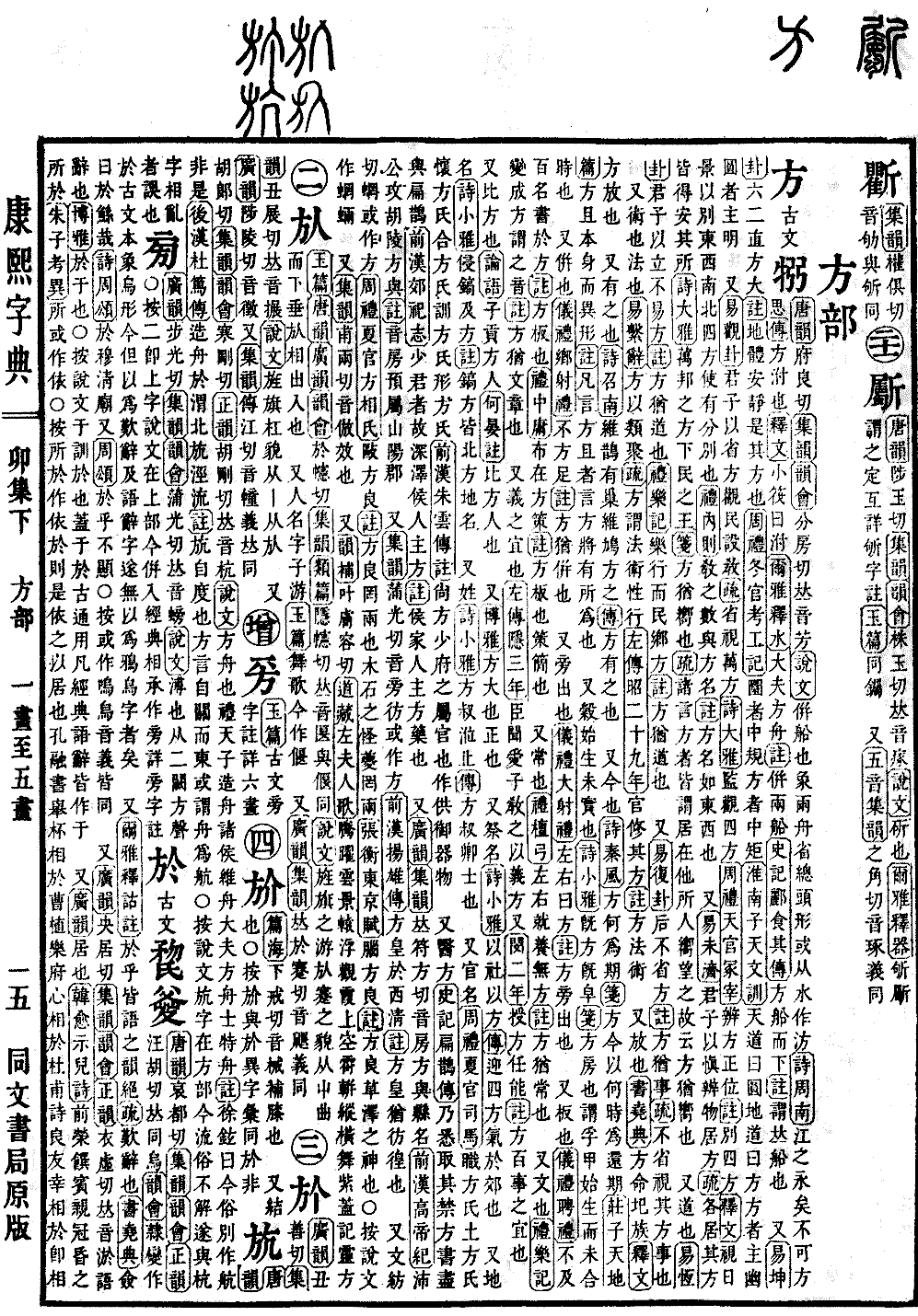
Mao Collection, Lower Volume
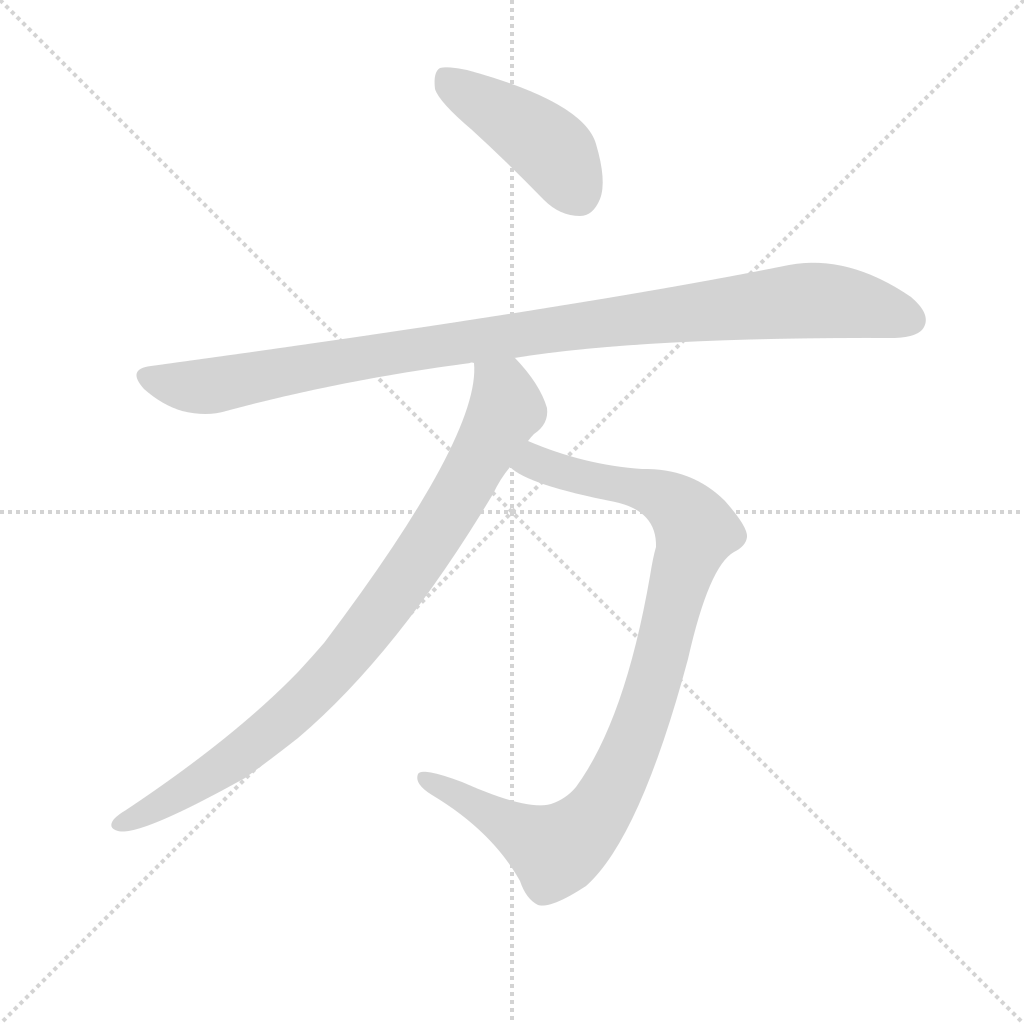
Radical: Square (fāng)
Page 481, Entry 03
Ancient form. Pronounced fang.
According to the Explaining Graphs and Analyzing Characters (Shuowen Jiezi), it refers to two boats joined together. It depicts the shape of two boats joined at their heads. Sometimes written with the water radical as a variant.
Book of Odes (Shijing), Zhou Nan section: The Jiang is long, one cannot cross it. The commentary states: Fang means a raft. The Explaining Texts (Shiewen) says: A small raft is called a fu.
Book of Rites (Erya), Explaining Water section: A high official uses joined boats. The commentary states: Joining two boats together.
Records of the Grand Historian (Shiji), Biography of Li Yiji: Navigating downstream with joined boats. The commentary states: Refers to joining boats together.
Also, Book of Changes (Yijing), Kun Hexagram, Six Two line: Straight, square, and great. The commentary states: The nature of the earth is to be quiet and still, which is its squareness.
Book of Rites (Zhou Li), Winter Official, Artificers' Record: That which is round should follow the compass, that which is square should follow the square rule.
Huainanzi, Treatise on Astronomy: The way of heaven is round, the way of earth is square. Squareness belongs to the dim and dark, roundness belongs to the bright and clear.
Also, Book of Changes (Yijing), Guan Hexagram: The superior man by inspecting the regions (fang) observes the people and establishes teachings. The sub-commentary states: To inspect all the regions.
Book of Odes (Shijing), Greater Odes: He inspects the four regions.
Book of Rites (Zhou Li), Heaven Official, Prime Minister: Distinguish the regions and set the positions. The commentary states: To differentiate the four directions. The Explaining Texts (Shiewen) states: Observe the position of the sun to distinguish east, west, south, and north, so that there is a distinction.
Book of Rites (Neize): Teach them the numbers and the names of the directions. The commentary states: Direction names, such as east and west.
Also, Book of Changes (Yijing), Weiji Hexagram: The superior man carefully distinguishes things and resides in his proper place (fang). The sub-commentary states: Each residing in their place, all obtaining their proper comfort.
Book of Odes (Shijing), Greater Odes: The regions of the myriad states, the king of the lower people. The annotation states: Fang means to face or turn toward. The sub-commentary states: All instances of fang refer to residing in a place where people look toward them; therefore, it says fang means to face.
Also, it means a path or way. Book of Changes (Yijing), Heng Hexagram: The superior man stands firm and does not change his path. The commentary states: Fang means the same as path.
Book of Rites (Yueji): When music is performed, the people turn toward the path. The commentary states: Fang means the same as path.
Also, Book of Changes (Yijing), Fu Hexagram: The ruler does not inspect the affairs (fang). The commentary states: Fang means the same as matters. The sub-commentary states: Not inspecting the affairs of the regions.
Also, it means technique or method. Book of Changes (Yijing), Xici: Things are gathered together according to their category (fang). The sub-commentary states: Fang refers to methods, techniques, nature, and conduct.
Zuo Tradition (Zuozhuan), 29th year of Duke Zhao: The officials cultivate their methods. The commentary states: Fang means methods or techniques.
Also, it means to release or discharge. Book of Documents (Shujing), Canon of Yao: He discharged (fang) his duties and destroyed his kin. The Explaining Texts (Shiewen) states: Fang means to release.
Also, it means to possess. Book of Odes (Shijing), Zhao Nan: The magpie has a nest, the turtledove possesses (fang) it. The commentary states: Fang means to possess.
Also, it means now or at present. Book of Odes (Shijing), Qin Feng: When (fang) will you return? The annotation states: Fang now refers to what time you will return.
Zhuangzi, Tiandi chapter: Now (fang) just follow one's own nature and differentiate forms. The commentary states: Whenever the text says "fang qie," it means that one is about to do something.
Also, when grain begins to grow and is not yet full. Book of Odes (Shijing), Lesser Odes: Already in the husk (fang), already in the chaff. The annotation states: Fang means a housing. It refers to when the seed coat first grows but has not yet closed.
To join. Book of Rites (Yili), Village Shooting Rites: Do not join (fang) the feet. The commentary states: Fang means the same as to join.
Also, to extend to the side. Book of Rites (Yili), Great Shooting Rites: Left and right are called the sides (fang). The commentary states: Fang means to extend to the side.
Also, a wooden tablet. Book of Rites (Yili), Hiring Rites: If there are fewer than one hundred names, write them on a tablet (fang). The commentary states: Fang means a tablet.
Book of Rites (Zhongyong): Spread out on the tablets and slips. The commentary states: Fang means a tablet. Ce means a bamboo slip.
Also, it means regular or constant. Book of Rites (Tan Gong): To attend to one's parents without a constant (fang) place. The commentary states: Fang means the same as constant.
Also, it means literary patterns. Book of Rites (Yueji): When changes become patterns (fang), it is called music. The commentary states: Fang means the same as literary patterns.
Also, it means appropriate righteousness. Zuo Tradition (Zuozhuan), 3rd year of Duke Yin: I have heard that when loving a son, one must teach him with appropriate (fang) righteousness.
Also, 2nd year of Duke Min: Bestow office and appoint the capable. The commentary states: Fang means the appropriateness of all matters.
Also, to compare. Analects: Zigong compared (fang) people. He Yan's commentary states: To compare people.
Also, according to the Bow ya dictionary, fang means great or correct.
Also, the name of a sacrifice. Book of Odes (Shijing), Lesser Odes: By the altars to the land and the fang. The commentary states: To welcome the qi of the four directions in the suburbs.
Also, a place name. Book of Odes (Shijing), Lesser Odes: Invading Hao and Fang. The commentary states: Hao and Fang are both place names in the north.
Also, a surname. Book of Odes (Shijing), Lesser Odes: Fang Shu has arrived. The commentary states: Fang Shu was a high minister.
Also, a government title. Book of Rites (Zhou Li), Summer Official, Minister of War: The Director of Regional Records, the Director of Territory, the Director of Pacification, the Director of Unification, the Director of Instruction, and the Director of Geography.
Commentary in the Biography of Zhu Yun in the Former Han History: The Shangfang was an office subordinate to the Minor Treasury, responsible for producing items for imperial use.
Also, medical prescriptions. Records of the Grand Historian (Shiji), Biography of Bian Que: He then took all his forbidden medical prescription (fang) books and gave them all to Bian Que.
Former Han History, Treatise on Suburban Sacrifices: Shao Jun was a person from the former Shenze marquis's household who mastered prescriptions (fang). The commentary states: The marquis's household head mastered medicines and prescriptions.
Also, pronounced fang. Fangyu is the name of a county. Former Han History, Annals of Emperor Gao: The Prince of Pei attacked Huling and Fangyu. The commentary states: Pronounced fang yu, it belonged to Shanyang Commandery.
Also, pronounced pang. Variant of fanghuang (wandering). Former Han History, Biography of Yang Xiong: Wandering (fang huang) in the Western Palace. The commentary states: Fanghuang means the same as wandering (fanghuang).
Also, pronounced wen fang. Variant of the creature known as fangliang. Book of Rites (Zhou Li), Summer Official, Fangxiang clan: To drive away the fangliang. The commentary states: Fangliang are the wangliang (mountain demons). They are the monsters of wood and stone, the kui and wangliang.
Zhang Heng, Eastern Metropolis Rhapsody: Brains of the fangliang. The commentary states: Fangliang are the spirits of the marshes. Note that in the Explaining Graphs and Analyzing Characters, it is written as a different character.
Also, pronounced fang. To imitate.
Also, rhymes with the sound of "fu" and "rong". Found in the Daoist canon, Left Lady's Song: Soaring in the clouds and scenery, floating and viewing the morning sky. The heavenly carriages dance in crossing patterns, purple canopies record the spiritual path (fang).