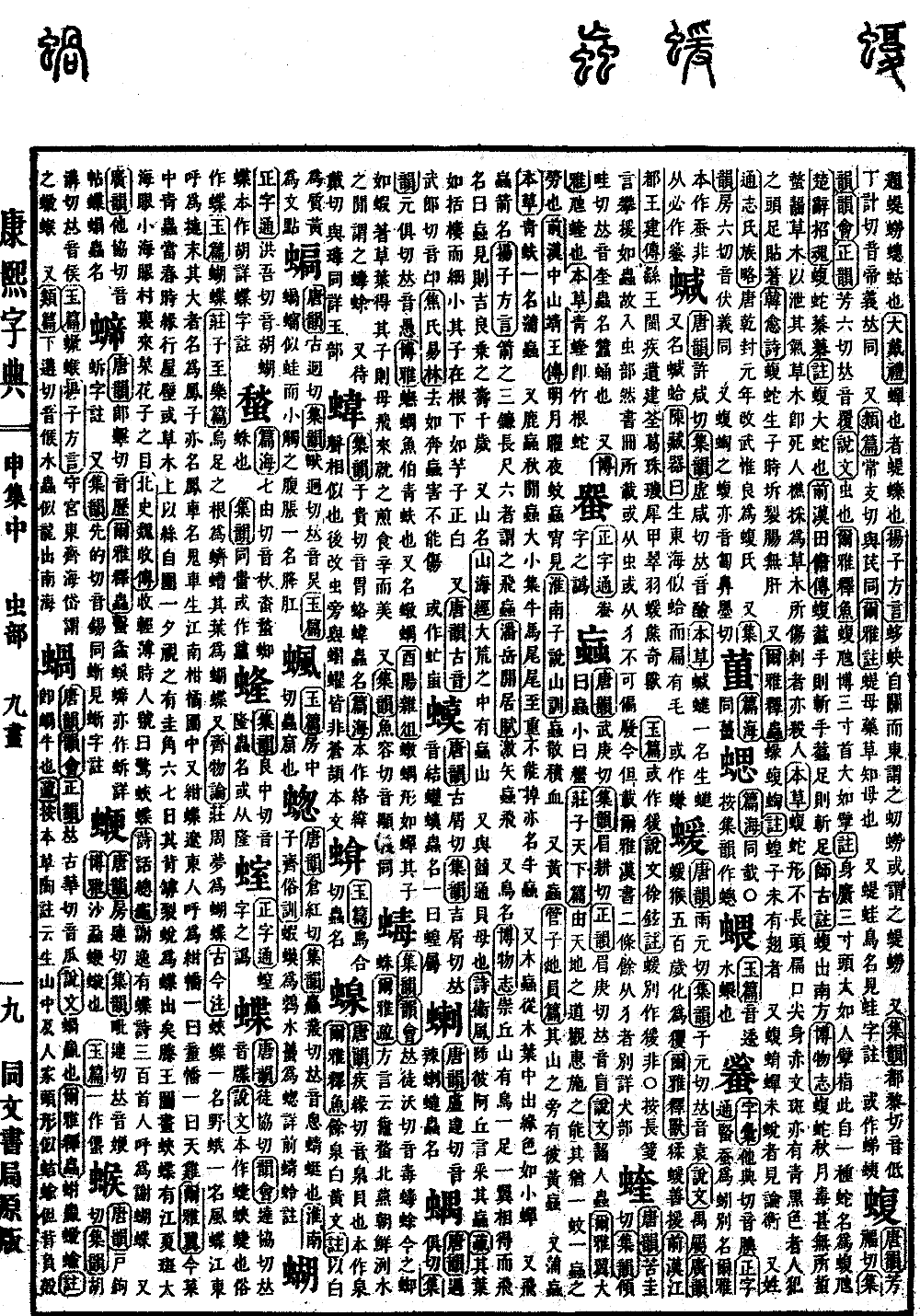
Shen Collection, Middle Volume
Radical: Insect (chóng)
Kangxi Strokes: 15
Page 1091, Entry 01
Tang Rhymes (Tangyun) states the pronunciation is fu. Collection of Rhymes (Jiyun), Collection of Rhymes and Explanations (Yunhui), and Orthodox Rhymes (Zhengyun) state the pronunciation is fu, with the same sound as fu.
Explaining Graphs and Analyzing Characters (Shuowen Jiezi) defines it as a type of insect.
Approaching the Elegances, Explaining Fish (Erya, Shiyu) records: The fu-hui snake is three inches wide with a head as large as a human thumb. Note: It explains that this snake is three inches wide with a head the size of a thumb; it is a unique snake called the fu-hui.
Songs of Chu, Summoning the Soul (Chu Ci, Zhaohun) describes: There are many fu snakes. Note: It explains that the fu is a type of large snake.
History of the Former Han, Biography of Tian Dan (Qian Hanshu, Tian Dan Zhuan) records: If bitten on the hand by a fu snake, one cuts off the hand; if bitten on the foot, one cuts off the foot. Shigut's Note explains: The fu snake is found in the south.
Treatise on Curiosities (Bowuzhi) records: The fu snake is most poisonous in autumn. If it has nothing to bite, it will bite plants and trees to vent its poison, and the plants and trees will immediately wither and die. If woodcutters are pricked by such plants, they will also be poisoned and die.
Compendium of Materia Medica (Bencao Gangmu) records: The fu snake is not long, with a flat head and pointed mouth, and it has red markings on its body, though some are dark green. If a person offends it, its head and tail will curl toward the person.
Han Yu's Poetry writes: When the fu snake gives birth, it tears open its belly, exposing its intestines, and it has no liver.
Also, Approaching the Elegances, Explaining Insects (Erya, Shichong) records: The yuan is the fu-tao. Note: This refers to locust nymphs that have not yet grown wings.
Additionally, the fu-yu refers to cicadas that have not yet molted, as seen in Balanced Discourses (Lunheng).
Also used as a surname. Records of Clans in the Comprehensive Treatise (Tongzhi, Shizulue) records: In the first year of the Qianfeng era of the Tang Dynasty, the Emperor changed the surname of Wu Weiliang to the Fu clan.
Also, Collection of Rhymes (Jiyun) states the pronunciation is fu, with the same sound as fu. The meaning is the same.
Additionally, the fu in fu-tao is also pronounced pu.