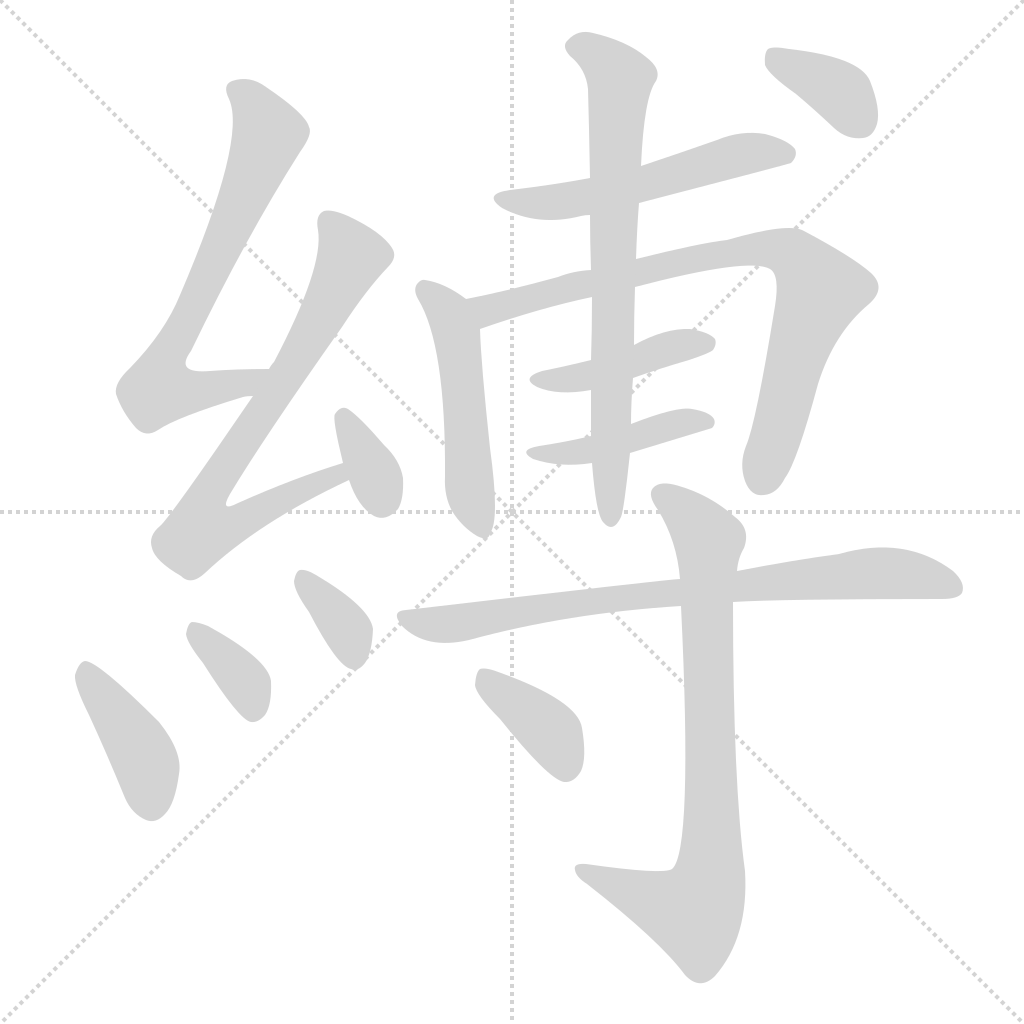
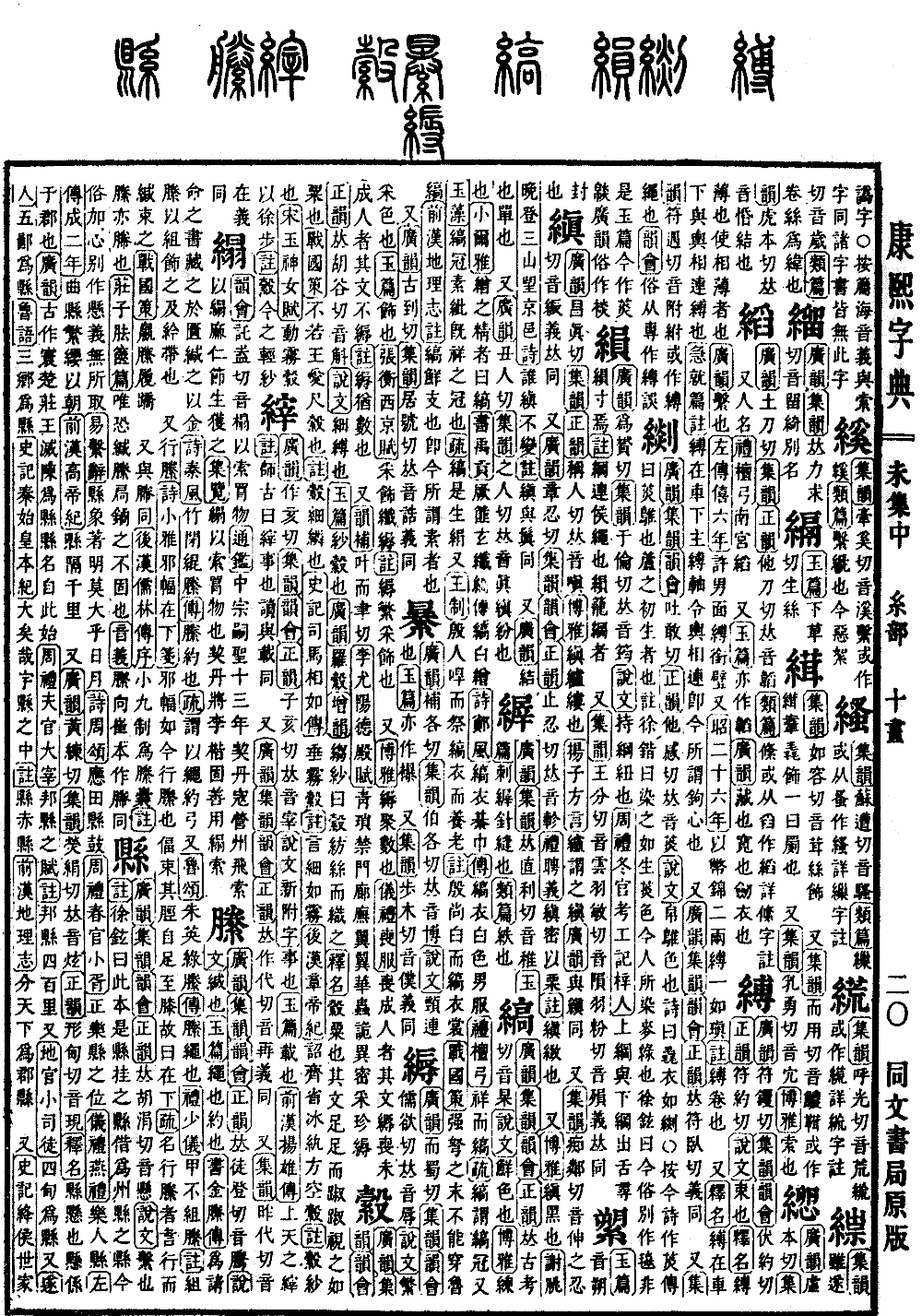
Wei Collection, Middle Volume
Radical: Silk (mì)
Kangxi Strokes: 16
Page 934, Entry 10
Pronounced fu.
According to the Explaining Graphs and Analyzing Characters (Shuowen Jiezi), it means to bind.
According to the Explaining Names (Shiming), to bind is to press; it means to cause things to be pressed against one another.
According to the Expanded Rhymes (Guangyun), it means to tie.
According to the Zuo Commentary (Zuozhuan), during the sixth year of Duke Xi, the Baron of Xu appeared bound and facing forward with a jade disc in his mouth.
Also, in the twenty-sixth year of Duke Zhao, two lengths of silk fabric were bound like a jade insert. The commentary notes that to bind here means to roll.
Also, according to the Explaining Names (Shiming), a binding under a carriage refers to the connection between the carriage body and the axles.
The commentary on the Quick Literacy Classic (Jijiupian) states that a binding under a carriage is used to secure the axle and connect the carriage body, which is what we now call a hook-center.
Also, pronounced fu. The meaning is the same.
Also, according to the Collected Rhymes (Jiyun), pronounced fu. It is a variant of the character meaning rope.
According to the Rhyme Compendium (Yunhui), the common form written with the radical for specialized is incorrect.
Textual research:
In the Explaining Names (Shiming), it states to bind is to press. In the original text, it reads cause things to be pressed. Following the original text, it has been corrected to pressed against one another.