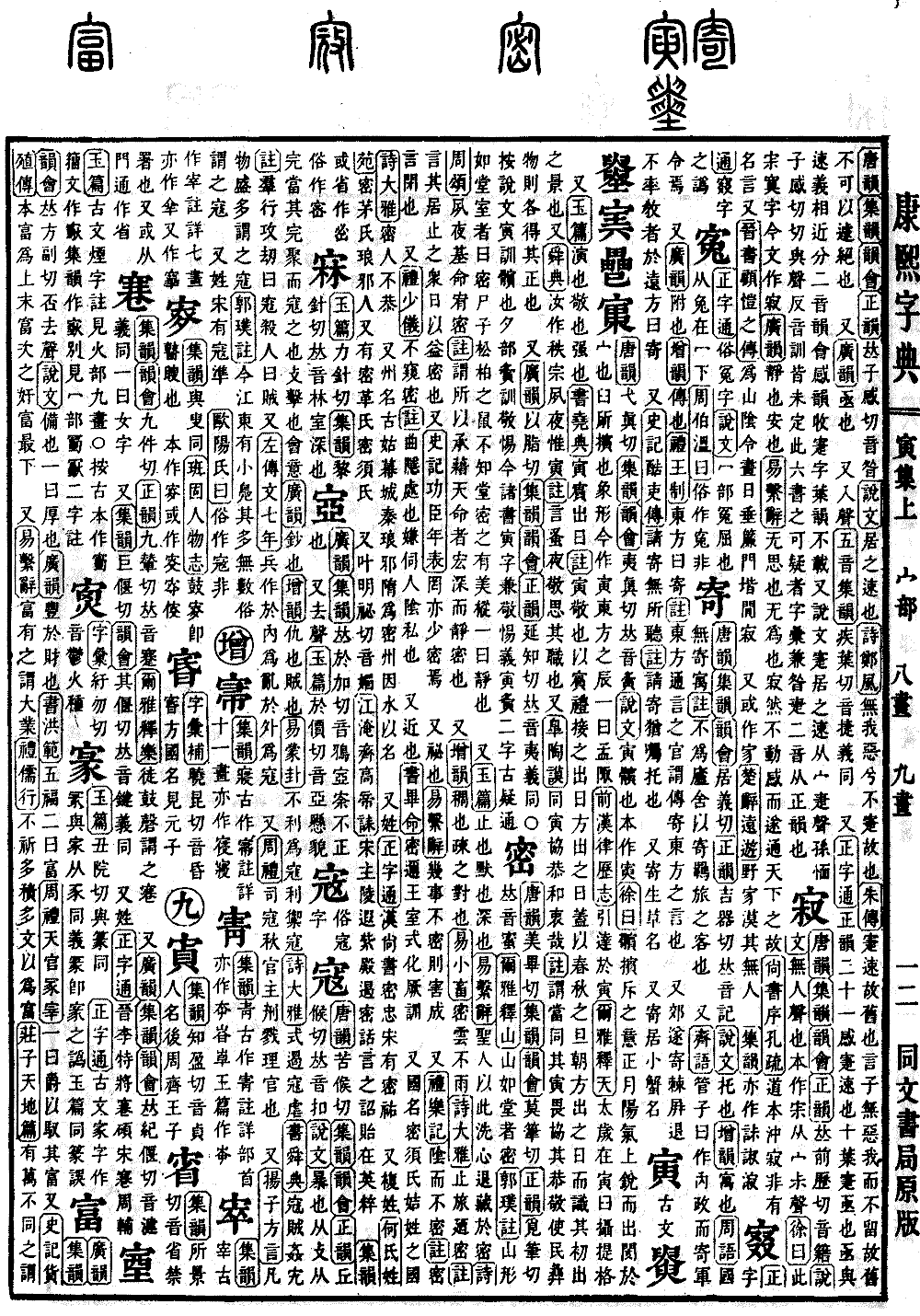
Yin Collection, Upper Volume
Radical: Roof (bù)
富
Kangxi Strokes: 12
Page 288, Entry 27
Guangyun (Guangyun), Jiyun (Jiyun), Yunhui (Yunhui): Pronounced fu (falling tone).
Shuowen Jiezi (Shuowen): The meaning of complete and well-prepared. Another source states it means abundant or plentiful.
Guangyun (Guangyun): Abundance of wealth and property.
Book of Documents (Shujing), Great Plan (Hongfan): Of the five blessings, the second is wealth.
Rites of Zhou (Zhouli), Offices of Heaven (Tianguan), Prime Minister (Zhongzai): The second is to use stipends to manage their wealth.
Records of the Grand Historian (Shiji), Biographies of the Money-makers (Huozhichuan): Relying on agriculture to attain wealth is superior, relying on industry and commerce is secondary, and relying on deceitful means is the lowest.
Book of Changes (Yijing), Appended Remarks (Xici): Possessing all things is called great attainment.
Book of Rites (Liji), Conduct of Scholars (Ruxing): Not praying for the accumulation of wealth, but considering the study of literature as being wealthy.
Zhuangzi (Zhuangzi), Heaven and Earth (Tiandipian): The myriad things each being different is called wealth.
Zhengzitong (Zhengzitong): Nianfu means that one is young and has a long time ahead to experience the affairs of the world.
Records of the Grand Historian (Shiji), Biography of Chancellor Cao (Cao Xiangguo Shijia): Prince Daohui was still young.
Book of Rites (Liji), Meaning of Sacrifices (Jiyi): The people of the Yin dynasty valued wealth and honored the elderly. Commentary: A minister being able to enjoy a stipend through successive generations is called wealth.
Also refers to wealth and bribery.
Book of Documents (Shujing), Canon of Lu (Luxing): Managing criminal cases does not end with authority, but ends with wealth. Commentary: Officials in charge of criminal cases should be able to apply the law not only to the powerful but also to those who offer bribes.
Also a surname. Zuo Commentary (Zuozhuan): The Zhou dynasty official Fu Chen.
Everything that is plentiful can be called wealth.
Book of Jin (Jinshu), Biography of Xia Houzhan: The writing is grand and rich.
Biography of Wang Jie: The diction and principles of the Zuo Commentary are rich.
Book of Song (Songshu), Biography of Xie Hongwei: Talent, thought, and rhetoric are eloquent and rich.
Book of Tang (Tangshu), Biography of Lu Wen: Literary talent is exquisite and rich.
The Literary Mind and the Carving of Dragons (Wenxin Diaolong): Classic books are profound and rich, and the literary style and principles are far-reaching and long-lasting.
Also rhymes with quji, pronounced ji (falling tone).
Book of Odes (Shijing), Greater Odes (Daya): What spirit does not bestow blessings? Rhymes with ci, lei, and cui from the preceding line.
Book of Odes (Shijing), Odes of Lu (Lusong): Making you long-lived and wealthy. Rhymes with chi from the preceding line and shi from the following line.
Also rhymes with ji, pronounced bi (falling tone).
Book of Odes (Shijing), Lesser Odes (Xiaoya): That person is muddled and unwise, becoming more intoxicated day by day. Rhymes with ke from the preceding line and you from the following line.
Zhu Commentary (Zhu Zhuan): Also read as yi-yi. Fu signifies a more severe degree.
Shuowen Jiezi (Shuowen): Formed from the roof radical and the phonetic component bi. Bi is the ancient character for blessing. Commonly written as the variant form (fu).
Correction: Rites of Zhou (Zhouli), Offices of Heaven (Tianguan), Prime Minister (Zhongzai): The original text states the second is to use stipends to manage their wealth, rather than using noble rank.