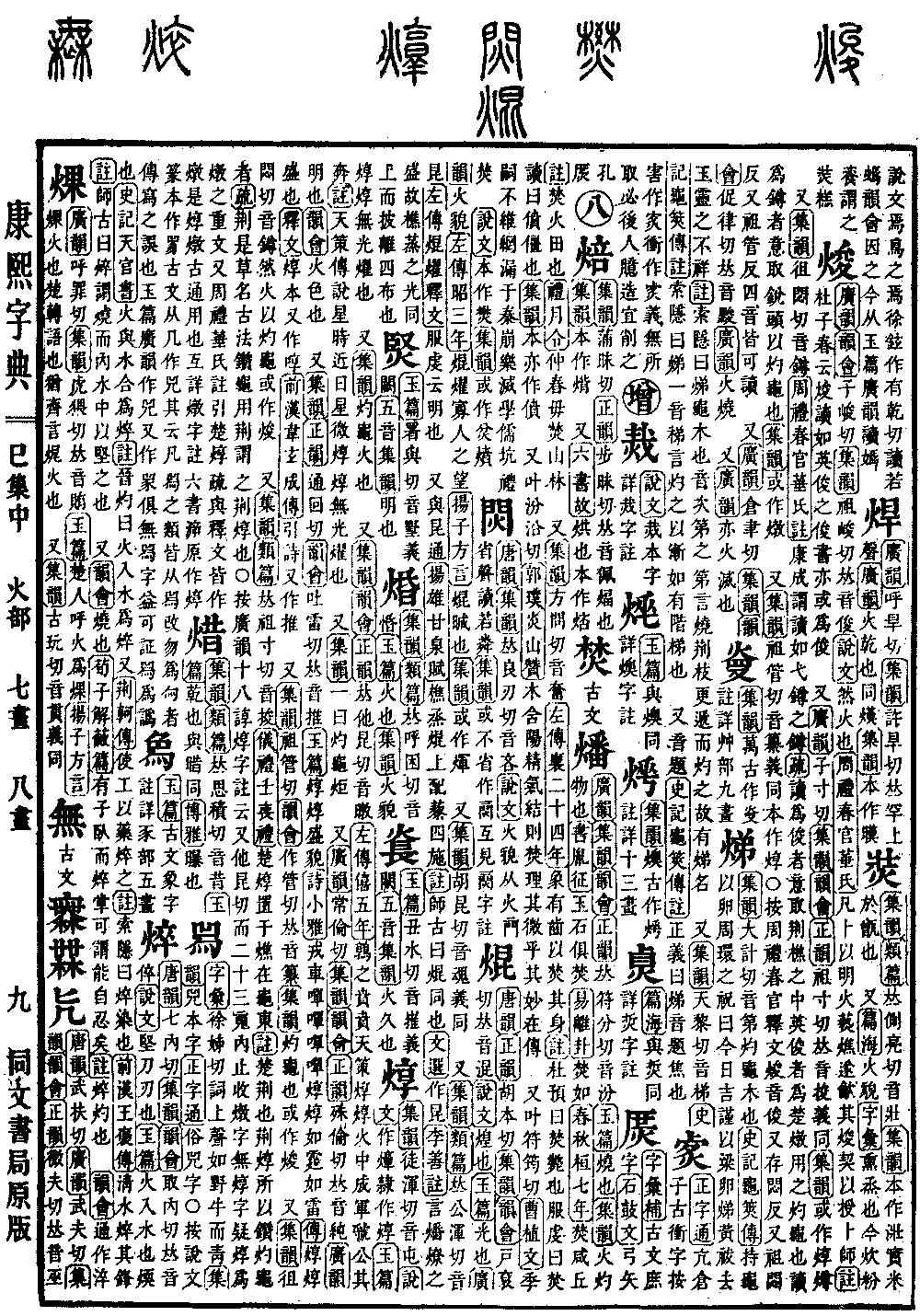
Si Collection, Middle Volume
Radical: Fire (huǒ)
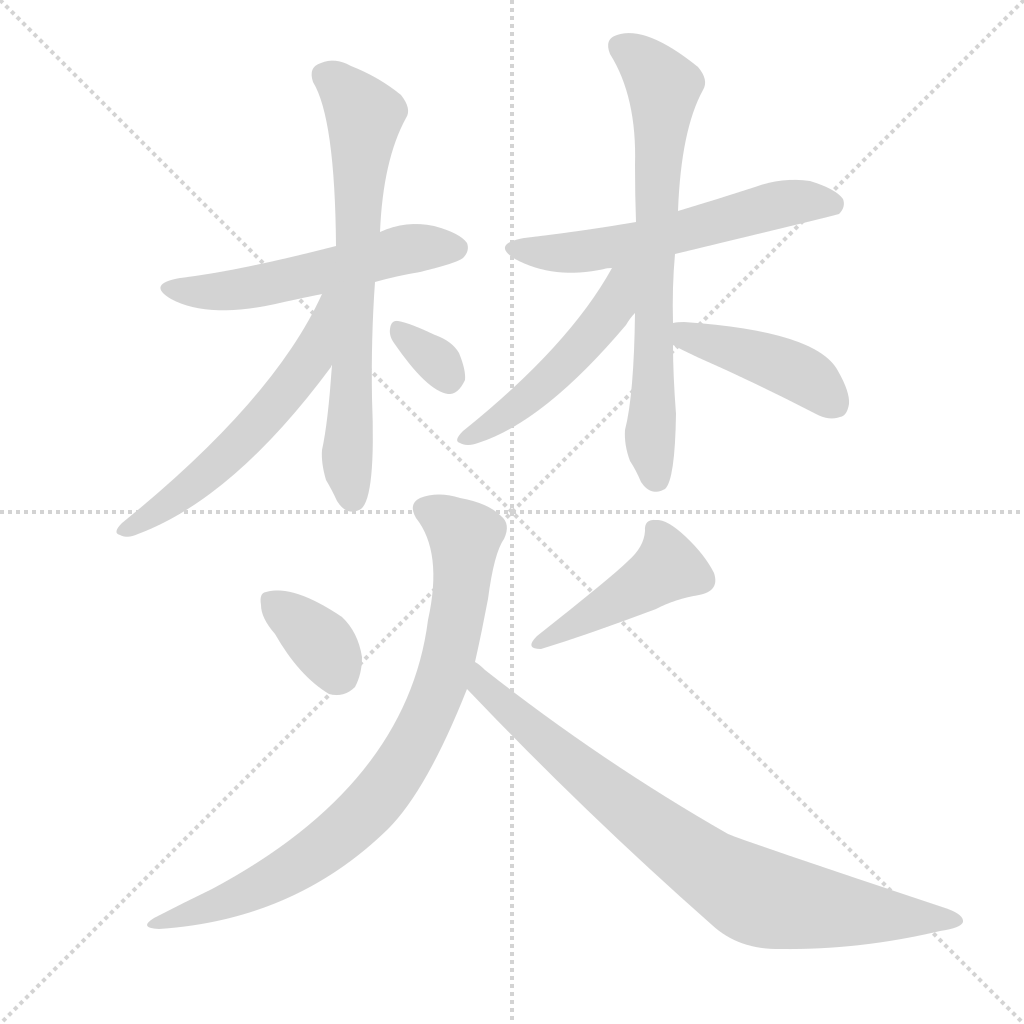
焚
Kangxi stroke count: 12
Page 673, Entry 13
In classical texts, it is written as a variant form (fán).
According to the Expanded Dictionary of Sounds and Meanings (Guangyun), the Collected Rhymes (Jiyun), the Rhyme Compendium (Yunhui), and the Corrected Rhymes (Zhengyun), it is pronounced fen.
The Jade Chapters (Yupian) defines it as: to burn.
The Collected Rhymes (Jiyun) defines it as: to scorch items using fire.
The Book of Documents (Shangshu), in the section Yin Zheng, contains the phrase: The jade and the stone are burned together.
The Book of Changes (Yijing), in the hexagram Li, contains the phrase: Burned like this.
The Spring and Autumn Annals (Chunqiu), in the seventh year of Duke Huan, records: Burned Xianqiu.
The commentary states: Fen refers to burning fields with fire.
The Book of Rites (Liji), in the Monthly Ordinances (Yueling), records: In the mid-spring season, do not burn the forests.
It is also recorded in the Collected Rhymes (Jiyun) with the pronunciation fen (falling-rising tone).
The Zuo Commentary (Zuozhuan), in the twenty-fourth year of Duke Xiang, records: The elephant has tusks, which leads to the burning of its body.
The commentary states: Du Yu believes fen means to collapse and die. Fu Qian believes fen is pronounced like fen (falling-rising tone) and refers to falling over stiffly.
The Collected Rhymes (Jiyun) records: It was originally also written as a variant form (fèn).
It also has a rhyming pronunciation of fen.
In the Praise for Yanshan (Yanshan Zan) by Guo Pu, it is said: Trees contain the essence of the Yang energy, and when the energy becomes stagnant, it ignites; the principle is subtle, and its excellence lies in what is passed down.
It also has a rhyming pronunciation of fen.
In the writings of Cao Zhi, it is said: Later generations could not maintain the state, the legal net had gaps during the Qin dynasty, rites and music collapsed, scholarship was destroyed, the Confucian scholars were buried alive, and the rites were burned.
In the Discussion of Writing and Explanation of Characters (Shuowen Jiezi), it was originally written as a variant form (fén).
The Collected Rhymes (Jiyun) records: It is sometimes also written in the variant forms (fén) or (fén).