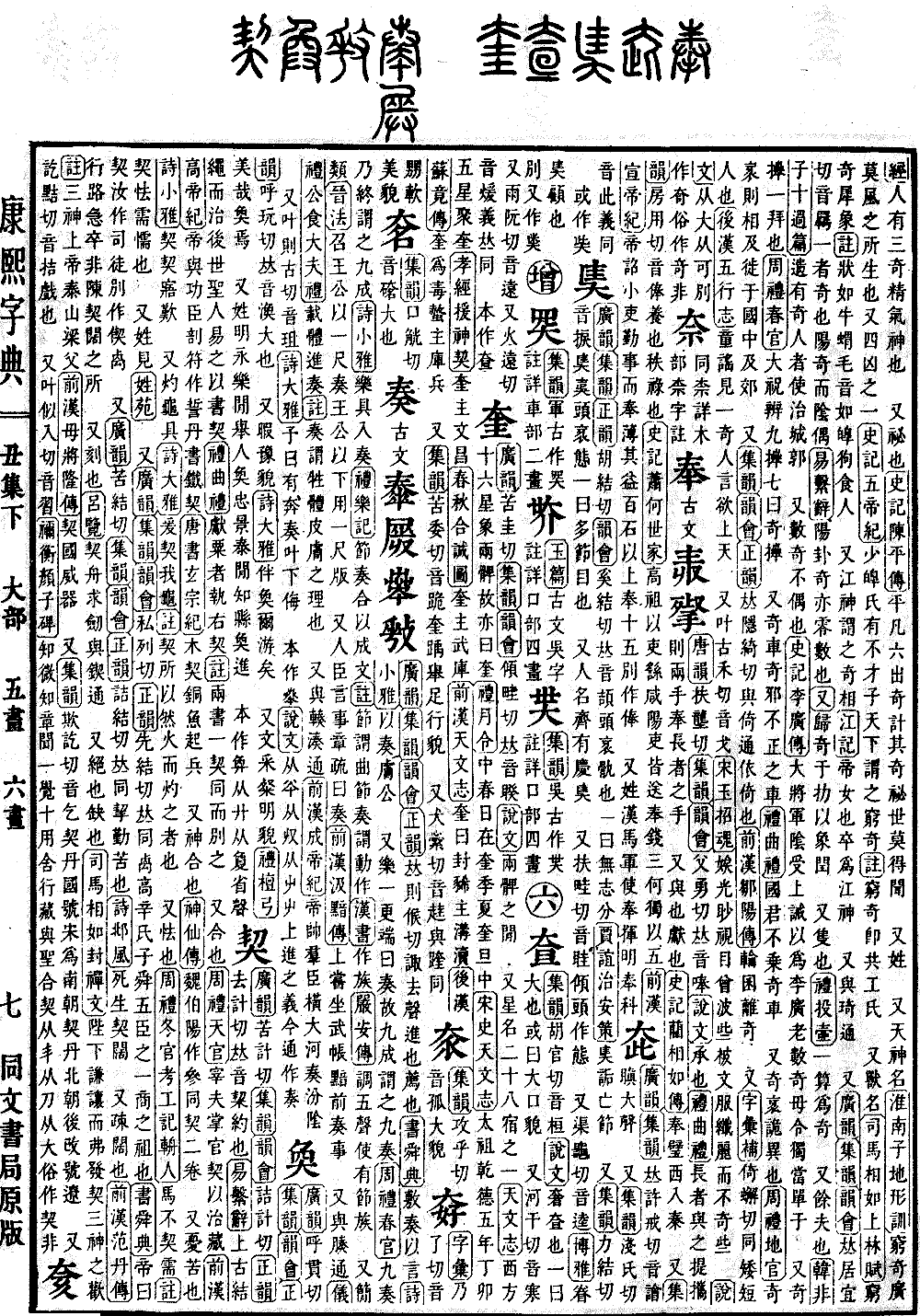
Chou Collection, Lower Volume
Radical: Big (dà)
Kangxi stroke count: 8
Page 251, Entry 02
Ancient form. Pronounced feng (rising tone). Pronounced feng (rising tone). Also read as feng (falling tone).
Shuowen Jiezi (Explanation of Writing and Analysis of Characters) defines this as to receive or to bear.
Book of Rites (Liji): When an elder extends a hand to assist, a junior should use both hands to cup the hand of the elder.
It also carries the meaning of to give or to offer.
Records of the Grand Historian (Shiji): To hold a jade disk while traveling west to enter the state of Qin.
Also pronounced feng (falling tone), sounds the same as the word for salary or support.
Records of the Grand Historian (Shiji): When the Exalted Ancestor (Gaozu) traveled to Xianyang as an official, the other officials all offered three hundred coins, but only Xiao He offered five hundred.
Book of Han (Hanshu): The Emperor issued an edict stating: Lower officials are burdened with heavy duties yet receive meager salaries; those officials with a salary of one hundred shi or more shall have their salary increased by fifteen shi.
It is also written as a variant form (feng).
It is also a surname. During the Han dynasty, there was a cavalry commander named Feng Hui; during the Ming dynasty, there was a scholar named Feng Ke.