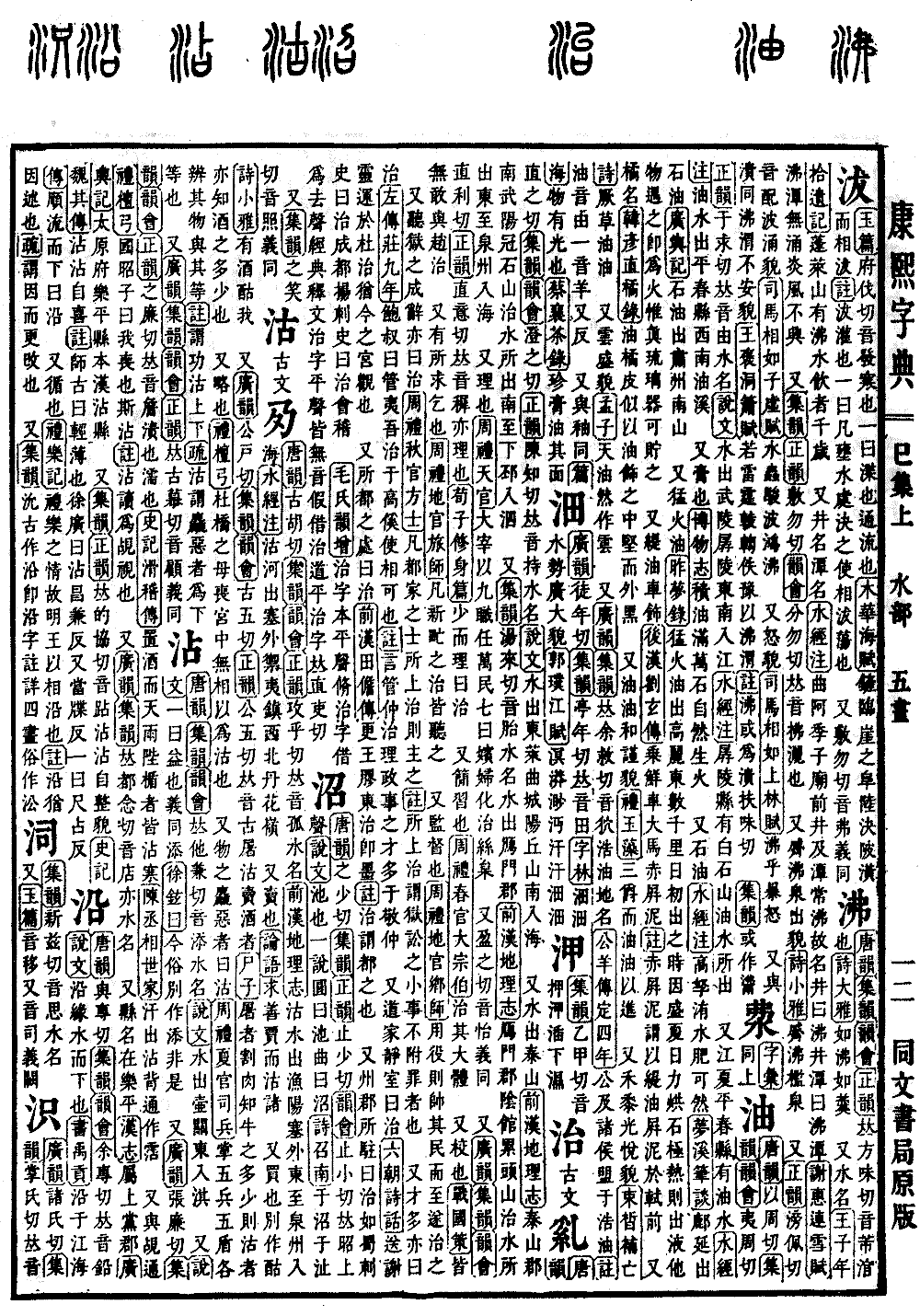
Si Collection, Upper Volume
Radical: Water (shuǐ)
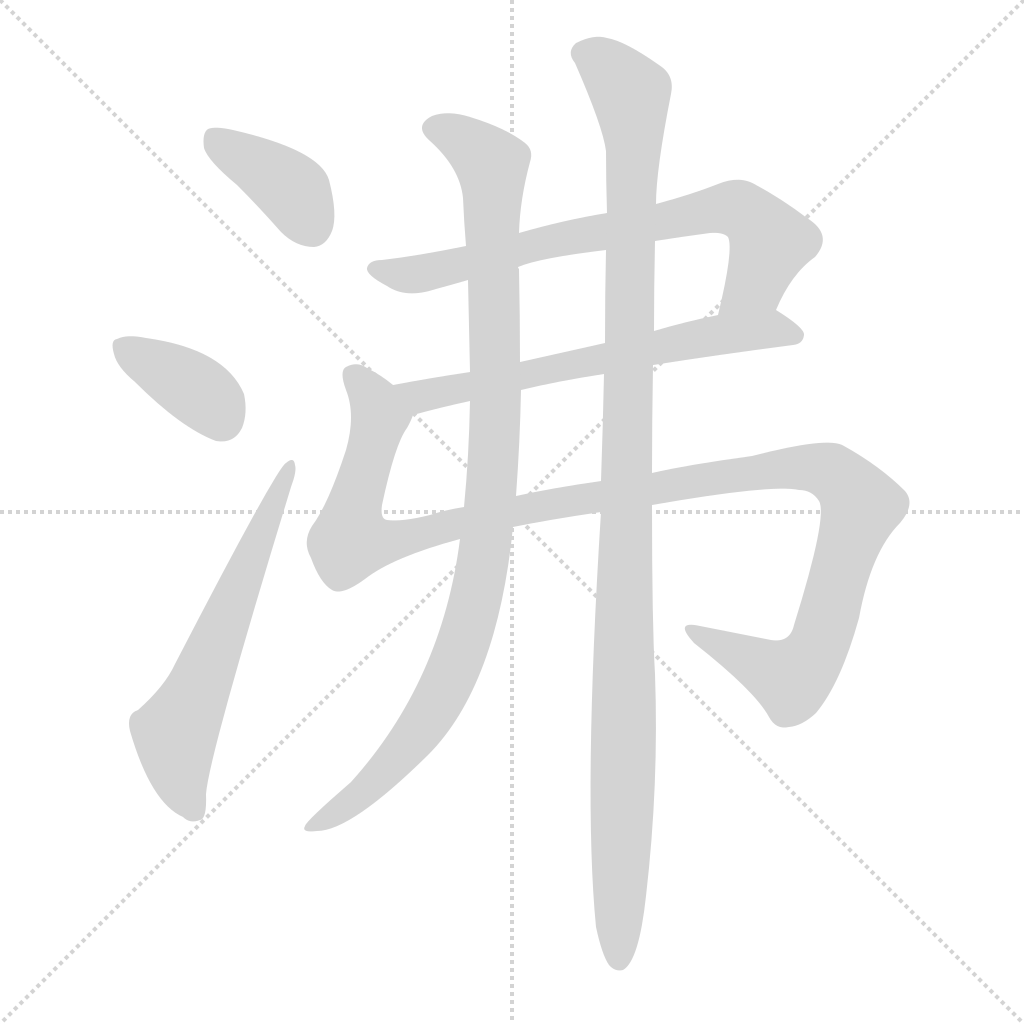
沸
Kangxi strokes: 9
Page 614, Entry 02
Pronounced fèi. The meaning of boiling.
Book of Odes (Shijing): Like boiling broth, it is clamorous.
Also the name of a body of water.
Wang Zinian: Shiyi Ji (Record of Gleanings): Mount Penglai has boiling water; drinking it allows one to live for a thousand years.
Also the name of a well and a pool.
Commentary on the Water Classic (Shuijing Zhu): The well and pool in front of the Jizi Temple in Qu’e are always boiling, so the well is called Boiling Well and the pool is called Boiling Pool.
Xie Huilian: Rhapsody on Snow (Xue Fu): The boiling pool no longer bubbles, and the hot wind no longer rises.
Also pronounced fú. The meaning of spraying or sprinkling.
Also bì fèi, the appearance of a spring gushing forth.
Book of Odes (Shijing): Springs flowing continuously without ceasing.
Also pronounced pèi. The appearance of waves tossing and surging.
Sima Xiangru: Rhapsody on Sir Vacuous (Zixu Fu): Aquatic creatures are startled, waves surging violently.
Also the appearance of anger.
Sima Xiangru: Rhapsody on the Shanglin Park (Shanglin Fu): The water forces surge as if in a violent rage.
Also identical to the character kuì. Fèi wèi, the appearance of being restless or unstable.
Wang Bao: Rhapsody on the Dongxiao Flute (Dongxiao Fu): Like thunder roaring, released and turbulent.
Note: Fèi is sometimes written as kuì.
Textual research: In Sima Xiangru's Rhapsody on Sir Vacuous (Zixu Fu), the original text reads aquatic creatures and surging waves. Based on the original text, the character for surging has been corrected to startling.