Shen Collection, Upper Volume
Radical: Grass (cǎo)
Kangxi Strokes: 15
Page 1044, Entry 16
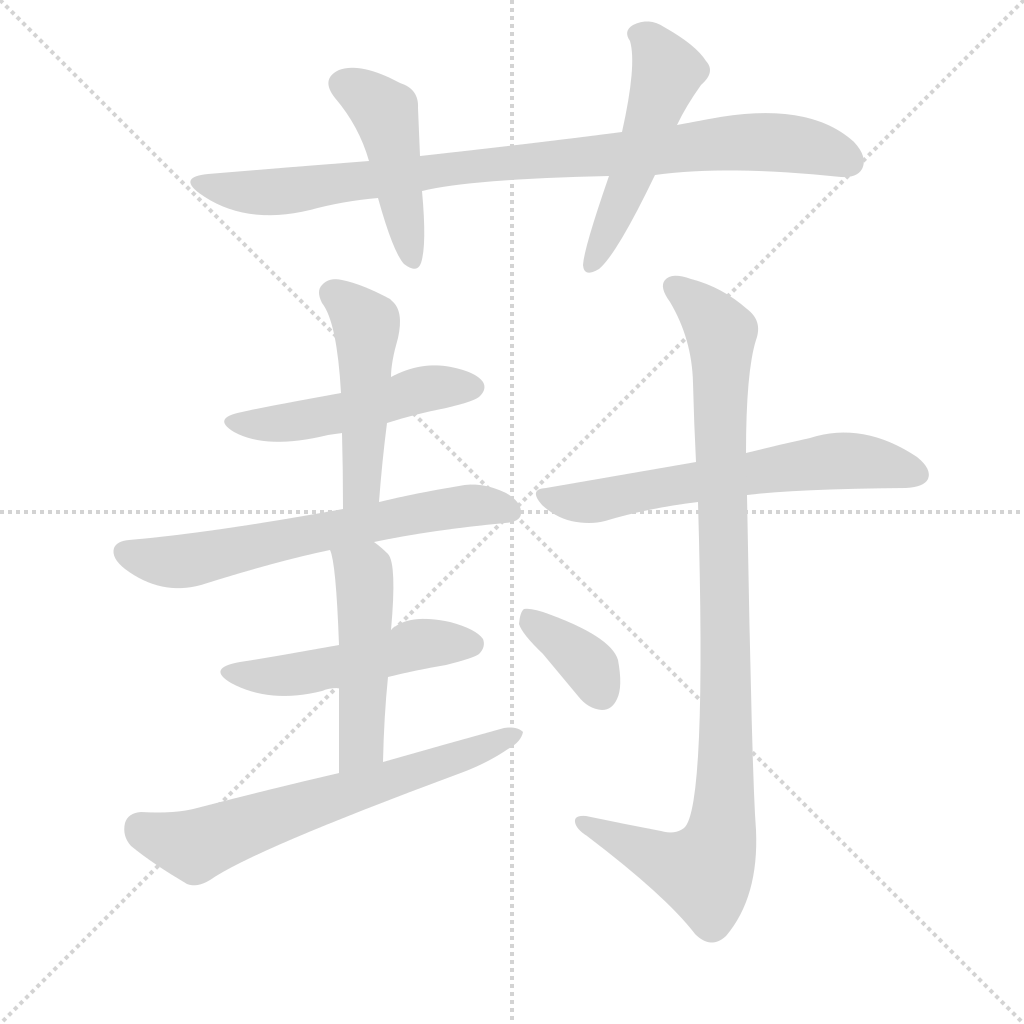
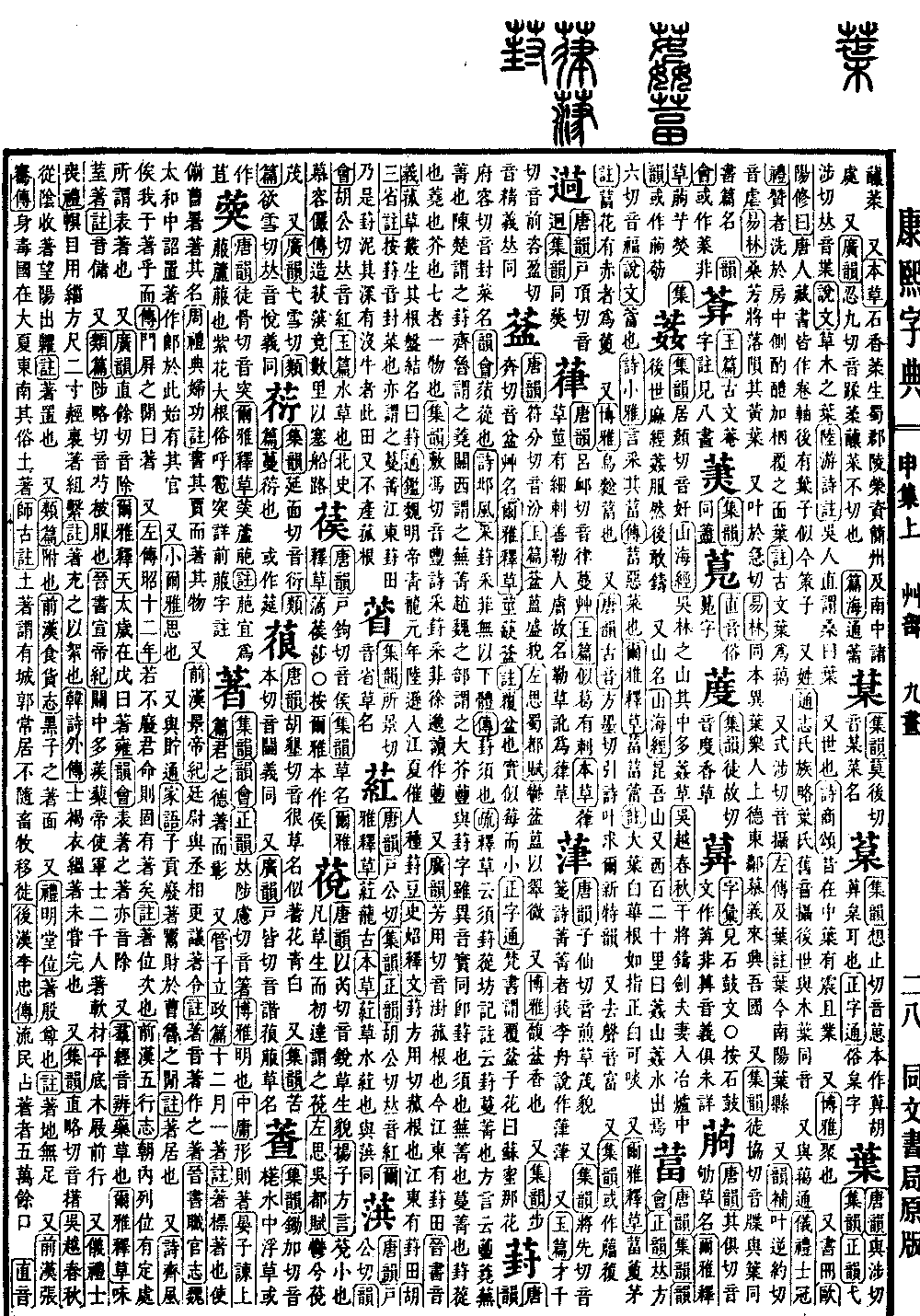
Pronounced feng. This is the name of a type of vegetable. According to the Rhyme Compendium (Yunhui), it is also known as fengcong. In the Book of Odes (Shijing), Beifeng section, it is stated: Gather the feng and gather the fei, do not look down upon the lower body. The Commentary (Zhuan) explains: Feng refers to the xu vegetable. The Subcommentary (Shu) further explains: The Erya (a dictionary of classical Chinese) states that xu is fengcong. The notes to the Book of Rites (Liji), Fangji section, state: Feng is the manjing (turnip). The Dialects (Fangyan) states: Fengrao is known as wujing (turnip). In the Chen and Chu regions, it is called feng; in the Qi and Lu regions, it is called rao; in the areas west of the pass, it is called wujing; and in the Zhao and Wei regions, it is called dajie. Although the characters feng and feng are written differently, their pronunciations are identical, and they refer to the same thing, known by seven different names including xu, wujing, manjing, fengcong, rao, and jie.
According to the Collected Rhymes (Jiyun), it is also pronounced feng. In the Book of Odes, the feng in the phrase gathering feng and gathering fei is pronounced as feng by Xu Miao. Additionally, according to the Expanded Rhymes (Guangyun), it is also pronounced yong. This refers to the root of the water-wild rice (gu); currently, in the Jiangdong region, there are feng fields. The Pronunciation and Meaning of the History of Jin (Jinshu Yinyi) explains: When water-wild rice grows in clusters, its roots intertwine, which is called feng. The Comprehensive Mirror (Tongjian) records: In the first year of the Qinglong era of Emperor Ming of Wei, Lu Xun entered Jiangxia and urged the people to plant feng and beans. The Explanation of Text (Shizhao Shiwen) explains: Feng is pronounced yong, referring to the root of water-wild rice; the Jiangdong region has feng fields. According to the annotation by Hu Sansheng: Feng is pronounced feng and is a type of vegetable, also known as manjing (turnip). The feng fields in the Jiangdong region actually refer to feng mud, which is a layer of mud formed by accumulated plant roots and stems; its depth can be sufficient to submerge an ox, and such fields do not produce the roots of water-wild rice.