Wu Collection, Middle Volume
Radical: Step (bō)
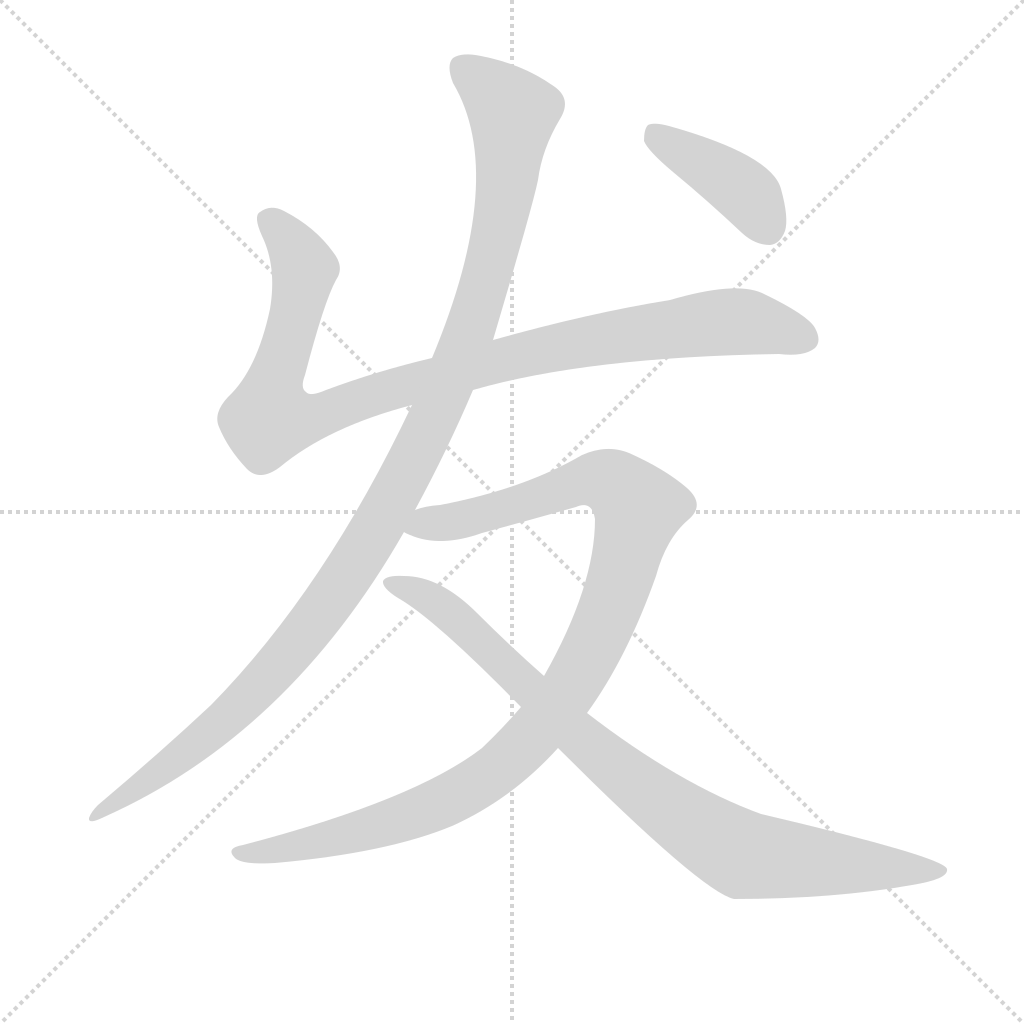
發
Kangxi stroke count: 12
Page 784, Entry 01
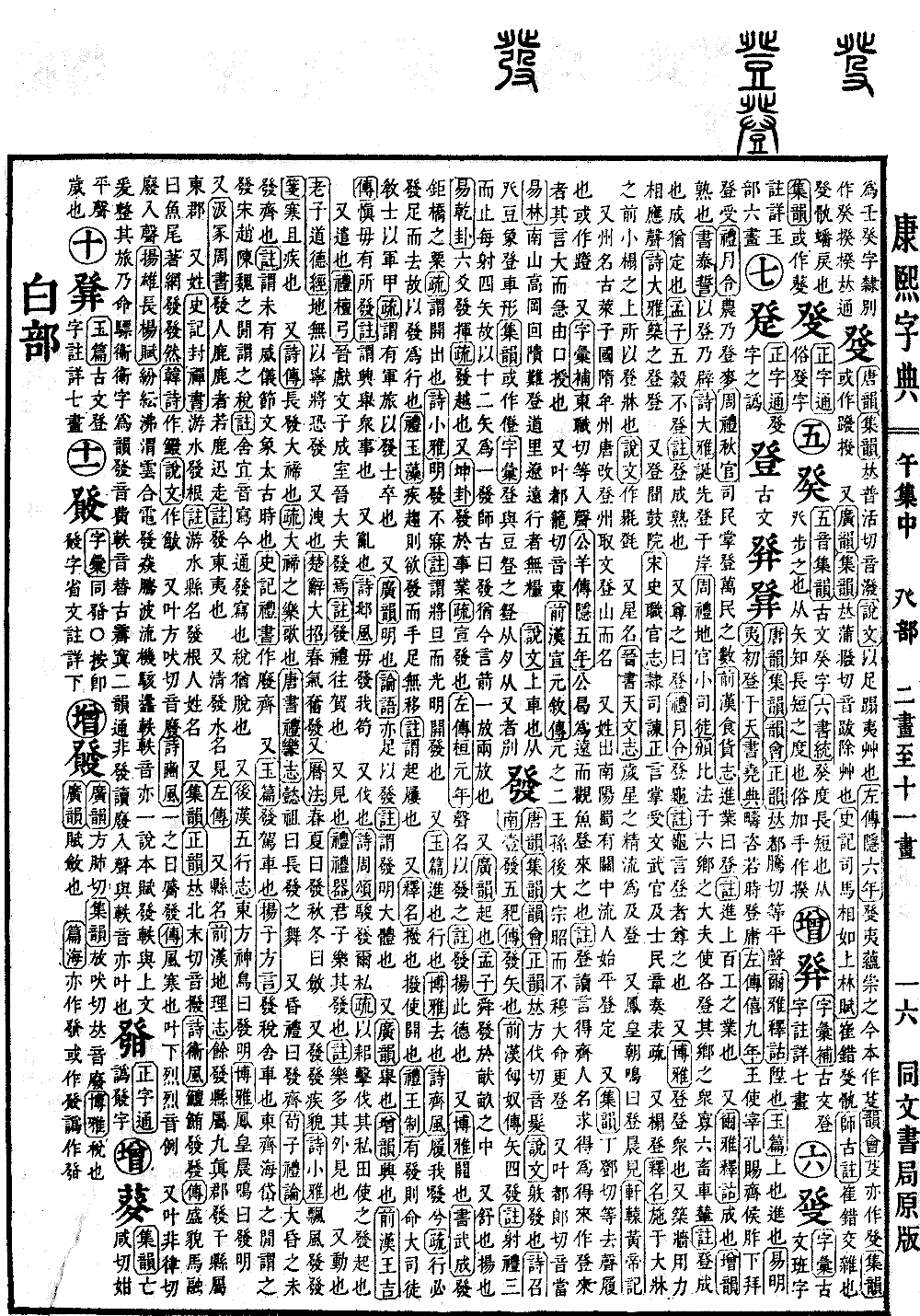
Pronounced fa. As recorded in Tang Rhyme (Tangyun), Collected Rhymes (Jiyun), Rhyme Compendium (Yunhui), and Correct Rhymes (Zhengyun). In the Explaining Graphs and Analyzing Characters (Shuowen), it means to send forth. In the Book of Odes (Shijing), it refers to shooting. The commentary notes that in archery rituals, one ends after three rounds, each round consisting of four arrows, thus twelve arrows are considered one set (fa). Master Shigu notes that this is like saying one or two shots of an arrow.
Also, per Broad Rhymes (Guangyun), it means to arise. As in the Mencius, Shun arose from among the furrows. It also means to extend or to lift. In the Book of Changes (Yijing), it refers to developing and expressing. The commentary explains it as spreading out. In the same work, it refers to initiating work. In the Zuo Tradition (Zuo Zhuan), it means to manifest or propagate such virtue.
Per Broad-Learning (Boya), it means to open. In the Book of Documents (Shujing), it refers to opening the granaries of Juchiao. In the Book of Odes (Shijing), it means the break of dawn.
Per Jade Chapters (Yupian), it means to advance or to walk. Per Broad-Learning (Boya), it means to depart. In the Book of Odes (Shijing), it is used to describe walking. In the Book of Rites (Liji), it refers to rising from a kneeling posture.
According to the Explanations of Names (Shiming), it means to strike or push open. In the Book of Rites (Liji), it refers to mobilizing soldiers.
Per Broad Rhymes (Guangyun), it means clear. In the Analects (Lunyu), it means to elucidate the general principles.
Per Broad Rhymes (Guangyun), it means to raise. Per Expanded Rhymes (Zhengyun), it means to flourish. In the Former Han History (Hanshu), it refers to raising and initiating various tasks.
It also means to disturb. In the Book of Odes (Shijing), it means do not disturb my fish trap.
It also means to cut. In the Book of Odes (Shijing), it refers to using a plow to strike the private fields to stir the soil.
It also means to send. In the Book of Rites (Liji), it refers to sending gifts to congratulate others.
It also means to appear. In the Book of Rites (Liji), it refers to enjoying the external manifestation.
It also means to move. In the Laozi (Daodejing), it refers to fear that something might occur.
It also means to leak. In the Chu Ci (Great Summoning), it refers to the springing up of spring energy.
In calendar systems, spring and summer are called fa, while autumn and winter are called lian (to gather).
Also, fa-fa describes a swift appearance. In the Book of Odes (Shijing), it describes a cold and rapid wind.
In the Commentary on the Odes, it refers to the Great Di sacrifice.
Regarding wedding etiquette, it refers to the initial preparations (fa-qi).
Per Jade Chapters (Yupian), it means to unharness a carriage. In Yang Xiong's Dialects (Fangyan), it refers to releasing or unyoking a carriage.
In the Later Han History (Hou Hanshu), the bird of the east is called fa-ming. Per Broad-Learning (Boya), the morning call of the phoenix is called fa-ming.
In the Bamboo Annals (Zhou Shu), fa-ren refers to people who move as swiftly as deer. The commentary notes that Fa is a name for the Eastern Yi tribes.
Qingfa is the name of a river, appearing in the Zuo Tradition (Zuo Zhuan).
It is also the name of a county. In the Former Han History (Hanshu), Yufa County was under the jurisdiction of Jiuzhen Commandery, and Fagan County was under the jurisdiction of Dong Commandery.
It is also a surname. In the Records of the Grand Historian (Shiji), it appears as a personal name.
Pronounced bo. Per Collected Rhymes (Jiyun) and Correct Rhymes (Zhengyun). In the Book of Odes (Shijing), it describes the appearance of fish.
It can also be read as fei (falling tone). In the Book of Odes (Shijing), it describes the sound of wind and cold.
It can also be read as fei (entering tone). In Yang Xiong's Changyang Rhapsody (Changyang Fu), it is used to describe a scene of intense, thunderous motion.