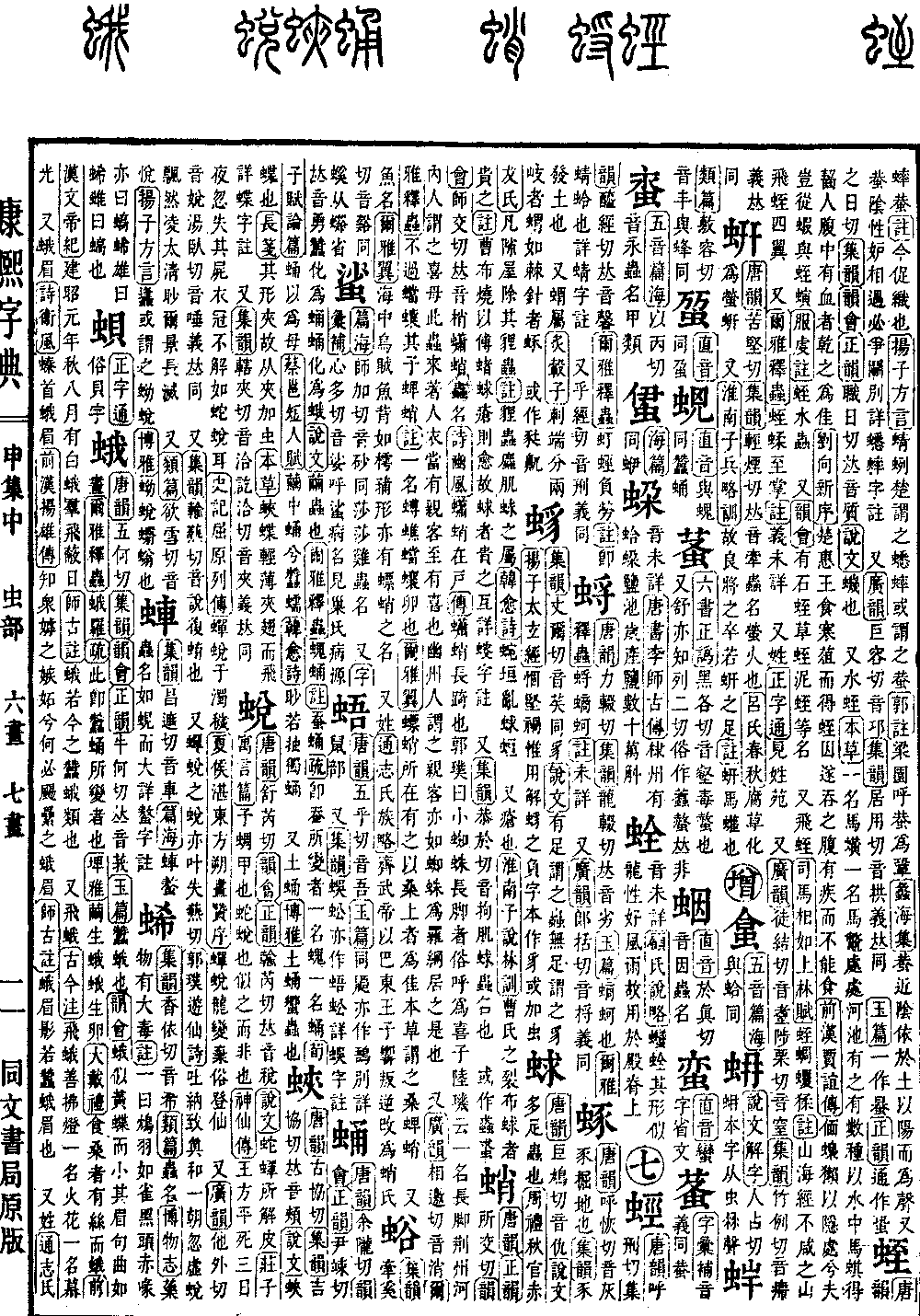
Shen Collection, Middle Volume. Radical: Insect (chóng). Kangxi stroke count: 13. Page 1083, Entry 31.
Pronounced é.
In the Yupian dictionary, it is described as the silkworm moth. In the Rhyme Anthology (Yunhui), it is described as resembling a yellow butterfly but smaller, with antennae curved as if painted.
In the Er-ya, on the explanation of insects, it is called e-luo. The commentary states that this refers to the creature that emerges from the silkworm chrysalis. In the Piya, it is stated that cocoons produce moths, and moths produce eggs. In the Record of Rites by Dai the Elder (Dadai Liji), it is noted that creatures eating mulberry leaves spin silk and then transform into moths.
In the History of the Former Han (Qianhan Shu), in the annals of Emperor Wen, it is recorded that in the eighth month of the first year of the Jianzhao era, white moths flew in swarms, obscuring the sun. The commentary by Yan Shigu states that these are similar to the silkworm moths of the present day.
It also refers to flying moths. According to the Record of Ancient and Modern Things (Gujin Zhu), flying moths are attracted to flames; they are also known as fire-blossoms or light-seekers.
It also refers to moth-like eyebrows. In the Book of Odes (Shijing), in the Odes of Wei, it is written: With cicada-like head and moth-like eyebrows. In the Biography of Yang Xiong in the History of the Former Han (Qianhan Shu), it is written: Knowing the jealousy of the many beauties, why lift those eyebrows shaped like the antennae of a silkworm moth? The commentary by Yan Shigu states that moth-like eyebrows are shaped like the antennae of a silkworm moth.
It is also a surname. In the Comprehensive Treatises (Tongzhi), in the brief notes on the genealogy, it is noted to appear in the Garden of Surnames (Xingyuan). It includes the descendants of E Xi, a grandee of the State of Jin, and E Qing, a General of the East in the State of Wei.
There is also the Shadow of the Moth Pond, a name of a pool. According to the Yellow Map of the Three Prefectures (Sanfu Huangtu), the Shadow of the Moth Pond was a pool excavated by Emperor Wu of the Han to enjoy the reflection of the moon, where palace ladies would ride boats and stir the moon's reflection.
It is also interchangeable with the character e (meaning brief or sudden). In the History of the Former Han (Qianhan Shu), in the biographies of the consorts, it is noted that Consort Ban of Emperor Cheng was selected for the inner palace upon the Emperor's accession; initially serving as a low-ranking female official, she soon gained great favor. The commentary by Yan Shigu notes that in ancient times, the characters for moth and brief were interchangeable.
Pronounced yi (rising tone). It is the same as the character for ant. In the Book of Rites (Liji), in the record of music, it is written: The ant larvae are always learning to carry earth. The commentary states that the character refers to large ants. In the Biography of Huangfu Gui in the History of the Later Han (Houhan Shu), it is noted that Zhang Jiao and his followers all wore yellow turbans as markers; people of the time called them the Yellow Turbans, and also the moth bandits. The commentary states that this is the same as the character for ant, used here as a metaphor for the great number of rebels, hence the name.
It is also a personal name. In the Zuo Tradition (Zuo Zhuan), it appears as E Xi. It is also pronounced yi (falling tone). In the Er-ya, it is written in a variant form. The Rhyme Anthology (Jiyun) notes that it was originally written in a variant form.