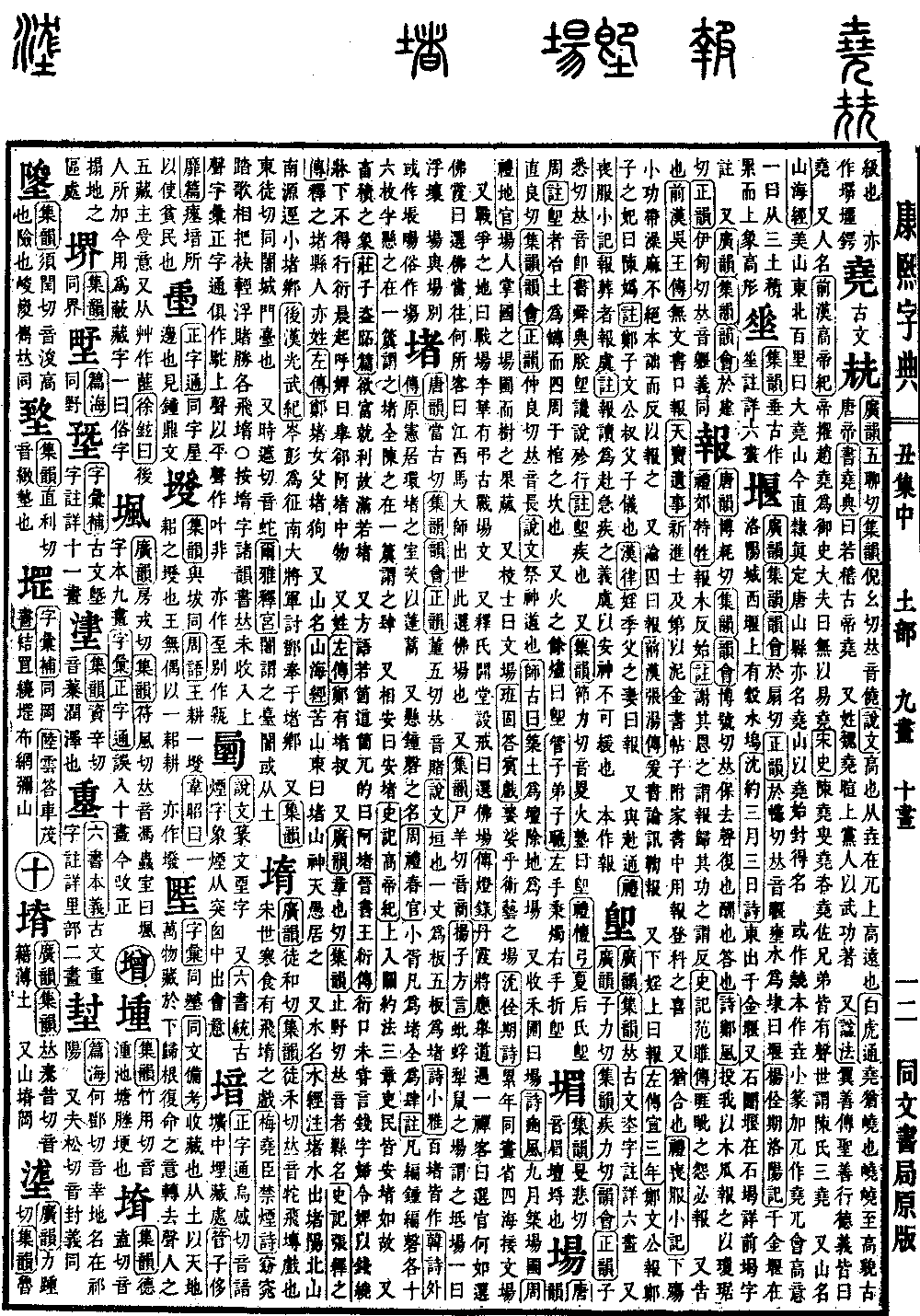
Chou Collection, Middle Volume
Radical: Earth (tǔ)
Kangxi stroke count: 12
Page 234, Entry 09
Tang Dynasty Rhyme (Tangyun): Pronounced du. Collected Rhymes (Jiyun), Rhyme Compilation (Yunhui), and Orthodox Rhymes (Zhengyun): Pronounced du (third tone).
Explanation of Characters (Shuowen): An earthen wall. One zhang is a board, five boards make a du.
Book of Odes (Shijing): One hundred walls were constructed.
Han Dynasty Outer Commentary (Hanshi Waizhuan): Yuan Xian lived in a small hut of circular walls, thatched with mugwort and wild grasses.
Also, the name for hanging bells and stone chimes.
Rites of Zhou (Zhouli): The minor official, a half set is called a du, a full set is called a si.
Commentary: Generally, sixteen bells or sixteen stone chimes suspended on one stand is called a du, a full set on one stand is called a si.
Also, to live in peace is called an du.
Records of the Grand Historian (Shiji): When the Emperor entered the pass, he agreed to three simple laws, and the officials and commoners remained at peace as before.
Also, a symbol of accumulation.
Zhuangzi: Desire for wealth and profit, thus filled up like a wall.
Also, colloquial speech for this or that, called a du.
Book of Jin (Jinshu): Wang Yan never spoke the word money; his wife ordered a servant to scatter coins under the bed so he could not walk, Wang Yan arose in the morning and called the servant: Remove these things from before me.
Also, a surname.
Zuo Commentary (Zuozhuan): There was Du Shu in the state of Zheng.
Also, Guangyun: Pronounced zhe (third tone). Jiyun: Pronounced zhe (third tone).
Name of a county.
Records of the Grand Historian (Shiji): Shi Zhi was a man from Du County.
Also, a surname.
Zuo Commentary (Zuozhuan): In Zheng, there was Du Nufu and Du Gou.
Also, name of a mountain.
Classic of Mountains and Seas (Shanhai Jing): East of Kushan is Du Mountain, the deity Tianyu resides there.
Also, name of a river.
Commentary on the Classic of Water (Shuijing Zhu): Du River, emerges from the south of the northern mountain of Duyang, the source flows through the village of Xiaodu.
History of the Later Han (Houhan Shu): Cen Peng was the General who Conquers the South, attacking Deng Feng at Du Village.
Also, Jiyun: Pronounced tu. Same as she. A watchtower above a city gate.
Also, pronounced she (level tone).
Erya: A she is called a tai. She, sometimes written with the earth radical.
Textual Research: In the Rites of Zhou, the Minor Official entry, the original text states half is called a du, full is called a si. Commentary: Generally, sixteen bells or sixteen stone chimes, a half set suspended on one stand is called a du, a full set displayed on one stand is called a si. The original text has been corrected to read half instead of all, and the character for stand in the commentary has been corrected.