Mao Collection, Lower Volume
Radical: Tap (pù)
Kangxi Strokes: 12
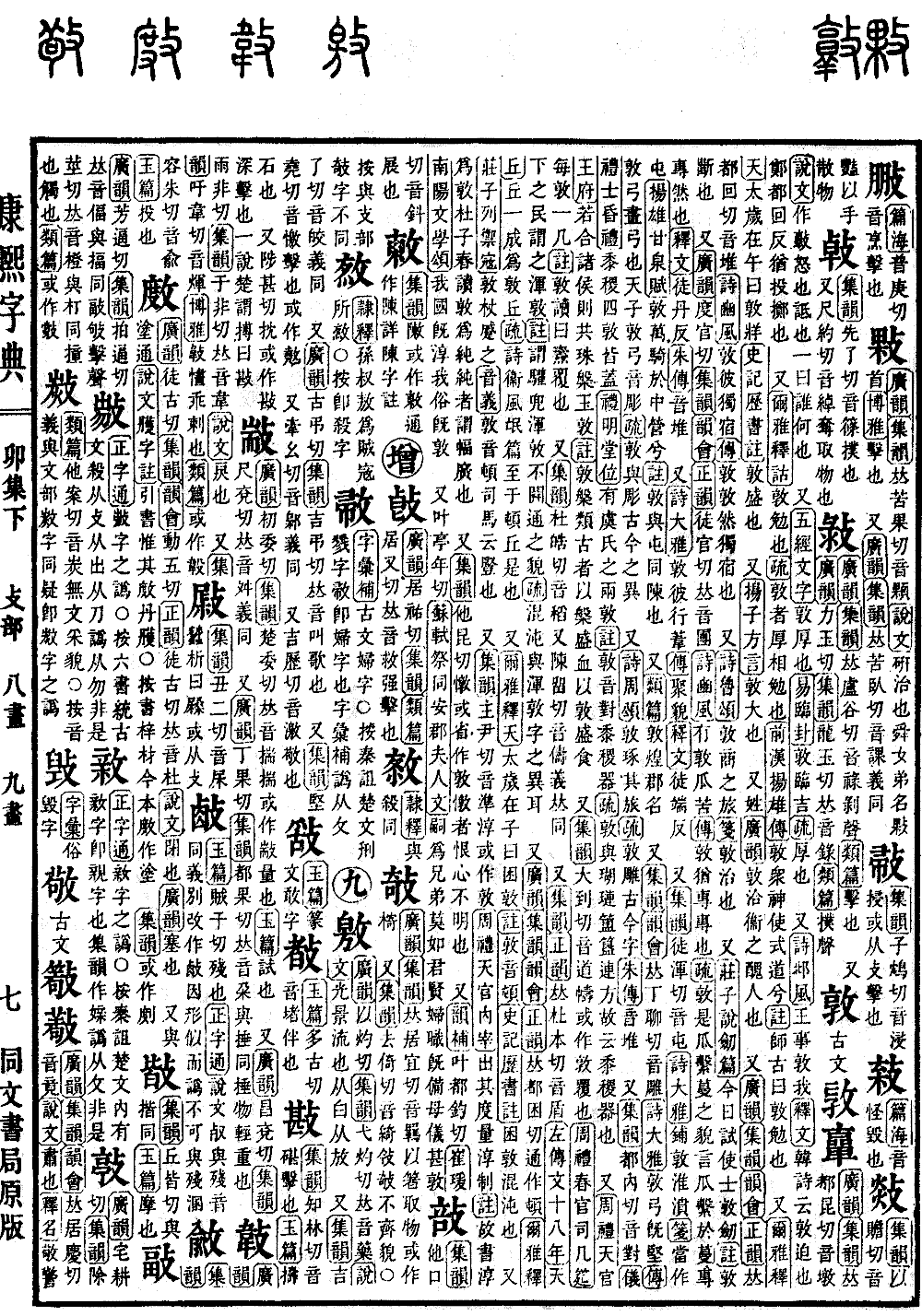
Page 473, Entry 08
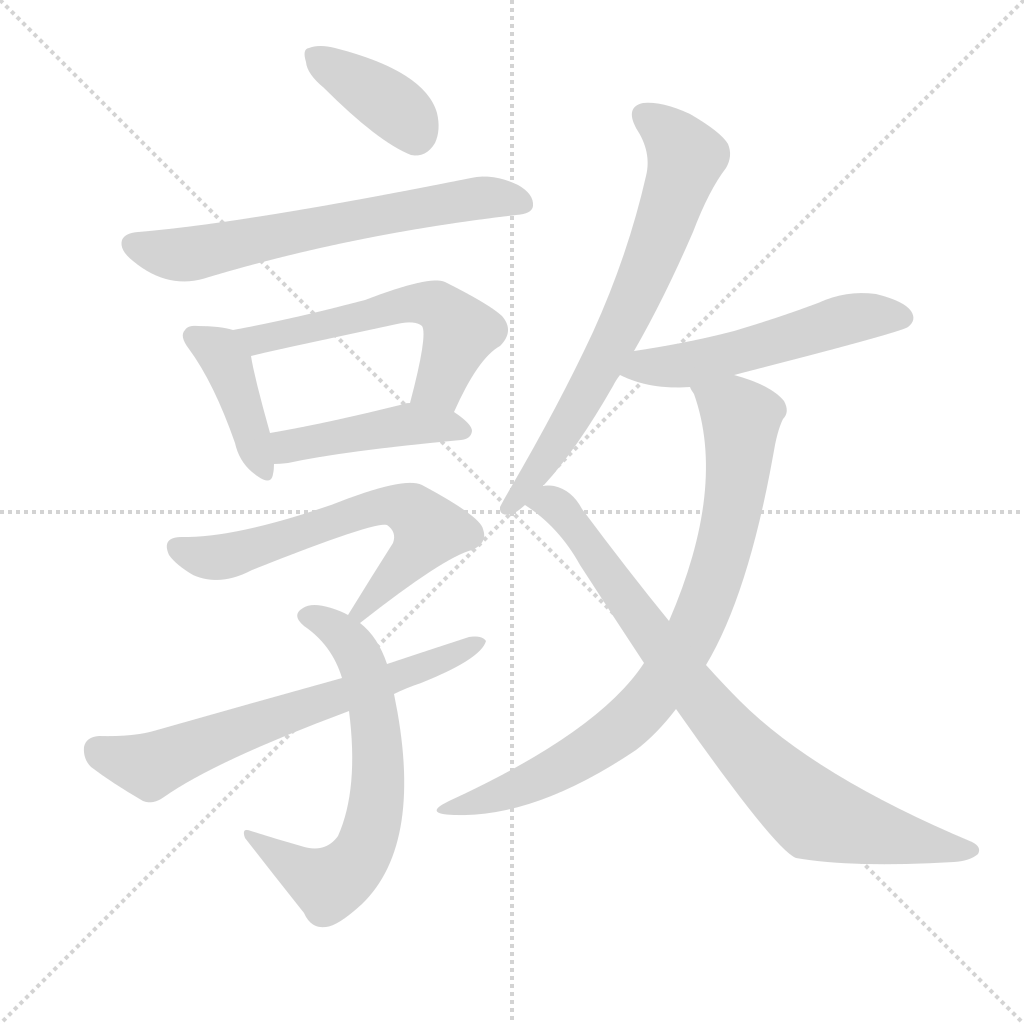
Ancient form. Pronounced dun. As recorded in the Broad Rhymes (Guangyun) and Collection of Rhymes (Jiyun), it means to be angry or to slander. Another definition is to challenge or confront.
Also, as recorded in Five Classics Characters (Wujing Wenzi), it means thick or substantial. In the Book of Changes (Yijing), regarding the Approach hexagram (Lin), it says to approach substantially brings good fortune. The commentary states that this means substantial.
In the Book of Odes (Shijing), in the Odes of Bei, it says royal affairs press upon me. The exegetical commentary notes the Han commentary says it means to press. Zheng Xuan pronounces it as dun, equivalent to to throw or cast.
In the Erya (Er Ya), under the chapter on explanations of words, it means to encourage. The commentary states that it means to encourage one another substantially. In the History of the Former Han (Qianhan), in the Biography of Yang Xiong, it states that it encourages all the spirits to follow the way. The commentary by Yan Shigu states that it means to encourage.
In the Erya, under the chapter on explanations of heaven, when the planet Jupiter is in the position of Wu, it is called dunzhun. The commentary on the History of the Grand Scribe (Shiji) says it means abundant.
In the Fangyan (Local Customs) by Yang Xiong, it means great.
Also a surname. According to the Broad Rhymes, Dun Qia was an ugly person from the state of Wei.
Also, as recorded in the Broad Rhymes, Collection of Rhymes, Dictionary of Rhymes (Yunhui), and Rectified Rhymes (Zhengyun), it is pronounced dui. In the Book of Odes, in the Odes of Bin, it refers to sleeping alone. The commentary explains it as the state of sleeping alone in a solitary manner.
In the Book of Odes, in the Odes of Lu, it refers to the merchants' travels. The commentary states it means to manage or govern.
In the Zhuangzi, in the chapter on the discourse on swords, it says today try to have the knight cut the sword. The commentary notes it means to break or sever.
According to the Broad Rhymes, it is pronounced tuan. In the Book of Odes, in the Odes of Bin, it refers to the bitterness of the melon. The commentary explains it as the appearance of the melon clinging to the vine, describing how it stays attached in a concentrated manner.
In the Book of Odes, in the Greater Odes of the Kingdom (Daya), it describes the reeds along the path. The commentary describes this as a gathered appearance.
According to the Collection of Rhymes, it is pronounced tun. In the Book of Odes, in the Greater Odes of the Kingdom, it mentions spreading out along the banks of the Huai River. The commentary states it should be written as tun. In the Ganquan Rhapsody by Yang Xiong, it refers to stationing ten thousand cavalry in the central camp. The commentary notes it is identical to tun.
According to the Category Dictionary (Leipian), Dunhuang is the name of a prefecture.
According to the Collection of Rhymes and Dictionary of Rhymes, it is pronounced diao. In the Book of Odes, in the Greater Odes of the Kingdom, it mentions the carved bow is sturdy. The commentary explains that the carved bow is a decorated bow.
In the Book of Odes, in the Odes of Zhou, it refers to carving and polishing the troops. The commentary explains this as an ancient and modern variant of the word for carve.
According to the Collection of Rhymes, it is pronounced dui. In the Book of Rites (Liji), specifically the Rites of Officers and Marriage, it refers to the four sacrificial vessels for grain. In the Book of Rites, in the chapter on the Hall of Distinction (Mingtangwei), it mentions the two sacrificial vessels of the Yu dynasty. The commentary notes the pronunciation is dui, referring to vessels for grain. It is mentioned alongside other sacrificial vessels like the hu and lian, thus it is called a vessel for grain.
In the Rites of Zhou (Zhouli), in the section on the Office of Heaven and the Jade Treasury, it states if meeting with feudal lords, then provide the pearl dish and jade vessel. The commentary notes it is a type of dish; in ancient times, dishes were used to hold blood, and these vessels were used to hold food.
According to the Collection of Rhymes, it is pronounced dao. It is sometimes written as the character for cover. In the Rites of Zhou, in the section on the Office of Spring and the Master of Mats, it mentions each vessel on a table. The commentary notes it is read as cover.
According to the Collection of Rhymes, it is pronounced dao or chou. The meaning is the same.
According to the Collection of Rhymes and Rectified Rhymes, it is pronounced dun. In the Zuo Tradition (Zuozhuan), in the 18th year of Duke Wen, it refers to the people of the world being called Hun Dun. The commentary refers to the mythical chaos, describing a state of being closed-off or lacking understanding.
According to the Broad Rhymes, Collection of Rhymes, Dictionary of Rhymes, and Rectified Rhymes, it is pronounced dun. Commonly used as the character for stop or halt. In the Erya, under the chapter on explanations of hills, a hill formed in one level is called a Dun hill.
In the Erya, under the chapter on explanations of heaven, when the planet Jupiter is in the position of Zi, it is called kun dun. The commentary notes the pronunciation is dun. The commentary on the History of the Grand Scribe identifies it as chaos.
In the Zhuangzi, in the Lie Yukou chapter, it refers to the staff being pressed. The commentary notes it is pronounced dun.
According to the Collection of Rhymes, it is pronounced zhun. The word for pure (chun) is sometimes written as this character. In the Rites of Zhou, regarding the Office of Heaven and the Internal Steward, it mentions issuing the measures and standards. The commentary notes that the original text used this character for pure.
According to the Collection of Rhymes, it is pronounced tu. It is a simplified variant of a word meaning a distressed heart lacking clarity.
According to the Dictionary of Rhymes Supplement, it rhymes with the sound of dun. In the eulogy by Cui Yuan, it mentions our country is already pure, our customs are already substantial.
Also rhymes with the sound of nian. In the sacrificial text by Su Shi, it mentions becoming brothers, none are as virtuous as you. The duties of a wife are fulfilled, the model for mothers is very substantial.