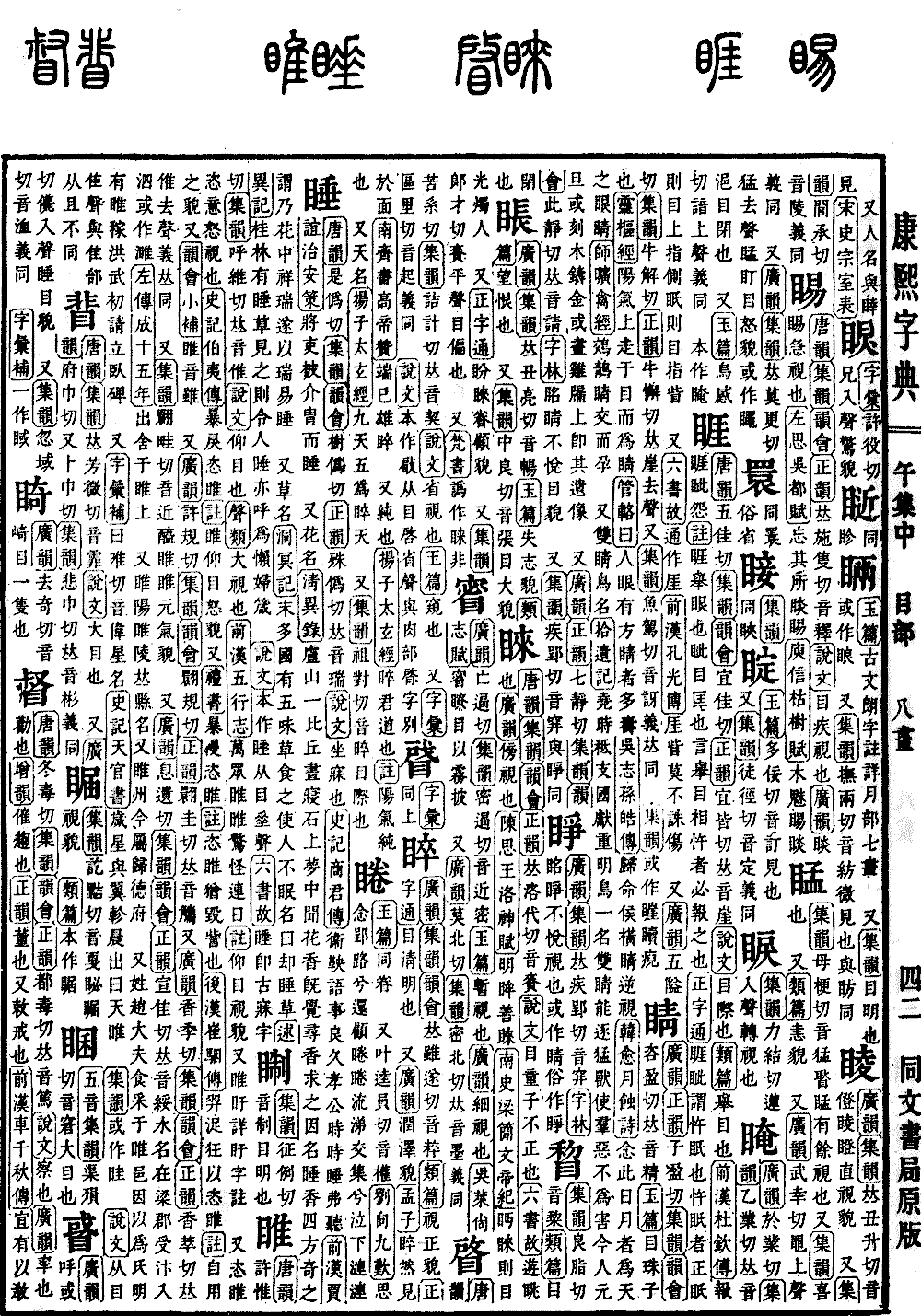
Wu Collection, Middle Volume
Radical: Eye (mù)
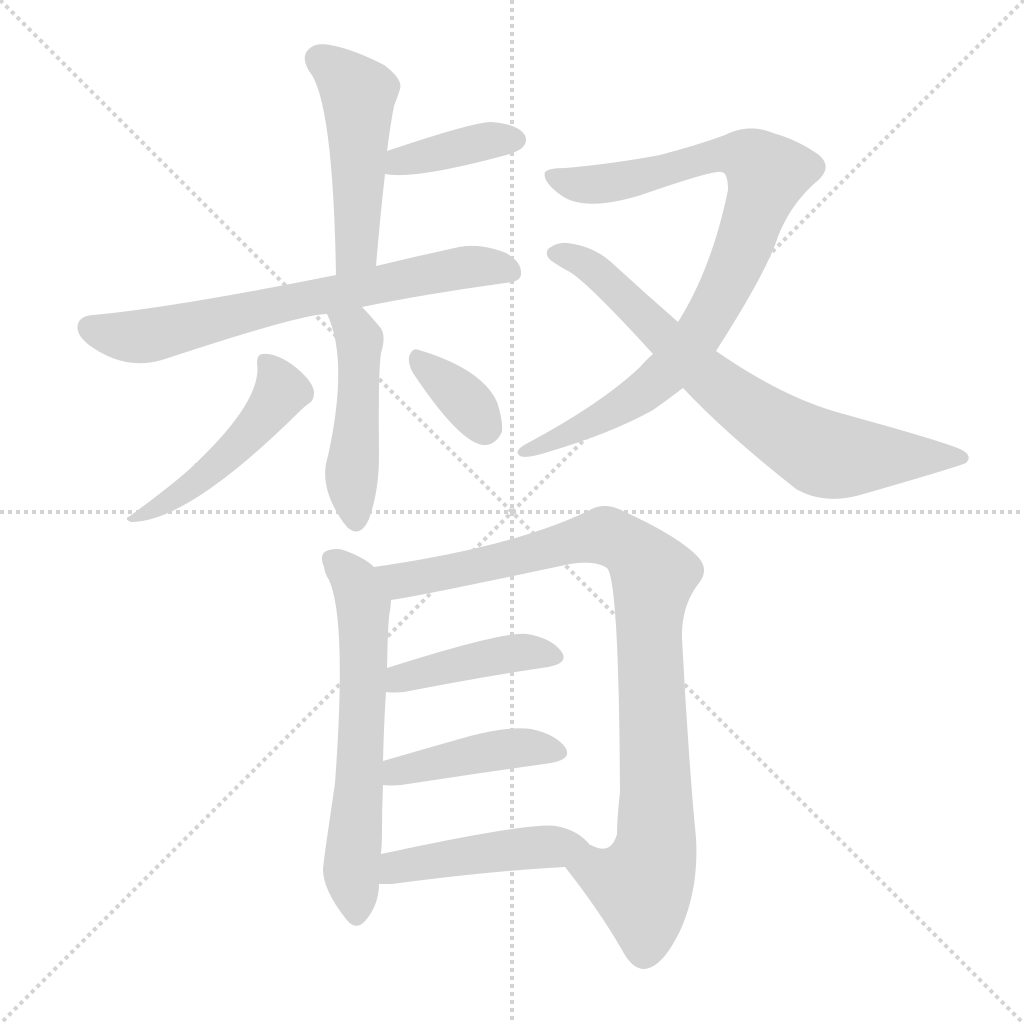
督
Kangxi Stroke Count: 13
Page 810, Entry 31
Pronounced du (low-rising tone).
Shuowen Jiezi (Shuowen): To examine.
Guangyun: To lead, to exhort.
Zengyun: To urge, to hasten.
Zhengyun: To oversee. Also, to enjoin or warn.
Book of Han (Hanshu), Biography of Che Qianqiu: It is appropriate to provide instruction and oversight.
Old Book of Tang (Jiu Tangshu), Biography of Pei Du: Requested to personally oversee the battle.
Also, according to Shuowen Jiezi: Eye pain.
Also, according to Erya, Shigu: To correct.
Zuo Zhuan, 12th year of Duke Xi: To speak of du (oversight) is not to forget.
Commentary (Shu): Referring to the merits and virtues of Guan Zhong being correct and not forgotten.
Also, according to Zengyun: To reproach.
Records of the Grand Historian (Shiji), Annals of Xiang Yu: Heard that the Great King intends to reproach me for my faults.
Note: Du means to reproach.
Also, to examine.
Han Feizi, Yangquan Chapter: To examine and interrogate them thoroughly.
Note: To examine completely.
Also, the middle.
Zhou Rites (Zhouli), Winter Officials, Artisans Record, Commentary: The length of the side of the du.
Commentary (Shu): The center is called du, which is used to supervise both sides.
Zhuangzi, Nourishing the Lord of Life: Follow the middle as the constant.
Note: Du means the middle. It refers to standing exactly between two spaces, commonly known as riding the seam.
Liushu Gu: The governor vessel (dumai) of the human body is the center of the body, running from top to bottom; therefore, the seam of a garment running down the center of the back, reaching from top to bottom, is also called du. It is also written as a variant form (du).
Also, Qijing Kao: Du means gathering (du), as the governor vessel is the central meridian for all yang vessels.
Also, Jia Du: The eldest son.
Records of the Grand Historian (Shiji), House of Yue: The eldest son of Zhu Gong is called Jia Du, meaning the head of the family.
Also, a general is called Du.
Book of the Later Han (Hou Hanshu), Biography of Guo Gong: Military officers are all unified under the command of the Du.
Also, Duyu and Duhu and Dudu are all titles of officials.
Also, a place name.
Zuo Zhuan, 16th year of Duke Cheng: Our army stationed at Duyang.
Note: This is Zhuke County, now part of Jinan Prefecture.
Also, Records of the Grand Historian (Shiji), House of Yan: Jing Ke presented the map of Dukang to the state of Qin.
Note: Dukang is a place in Yan. Xu Guang says: Zhuo has a Dukang Pavilion.
Also, a surname. Its prominent branch originates from Ba Prefecture; there was a Du Rong during the Jin Dynasty.
Also, interchangeably used with du (thick/sincere), du (poison), and zhu (India).
Book of Documents (Shujing), Charge to Weizi: Saying, to be sincere and not forget.
Kong Commentary: Du means thick (sincere). The original text is also written as zhu. The Zuo Zhuan mentions: Du (sincere) and not forgotten. Lin's note says: To be sincere is not to be forgotten.
Book of Han (Hanshu), Biography of Zhang Qian: Shendu is located to the southeast of Daxia.
Li Qi says: Also called Tiandu.
Shi Gu says: Present-day Tianzhu (India) is likely Shendu; the sound shifted to Tiandu; the character du was abbreviated as zhu, which later shifted to the sound of zhu.
Book of the Later Han (Hou Hanshu), Du Du's Lun Du Fu: Destroying Tiandu.
Note: This refers to the country of Tianzhu. This shows that the characters for du, du, zhu, and du were anciently interchangeable.