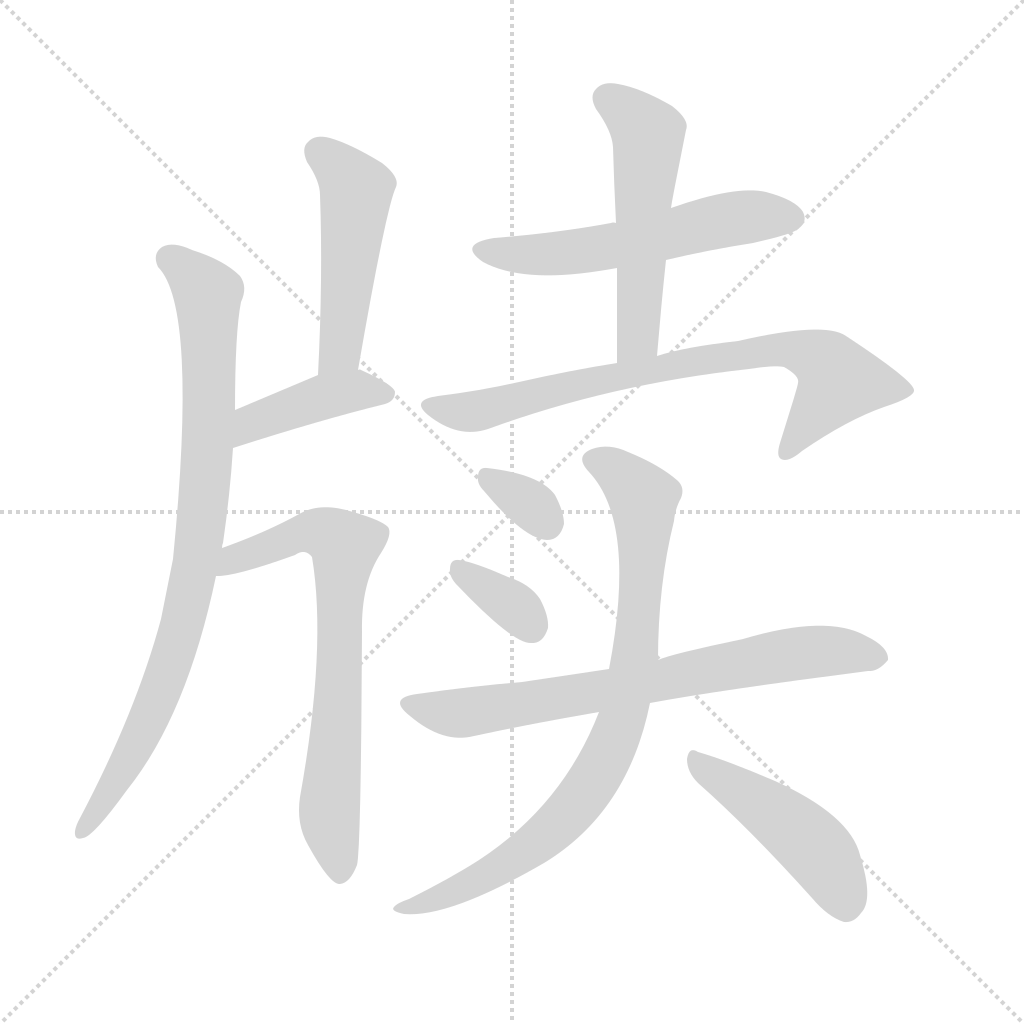
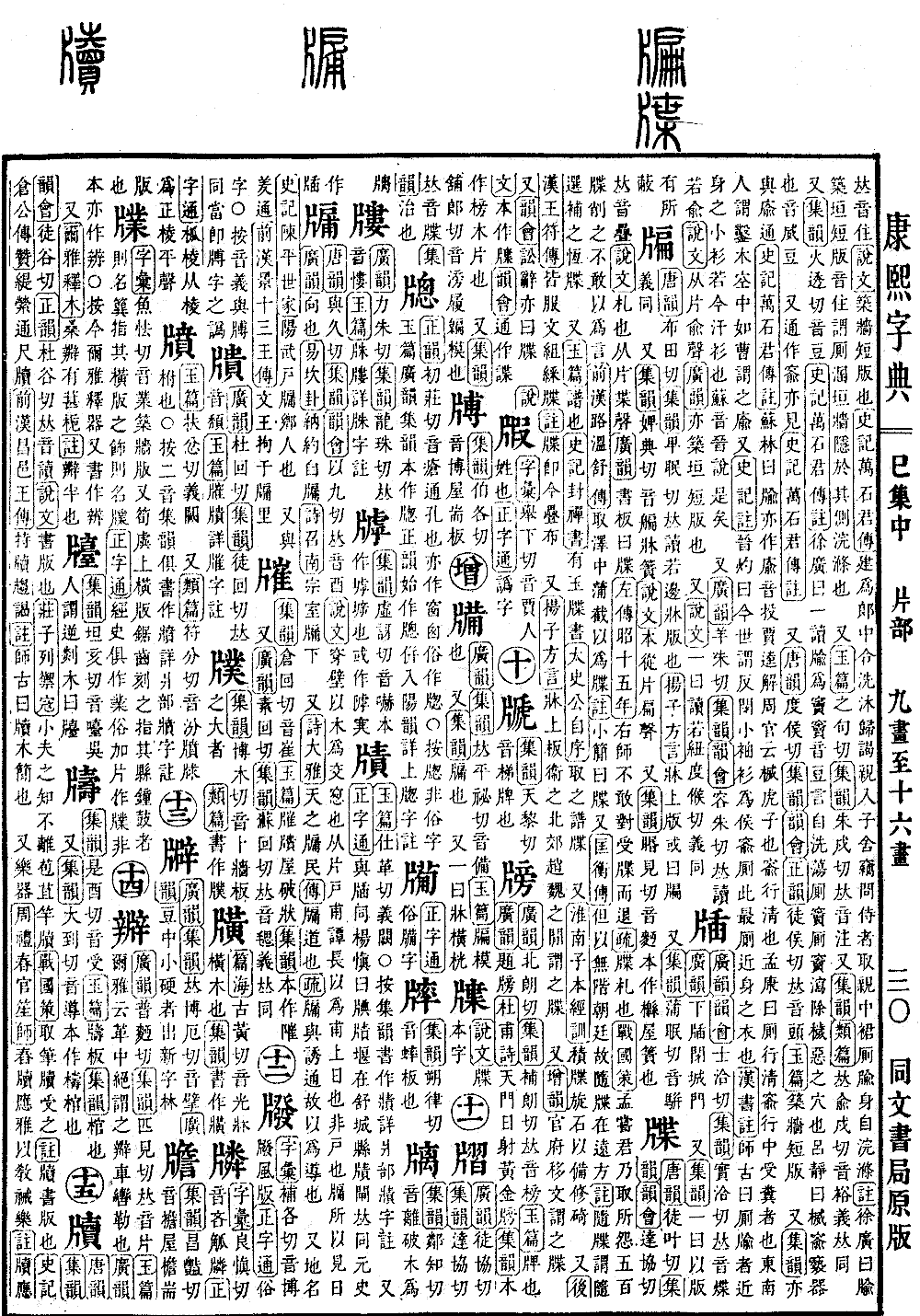
Si Collection, Middle Volume
Radical: Slice (piàn)
Kangxi Strokes: 19
Page 694, Entry 01
Pronounced du
In the Discussion of Characters (Shuowen Jiezi), it refers to a writing board.
In the Zhuangzi (Zhuangzi), Lie Yukou section: Common people's knowledge does not go beyond the scope of bribes and written letters.
In the Strategies of the Warring States (Zhanguo Ce): He took the brush and writing board to receive it.
Commentary: A du is a writing board.
In the Records of the Grand Historian (Shiji), Biography of Cang Gong, Appended Eulogy: Ti Ying sent a wooden tablet.
In the Former Han (Qianhan), Biography of the Prince of Changyi: Holding a wooden tablet, he hurried to the audience.
Commentary: Shigu stated that a du is a wooden slip.
Also, a type of musical instrument.
In the Rites of Zhou (Zhouli), Spring Officials, Master of Sheng: Strike the du, ying, and ya instruments, to teach the gai music.
Commentary: The du, ying, and ya instruments are used to teach the striking. This refers to striking the earth.
Sub-commentary: The striking du is made of bamboo, five or six inches in diameter and seven feet long, with shorter ones being one or two feet. At the ends are two holes; it is painted and used with both hands to strike the earth. The du, ying, and ya are used to teach the striking, which refers to when the guests are intoxicated and leave, performing the gaixia music. Using these three instruments to strike the earth is known as a rhythmic measure.
In the Explanation of Names (Shiming): To strike means to collide. A du is a beating instrument. It is used to strike the earth to provide a rhythm.
In the Collection of Rhymes (Yunhui), Master Mao stated: The Discussion of Characters (Shuowen Jiezi) uses the radical Slice (piàn) and the phonetic mai. It should be written as mai. It should not be derived from the net (wǎng) radical.