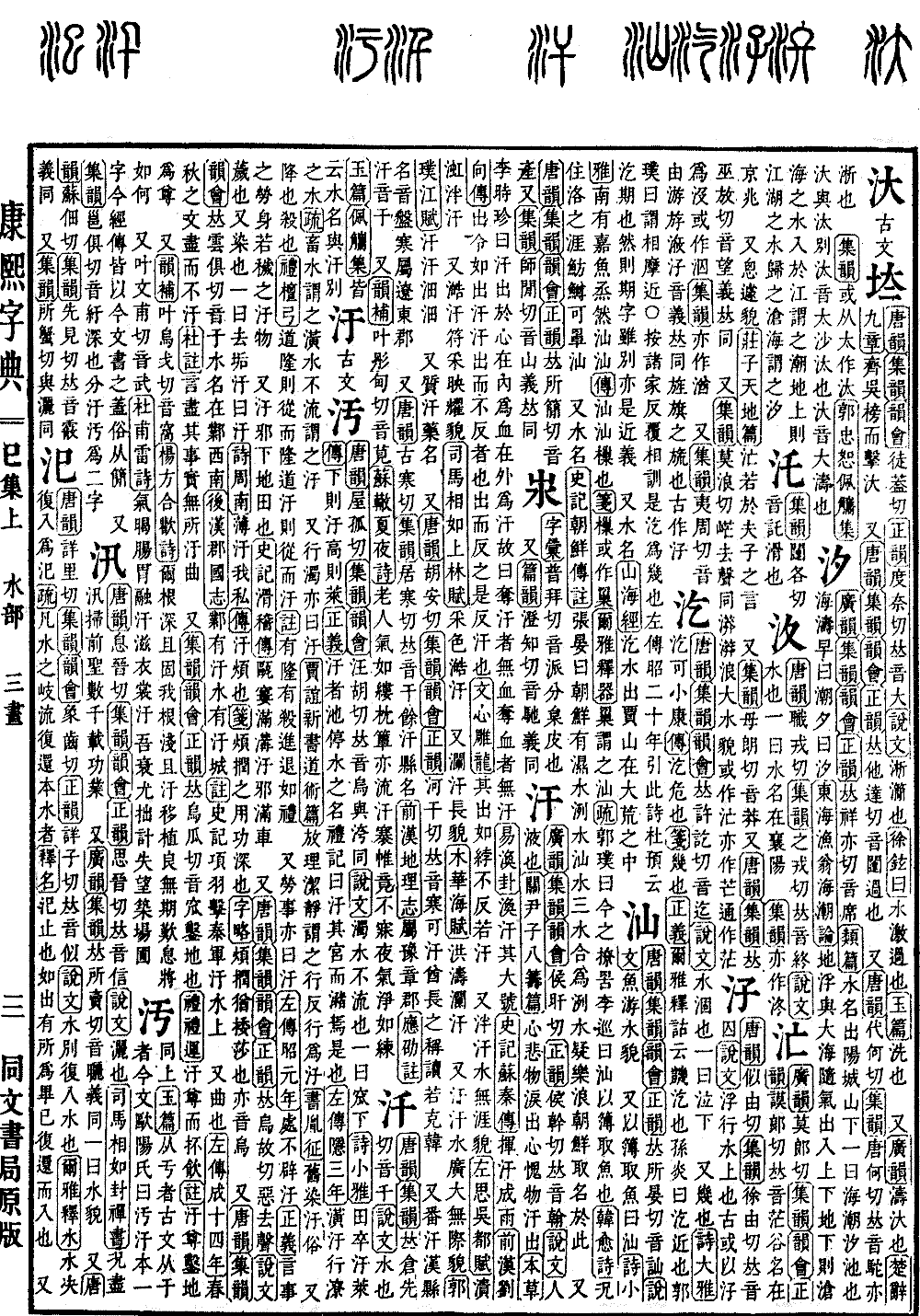
Si Collection, Upper Volume
Radical: Water (shuǐ)
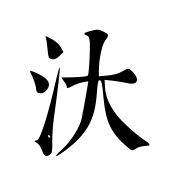
Entry: Da
Kangxi Stroke Count: 7
Page 605, Entry 01
Ancient character forms:
According to Tang Rhymes (Tangyun), Collection Rhymes (Jiyun), and Dictionary of Rhymes (Yunhui), the pronunciation is da (falling tone). According to Correct Rhymes (Zhengyun), the pronunciation is da (falling tone).
According to Explaining Graphs and Analyzing Characters (Shuowen Jiezi), it means to wash rice.
Xu Xuan says it refers to water rushing past something.
According to Jade Articles (Yupian), it means to wash.
Furthermore, according to Broad Rhymes (Guangyun), it refers to the rushing of waves.
In the Songs of Chu (Chuci), section Nine Chapters (Jiuzhang), it is written: "Align the oars of the Wu boat and strike the waves."
Additionally, according to Tang Rhymes, Collection Rhymes, Dictionary of Rhymes, and Correct Rhymes, the pronunciation is ta (entering tone). It means to pass by.
Also, according to Tang Rhymes, the pronunciation is tuo (rising tone); according to Collection Rhymes, the pronunciation is tuo (rising tone). It also means to wash rice.
According to Collection Rhymes, sometimes written with the character for great (tai) as a variant form (tai).
According to Guo Zhongshu in the Collection of Distinctions (Peixi Ji), the characters da and tai are distinct. Tai is pronounced tai (falling tone) and refers to the sifting of sand or selection. Da is pronounced da (falling tone) and refers to the action of waves.