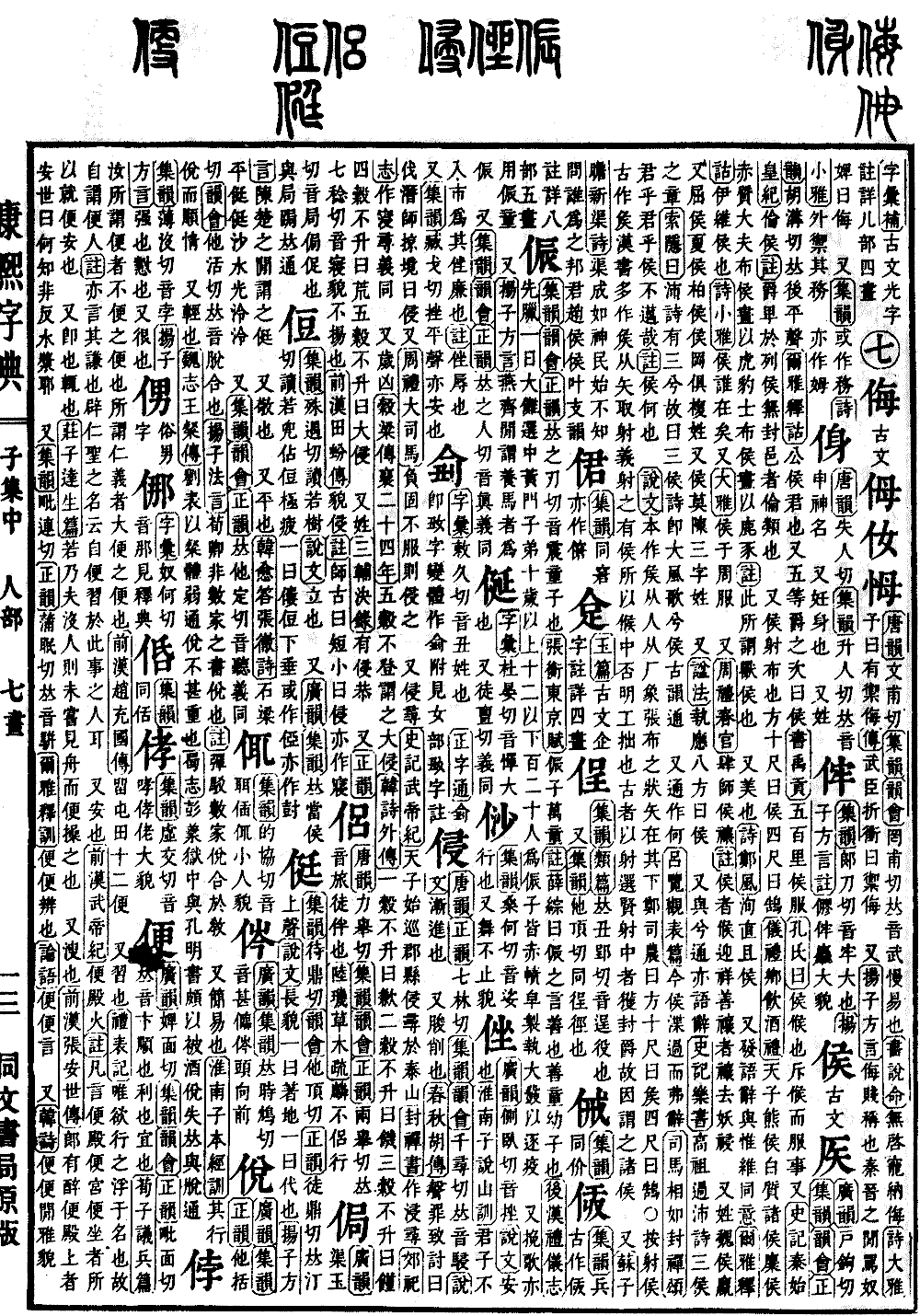
Zi Collection, Middle Volume
Radical: Person (rén)
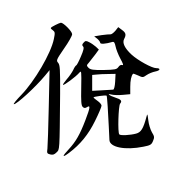
Headword: tuō
Kangxi Stroke Count: 9
Page 103, Position 26
According to the Extensive Rhymes (Guangyun), Collected Rhymes (Jiyun), and Correct Rhymes (Zhengyun), the pronunciation is derived from the combination of the sounds ta and kuo. According to the Rhyme Assembly (Yunhui), the pronunciation is derived from the combination of ta and huo. It is pronounced like tuō.
The character means to accord with or to match. The Exemplary Sayings (Fayan) mentions that Xunzi criticized the works of several schools of thought as being matched and combined. An annotation explains that this refers to critiquing the doctrines of various schools to make them accord with moral education.
It also means simple and easy. The Master of Huainan (Huainanzi) states that one’s behavior should be simple and easy, conforming to human sentiment.
It also means rash or imprudent. In the Records of the Three Kingdoms (Sanguo Zhi), it is recorded that Liu Biao did not hold Wang Can in high regard because Wang Can was physically frail and had a rash disposition. Furthermore, the Records of the Three Kingdoms mentions that Peng Yang wrote a letter to Zhuge Liang while in prison, admitting that he had made many rash errors due to being intoxicated.
This character is interchangeable with the character pronounced tuō.