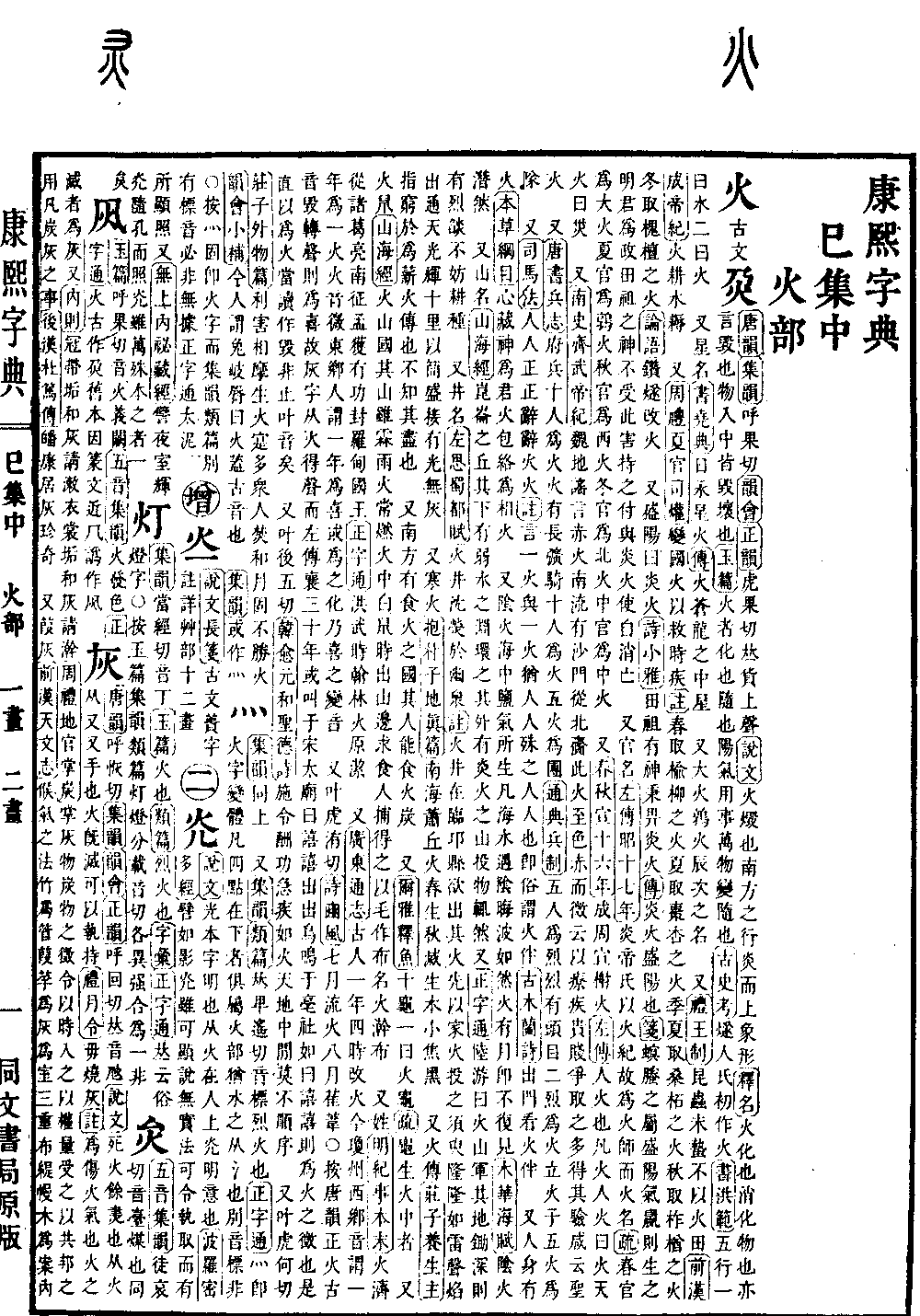
Si Collection, Middle Volume
Radical: Fire (huǒ)
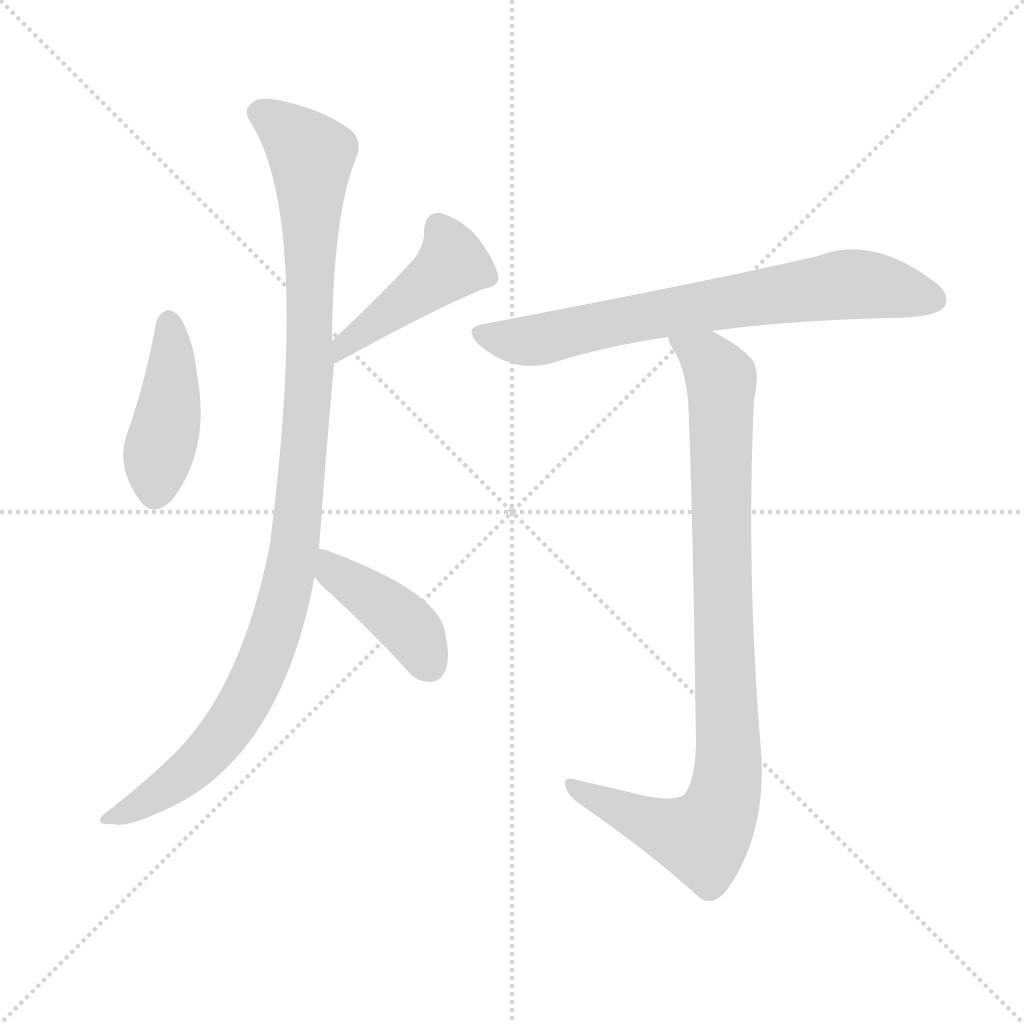
灯
Kangxi strokes: 16
Page 665, Entry 06
Sound of Jiyun (Book of Rhymes), pronounced ding.
In Yupian (Jade Chapters), it means fire.
In Leipian (Classified Chapters), it means raging fire.
Zihui (Collection of Characters) and Zhengzitong (Proper Character Mastery) state it is the common, simplified form of the character for lamp. However, according to Yupian, Jiyun, and Leipian, the two characters are recorded separately with different pronunciations and readings; to combine them forcibly is incorrect.
Lamp
Guangyun (Broad Rhymes), Jiyun (Book of Rhymes), Yunhui (Collection of Rhymes), and Zhengyun (Proper Rhymes) all record the reading as deng.
In Yupian (Jade Chapters), it refers to a lamp fire.
In Chunming Tuichao Lu (Record of Returning from Court in Chunming), it is noted that lanterns are lit for the Lantern Festival from dusk until dawn.
In Xijing Zaji (Miscellaneous Records of the Western Capital), it states that on the night of the Lantern Festival, nine-flowered lamps were lit on the Southern Mountain, with a radiance visible for one hundred miles.
Also, in the Xianyang Palace, there were green jade lamps with five branches, seven feet five inches tall, fashioned in the shape of coiling dragons holding the lamps in their mouths; when lit, the dragons' scales appeared to move, shining like a constellation of stars.
Furthermore, in Buddhist texts, lamps are used as metaphors for the Dharma, such as in the Record of the Transmission of the Lamp (Chuandeng Lu).
In the poetry of Du Fu: The transmission of the lamp knows no daylight.
Also, in Zhengzitong (Proper Character Mastery), it refers to the golden lamp herb, also known as mountain mushroom, which is used in medical prescriptions to prepare pills called jade pivot elixir, detailed in the Compendium of Materia Medica (Bencao Gangmu).
Also, with a different pronunciation, pronounced dang.
In the Rhapsody on the Whale Lamp by Fu of Wei: Depicting its form perched upon a golden lamp, with a soaring spine, raised tail, fins, and scales all spread out.
Jiyun (Book of Rhymes) notes it was originally written as the character for stirrup.
Shuowen (Explaining Characters): The character for stirrup denotes a stand; the annotation by Xu Xuan states that because a candle is placed within the stand, it is called a stirrup lamp. The current common simplified form is written as lamp, which is incorrect.