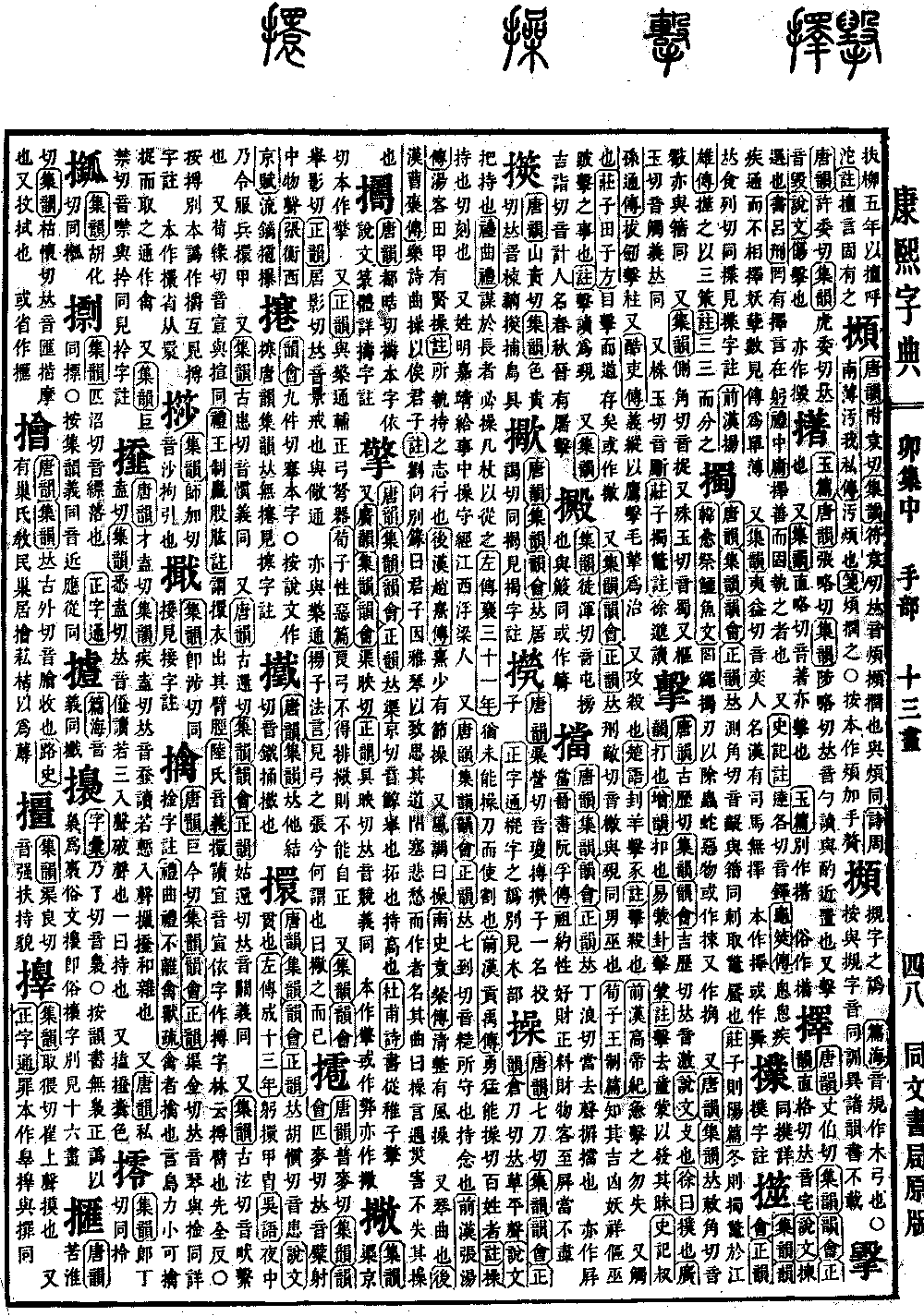
Mao Collection, Middle Volume
Radical: Hand (shǒu)
Kangxi stroke count: 17
Page 458, Entry 15
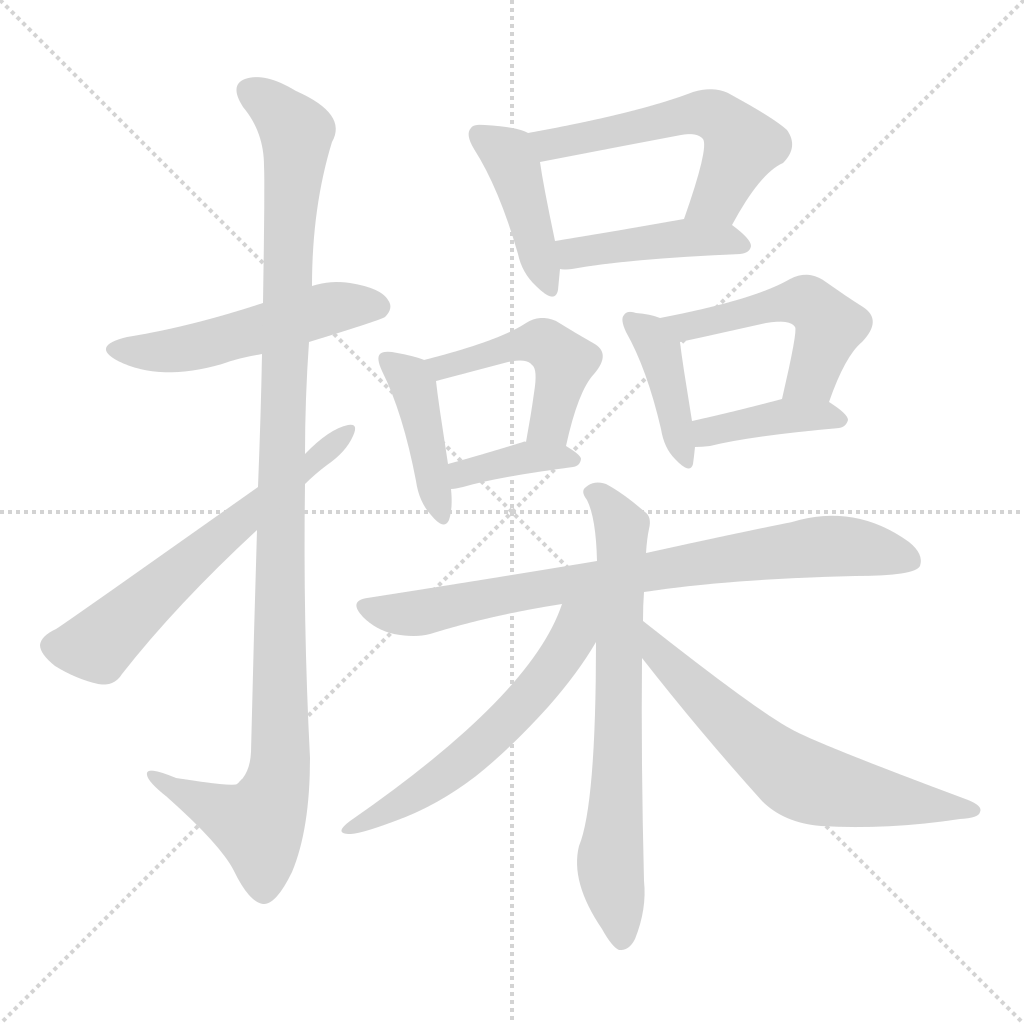
Pronounced cāo.
According to the Shuowen Jiezi (Explanation of Graphs and Analysis of Characters), it means to grasp or hold.
In the Book of Rites (Liji), specifically the Qu Li section: When discussing matters with an elder, one must hold the table and staff while following them.
In the Zuo Zhuan (Zuo’s Commentary), specifically the thirty-first year of Duke Xiang: It is like someone who does not yet know how to hold a knife being told to cut meat.
In the Book of Han (Hanshu), specifically the biography of Gong Yu: Those who are fierce and capable of coercing or acting harshly toward the common people. The commentary notes that cāo means to hold or grasp, and qiē means to be severe or harsh.
It is also a surname. During the Jiajing period of the Ming dynasty, there was a supervising secretary named Cao Shoujing, who was a native of Fuliang, Jiangxi.
Pronounced cào.
Refers to that which one holds fast to, namely one's aspirations or moral integrity.
In the Book of Han (Hanshu), specifically the biography of Zhang Tang: Zhang Tang’s retainer, Tian Jia, possessed virtuous conduct and integrity. The commentary notes this refers to the aspirations and character one maintains.
In the Book of the Later Han (Hou Hanshu), specifically the biography of Zhao Xi: Zhao Xi possessed moral integrity and strength of character from a young age.
It also refers to deportment and character. In the History of the Southern Dynasties (Nanshi), specifically the biography of Yuan Can: Yuan Can was refined, upright, and possessed strong moral character.
It also refers to a type of musical composition for the zither. In the Book of the Later Han (Hou Hanshu), specifically the biography of Cao Bao: He organized music, poetry, songs, and cāo to await the arrival of a gentleman. The commentary cites the Bie Lu (Separate Records) by Liu Xiang, which states: A gentleman uses the elegant zither to express his inner feelings. Works created during times when the world is in chaos, while the heart is filled with sorrow, are named cāo. This implies that even when encountering calamity, one does not lose one's moral integrity.