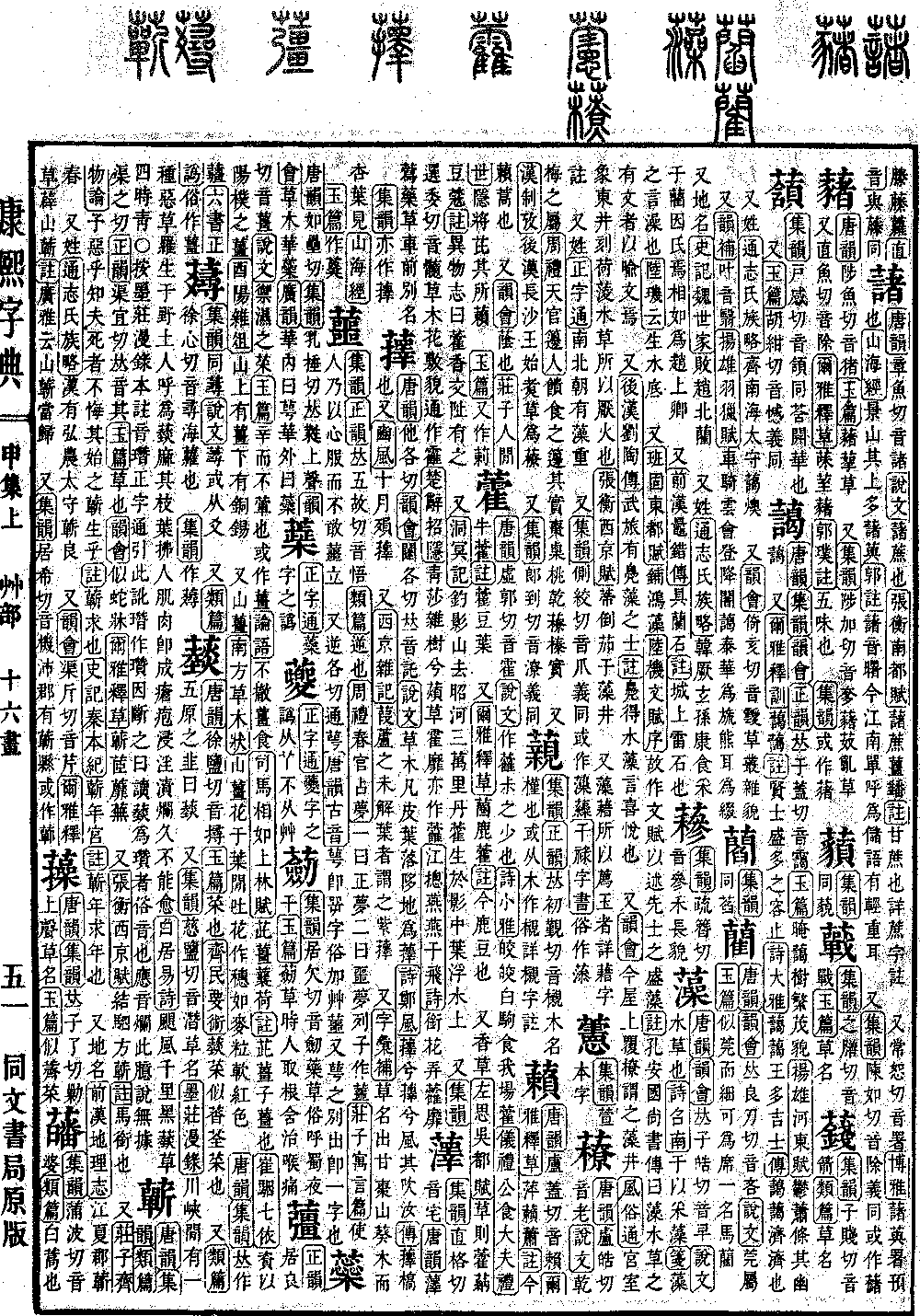
Shen Collection, Upper Volume
Radical: Grass (cǎo)
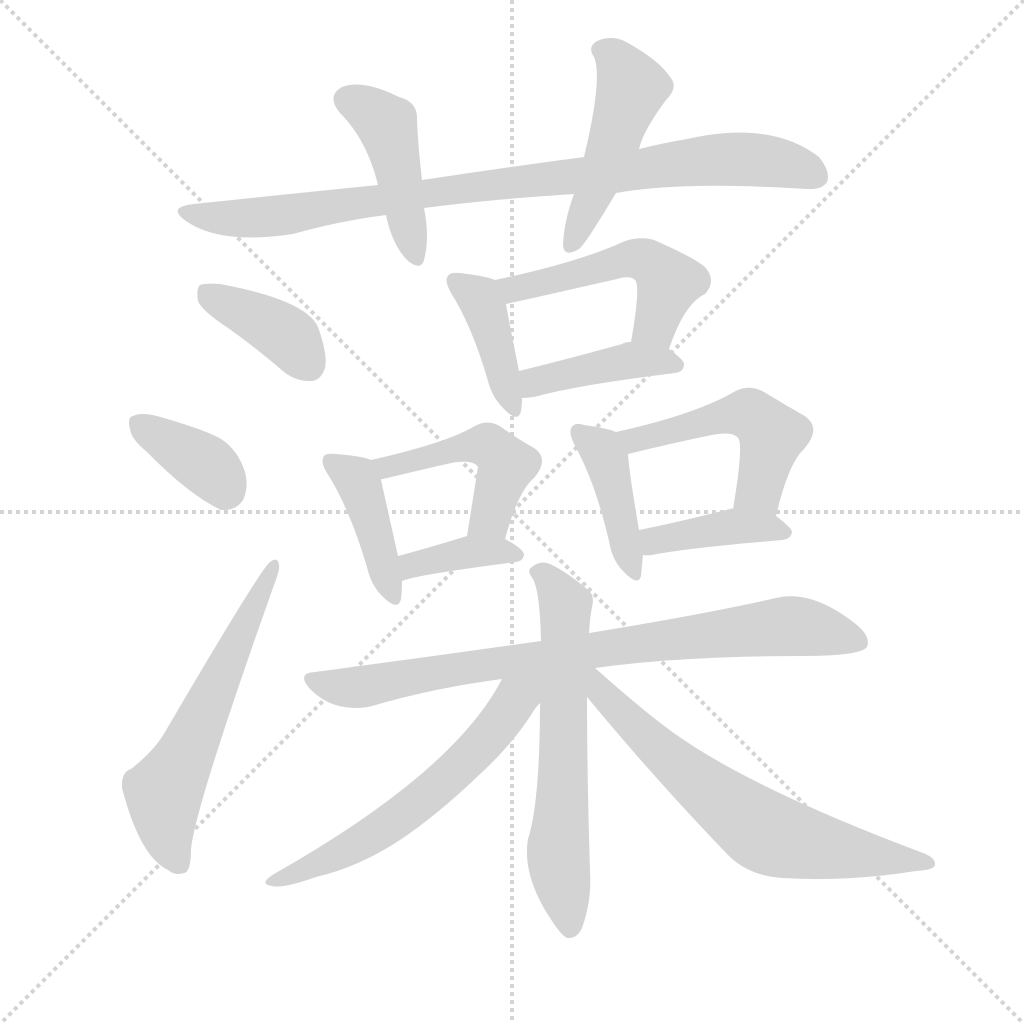
Zao
Kangxi stroke count: 22
Page 1067, Entry 11
According to Tang Rhymes (Tangyun) and Rhyme Collection (Yunhui), the pronunciation is zǎo.
As stated in Explaining Graphs and Analyzing Characters (Shuowen), it refers to aquatic grass.
Book of Odes (Shijing), Odes of Shao: To gather the pondweed.
Commentary (Jian): The word zao implies cleansing.
Lu Ji states: It grows at the bottom of the water.
Also, in Ban Gu, Eastern Capital Rhapsody (Dongdu fu): Spreading forth extensive literary talent.
Lu Ji, Preface to Rhapsody on Literature (Wen fu xu): Therefore I wrote the Rhapsody on Literature to describe the magnificent literary talent of the former scholars.
Note: Kong Anguo, Commentary on the Book of Documents (Shangshu zhuan) states: Zao refers to aquatic grass with patterns, used here as a metaphor for literary composition.
Also, in Book of the Later Han (Hou Hanshu), Biography of Liu Tao: Among the military ranks, there are men of duckweed-like vitality.
Note: Ducks obtain water grass, signifying joy and contentment.
Also, according to Rhyme Collection (Yunhui), the ceiling rafters of a house today are called the zaojing (ornamental caisson ceiling).
Popular Traditions (Fengsutong): Palaces are modeled after the Eastern Well constellation; they are carved with lotus, water chestnut, and water grass patterns as a means to ward off fire.
Zhang Heng, Rhapsody on the Western Capital (Xijing fu): With stems of lotus inverted upon the ornamental ceiling.
Also, zaojie refers to the mat used to support jade pieces. See the detailed note under the entry for jie.
Also a surname.
Correct Writing Explained (Zhengzitong): There was a person named Zao Zhong during the Northern and Southern Dynasties.
Also, according to Collection of Rhymes (Jiyun), pronounced zhuǎ. The meaning is the same; sometimes written as zǎo.
Manual for Promoting Prosperity (Ganlu zishu): The common form is written as shown.