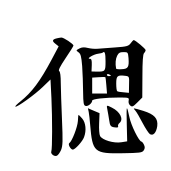
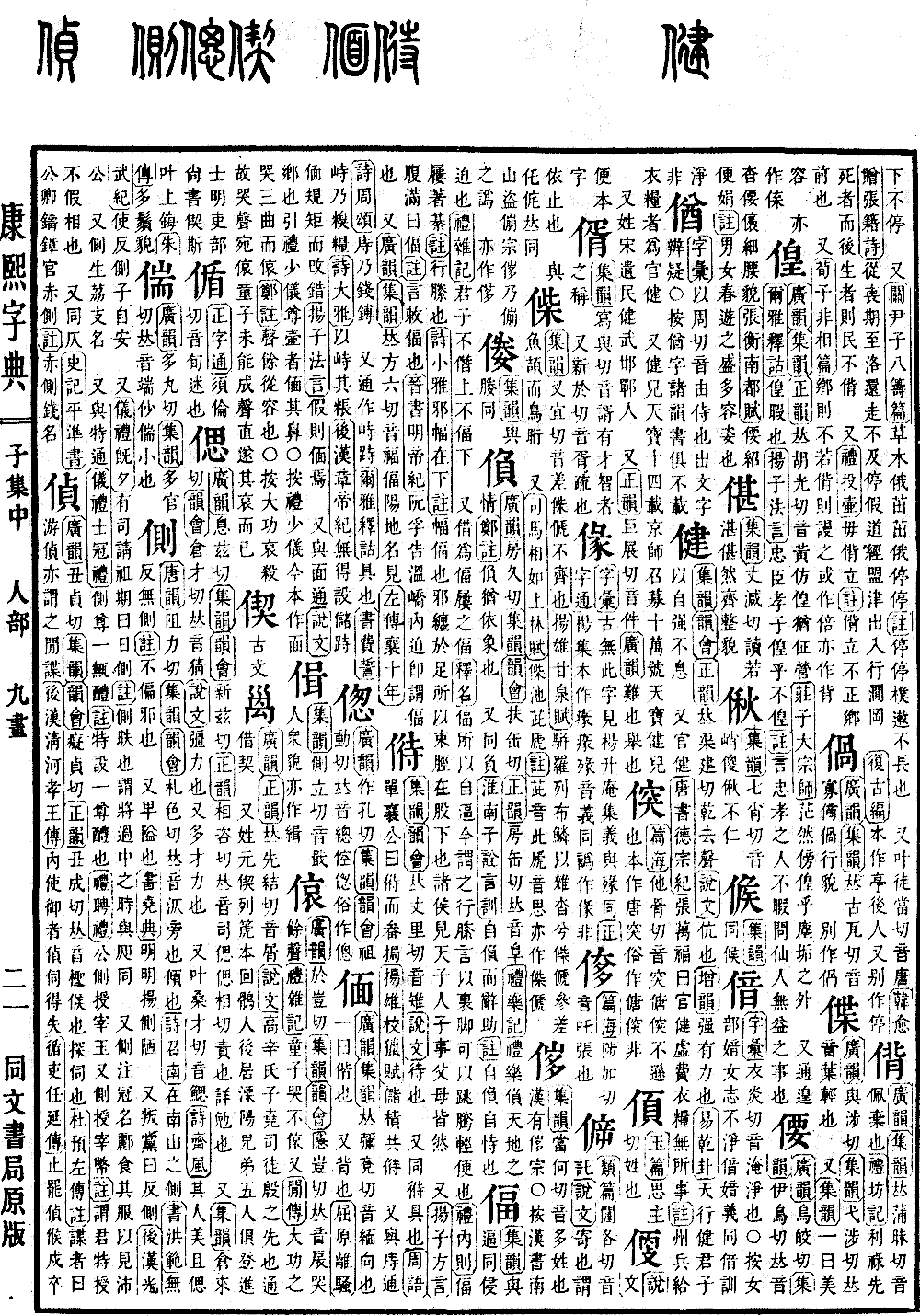
Zi Collection, Middle Volume
Radical: Person (rén)
Kangxi Stroke Count: 11
Page 111, Position 32
According to the Broad Rimes (Guangyun), the pronunciation is derived from the initial of xi and the final of zi. According to the Collected Rimes (Jiyun) and the Rhyme Assemblage (Yunhui), it is derived from the initial of xin and the final of zi. According to the Correct Rimes (Zhengyun), it is derived from the initial of xiang and the final of zi. The pronunciation is si. The term sisi means to mutually urge and admonish one another. The detailed explanation is to provide mutual encouragement.
Additionally, according to the Collected Rimes (Jiyun) and the Rhyme Assemblage (Yunhui), the pronunciation is derived from the initial of cang and the final of lai, or the initial of cang and the final of cai. The pronunciation is cai. Explaining Graphs and Analyzing Characters (Shuowen Jiezi) states that it refers to being strong and vigorous, and also refers to being multi-talented and capable.
Furthermore, it is used as a rhyming pronunciation derived from the initial of sang and the final of cai, pronounced as sai. In the Odes of Qi (Qi Feng) within the Book of Odes (Shijing): That man is beautiful and hirsute. It rhymes with the preceding word mei. The Commentary of Zhu Xi (Zhu Zhuan) states it refers to the appearance of a thick, dense beard.